Saturday, February 1, 2014

Toxic Twitter Feminism and the Long View of History

A bit over 20 years ago, I attended a conference at San Francisco’s Mission High School called Dynamics of Color.  Organized by a multiracial planning group over many months, it was a two-day extravaganza for lesbians to grapple with the myriad ways that racism divides us and gets in the way of our organizing for liberation.

I was there with half a dozen other members of LAGAI, which then stood for Lesbians And Gays Against Intervention – we’ve since gone through a few reworkings of the full name, which is now LAGAI – Queer Insurrection.  Since our mission statement, since the group’s founding in 1983, included, “To confront and challenge racism within the lesbian/gay community,” we were all looking forward to this conference as something historic and important.


As part of the introductions, we were given guidelines for calling out and responding to racial/racist dynamics that arose during the conference.  To concretize the discussion, the organizers put on a role-play that they said was based on something that actually happened during the conference organizing.  The role-play was a meeting.  A white woman announced that the outreach group had finished a huge mailing the night before, sending announcements (snail mail, that’s how we did it in those days, folding and stamping hundreds of letters and separating them by zip code and sending them off to physical mail boxes) to hundreds of organizations.  A mixed-race woman asked if a certain organization was on the list.  The white woman stammered.  She couldn’t remember, and she didn’t have the list with her.  She’d left it in the car, which was parked blocks away and she didn’t want to go get it.  The interchange culminated with the white woman crying and the women of color explaining, one by one, why that was an inappropriate and manipulative response.  Eventually she stumbled over an insincere apology, and that was the end of the role-play.

I felt a gnawing in the pit of my stomach.  Not because I had done something like that.  Not because I could identify with the white woman screwing up, crying in a meeting and being bawled out for it, although I could.  I didn’t believe the scenario, and I felt that it augured badly for the conference.  I discussed it later with my closest friend, who had the same reaction – that role-play seemed like a straw dog.  My friend said, “Every white woman I know would have brought the list.”

“Yes, I said.  She would say, ‘Oh, you want to see the list?  Here it is.  Please, feel free to add to it,’ and she would produce a list of ten single-spaced pages containing every group you ever heard of and lots that you never did, overwhelming you with her competence, and your insignificance.

Finally the agonizing preliminaries were done and BarbaraSmith, founder of Kitchen Table Press was introduced as the keynote speaker.

“Sometimes,” she began (I’m paraphrasing, of course, this is all at a remove of two decades) “I regret the day we ever decided to do anti-racism work in the lesbian community.”

I sensed a collective gasp.  She couldn’t be saying, “You brought me all this way to tell you you’re wasting your time.”  She wasn’t, exactly, but she was cautioning us against spending all our time focusing on the small harms we do to each other and losing sight of the bigger harms caused by the military-prison-industrial-educational complex.

“When I look around,” she said, “the people running the schools, the jails, the FBI, the Pentagon, they’re mostly not lesbians.”

That was truer then than maybe it is now, but the principle remains worth holding onto, as discussions of toxic twitter feminism begin to devour all the air in our intellectual atmosphere.  The opportunism of mainstream white feminists is a problem.  It certainly bears some of the blame for our failure to build a revolutionary, broad-based women’s movement confronting inequality, colonialism and imperialism.  But the lion’s share of responsibility for that failure doesn’t lie with feminism.  Feminism is not responsible for the backlash against it from Reagan and Schlafly and Cruz and Huckabee and and and and.  It’s not responsible for the rightward tornado that has swept the country and the world since circa 1973.  Mainstream feminism has not been as progressive as it should and could have been, but it has been consistently more progressive than the rest of the country.  Ultimately, the radical movements that should have been pushing on the mainstream of feminism and everything else did not fail to mobilize mass support because of feminism.  We failed all on our own, with lots of help from various forms or counterintelligence but also helped by our own unforgiving cultures.

In the early nineties, after volunteering with San FranciscoWomen Against Rape for eight years, I was tired of constantly hearing about what a problem white women were in the organization.  I felt stuck, like people expected me to do something I didn’t know how to do, to be something I wasn’t, and if I asked what it was, I was shirking responsibility for confronting my own racism.  I decided the best thing I could do was remove my toxic presence from the organization.

I wasn’t trying to be petulant.  I really thought I was doing the right thing.  If I couldn’t be part of the solution, at least I could stop being part of the problem.  I put more of my energy into ACT UP (the AIDS Coalition to Unleash Power) and LGBT antiwar organizing.  When ACT UP San Francisco imploded, due to the unwillingness of some of the middle- and upper-middle-class white gay men to consider racism, sexism and classism for even one precious minute, I went back to SFWAR with a new appreciation for an environment where at least, our divisions were seen as something to be confronted.  I learned that I could survive criticism and even grow from it.  I learned not to take every criticism of white feminist culture personally.  Most of all, I learned that the culture of an organization really can change, if there’s enough unity and commitment from the people in it.

I also made friends, both white women and women of color, who helped me to take those steps, and feel supported in my learning process.  That’s a piece that can easily be lost in movements where ideological purity is highly valued.  Of the people I’ve known who used to be political and no longer are, nearly every one has said the reason they stopped was because they felt unvalued and unsupported by their fellow activists.
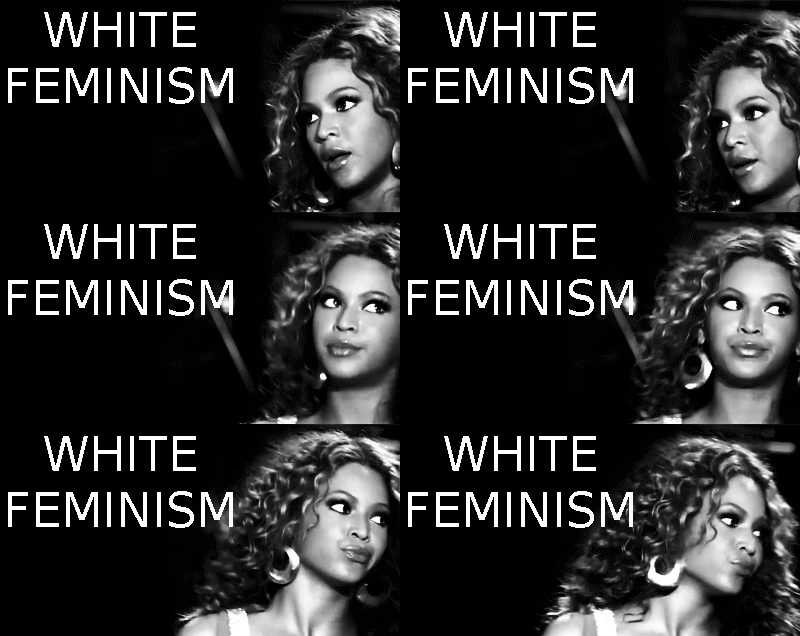
When I hear about Susan B. Anthony’s racism, or Betty Friedan’s classism and anti-lesbianism, Gloria Steinem’s Zionism and Islamophobia, Margaret Sanger’s pro-eugenics beliefs, I’m mortified.  I don’t want to be tainted by those positions and it’s tempting to follow the trend of defining them only by their failures.  Yet I don’t define Malcolm X or Huey P. Newton by their sexism, or MLK by his caving into homophobia and red-baiting.

Recently, I heard an incredible radio documentary by Fran Luck, a producer on Joy of Resistance at WBAI New York.  It traces the founding of the National Organization for Women to the exclusion of women from the podium at the 1963 March on Washington.  In the aftermath, African American women leaders organized, a woman named Pauli Murray wrote an op-ed which Betty Friedan read and reached out and suggested that they have a meeting in Washington, D.C. to form a national organization for women’s equality.  This history doesn’t wipe out the ways in which Friedan later narrowed the scope of women’s issues to those that most affected white middle-class women.  But it’s interesting to me that we all know the later history, and almost no one knows the founding story.

My friend Carwil Bjork-James writes helpfully:

Anger can motivate awesome work and can motivate toxic and destructive work. It can be clarifying and illuminating, or convince us that our closest friends are just out to get us. But in expressing our anger about pop culture (that is, about people who made art that reinforces our (or others’) oppression, rather than directly oppressing us), I would suggest these propositions:

--Strategically deployed anger ultimately seeks to enlarge the community seeking social transformation, not to split it. 

--Publicly expressed anger depends on establishing that it is justified to make it strategic.

--Even justified anger needs calm, patient work of educating current and potential allies.

I’ve been one of the people who liberally dispensed anger when people didn’t live up to my highest standards of anti-oppression politics, who tolerated no middle ground the cutting edge issues of any given day.  At the time, I believed that was necessary and important for pushing movements forward, and I’m not going to say that it wasn’t.  It’s only in hindsight that I think, maybe I helped drive people away from the movement.  Maybe they were people who didn’t belong there.  But maybe some of them were people who could have been helped to see how their behavior, or their use of privilege or their short-sighted vision was detrimental to our mutual goals.  My own politics have certainly evolved over the years, yet at times I casually judged some people as not worth educating.

I will never regret trying to make the movements I worked in as radical, as inclusive, as responsive to real people’s needs as they could be.  But I do regret some of the strategies I’ve used.  As I get older, I realize I want my contribution to be the people I brought into activism, not the people I turned away or turned off.

Hard as it is for women in their twenties and thirties to believe, multicultural feminism is still in its infancy.  Less time has passed since the founding of Ms. Magazine (42 years) than it took the first wave of US feminists to win the right to vote (71 years).  But as I follow the angst of online feminists trying to walk that line between grinding each other down and letting each other off the hook, I remember Barbara Smith's words all those years ago and I can't help thinking, "We haven't come very far."

Wednesday, January 1, 2014

Five Things I Love And Hate About New Years


I love New Years.  I love all of them – Jewish, pagan (which would be Halloween), Julian, Chinese, gay (now known as Pride Sunday – the newspaper I work on, UltraViolet, changes volumes in June) … haven’t been to a Nawrouz (Persian New Year) or Diwali (Indian New Year) celebration as yet but hope to soon.  I love it because let’s face it, New Year = Hope, and I’m an optimist.

Rebecca Solnit, in her otherwise amazing piece in The Nation, claims, “Optimism says that everything will be fine…,” but she’s wrong.  Optimism says, “Everything can be fine.”  As I was discussing with friends last night, all activists are optimists (even the ones that are ceaselessly negative in meetings).  That’s what enables us to keep going, despite the appearance of getting nowhere.  Optimism says, “We can do it.”  New Years is the Time of the Optimist. 

Here are a few of the things I love:


Here’s what I don’t love:

  • False cheer
  • The emphasis on dating and being kissed at midnight
  • Resolutions – especially since so many of them will have to do with dieting, like being thin or depriving yourself is what makes you a good person
  • Fixations on elections and what the year will bring for politicians
  • Hearing all the worst music of the year at once

Here are a few of my best ofs:   

Books:

  • WE ARE ALL COMPLETELY BESIDE OURSELVES by Karen Joy Fowler  - can’t say enough good things about this one (thanks, Julie).  Run don’t walk to your nearest indy bookstore.
  • QUIET: THE POWER OF INTROVERTS IN A WORLD THAT CAN’T STOP TALKING by Susan Cain - okay, it’s mainstream and promotes a false dichotomy between “extrovert” and “introvert”.  I learned a lot about myself and others.
  • SHAKE OFF by Mischa Hiller (thanks Radhika) – thriller by a Palestinian author with a Palestinian protagonist.  Great characters, fast-moving plot.  Just bought SABRA ZOO (his next), but making myself read some serious fiction first
  • THE SECRETS OF MARY BOWSER by Lois Leveen - not perfect, but engrossing story of a freed slave who returns to Richmond (my hometown) to spy for the North.  Great woman protagonist; good antidote to “12 Years a Slave” (the movie, not the book) with its lack of depiction of agency by the slaves.

Articles & blogs


Happy to see feminists challenging some harmful dynamics within our movements, without lapsing into solipsism:

After seeing Henry A. Giroux on Bill Moyers, I became a devotee of Giroux and his Public Intellectual Project.  This article rocked my world: The Spectacle of Illiteracy and the Crisis of Democracy 

Actions


Wishing everyone a joyous, contemplative, creative and revolutionary New Year

Monday, December 9, 2013

It Isn't Nice to Block the Buses

Last Friday, the litigation group at the law firm I work for held its annual bash at a restaurant in the Marina.  It’s a very fun event where the associates present skits and videos making fun of the partners, made funnier by a fair amount of alcohol consumption.  Since the restaurant was several miles from the office, they chartered a bus for staff – attorneys had to get there on their own.

This was my first time on one of the huge white buses everyone calls “Google buses,” although in fact, lots of companies use them to transport their employees to and from work.  The wi-fi equipped buses (no one said anything to us about wi-fi, incidentally) have become one of the most visible symbols of the rapid gentrification that is destroying the cultural and economic diversity of San Francisco.  I told one of my coworkers that getting on it reminded me eerily of riding settler buses in Palestine, which I tried not to do, but occasionally it was the only affordable way to get from Tel Aviv or Petakh Tikvah to the village where I lived in the West Bank.

This morning, a bunch of people I know were involved in blocking a Google bus at 24th and Valencia, in the heart of the Mission District.  The Mission has been one of the areas hardest hit by recent gentrification.  Once predominantly Latino/a, the Mission has experienced waves of gentrification beginning with artists and queers in the seventies, drawn by the cheap rents and eclectic culture, and vastly accelerated during the first tech boom in the nineties.  According to the Cesar Chavez Institute at San Francisco State, “On Valencia Street, 50 percent of the businesses that existed in 1990, mostly local operations that catered to the low-income Latino community were gone by 1998. Rental evictions tripled, and owner move-in evictions quadrupled in just two years.”  Today, the Mission teems with white hipsters.  Every time I go to Valencia Street, I see a couple new upscale restaurants, many replacing bookstores and bodegas that have been there for decades.  Every long-term business I know of on that strip has been threatened by skyrocketing rents.

The blockade of the Google bus highlighted a few issues.  One, the displacement being fueled by the influx of techies with lots of money to throw around, driving up rents and housing prices by offering cash up front over the asking price, motivating developers to use whatever dirty tricks they can to get rid of long-term tenants or owners.  And two, and more directly, the fact that the companies which attract skilled workers partly based on their proximity to chic and lively San Francisco choose to invest in private transportation for their employees, rather than contributing to better public services for everyone.  At the same time, their buses hog city bus stops and tear up the roads.  Trust me, during the two strikes by Bay Area Rapid Transit, I considered jumping on one of the buses I saw picking up workers downtown – only problem was, I didn’t know where they were going.

The highly organized protesters surrounded the bus carrying signs proclaiming, “Warning:  Illegal Use of Public Infrastructure,” “Two Tier System” and “San Francisco, not for sale”.  It attracted a ton of coverage not only from local media but also from national and even international outfits including a pretty good piece from Reuters, and coverage in Slate, Salon, Huffington Post and even China Daily.  Yahoo and Bing had it up top, but I didn’t see it on Google.

Someone got off the bus and yelled at the protesters that “This is a city for the right people who can afford it. You can’t afford it? You can leave. I’m sorry, get a better job.” The video of that confrontation went viral and probably helped to generate some of the media frenzy, before someone at the Bay Guardian realized that the “Google employee” in the video was actually well-known labor organizer Max Alper.   


This led to another frenzy of coverage, some negative, calling the theater piece a “hoax” and some surprisingly positive, like the Wall Street Journal’s observation that, “However false, Alper’s stagecraft touched a nerve in San Francisco, where some longtime residents say wealth from technology companies is pushing up housing costs and altering neighborhoods.”

On Facebook, the discussions were heated, thoughtful and mixed.  Many people felt that the controversy over the staged video distracted from the issue of gentrification, while others felt it enhanced it.  Some people said the performance was too understated and should have been readily identifiable as theater.  Several activists I respect a lot thought it unnecessarily alienated the Google workers, who are not the source of the problem and might have been sympathetic, by painting them all as hostile and clueless.  Others said they immediately knew it was fake because no Google employee would be that polite.

In later media coverage, Max said that he had just been there to support the action and decided to stage the confrontation on his own.  One of the organizers, Deepa Varma, a lawyer with the group Eviction Free San Francisco, condemned it in the press, saying, “‘We didn’t know that was going to happen and it’s too bad because the point was really to connect the housing crisis to the tech industry.”  

If it’s true that the organizers didn’t know about something that became a focal point for the media, that’s unfortunate, and it’s a learning experience.  My guess is that at least some of the organizers did know – there were a number of groups involved in the action, and it may be that the communication between the groups left something to be desired.  I’ve definitely been part of actions where some of us did things that others weren’t that comfortable with, and it’s generally been a matter of unclear agreements.

As an outsider, I feel like the invisible theater unquestionably strengthened the action.  It exponentially increased the attention to the action, both in social media and mainstream press.  I have been on the receiving end of that kind of upstagemanship and I can empathize with frustration that people may be feeling who did the grunt work to make the action happen – made the signs, fliers, wrote press releases, all that good stuff.  But without them, Max’s theater never would have happened.  In terms of more substantive critiques, no one said that all Google employees feel the way his fictitious one did.  But I can absolutely attest that every single thing he said has been said to me, in all seriousness, and not only by tech workers or people new to San Francisco.  Calling the workers names or yelling at them that they were single-handedly responsible for gentrification would not be useful, but as far as I know, no one did that.

Did any of the Google workers respond to Max’s outburst?  Argue with him, tell him to shut up, get back on the bus and wait?  Did any of them tweet, “Good for the protesters bringing attention to need for public transportation?”  Not that I heard about.  The media mainly quoted someone named Adelle, whose handle is @FashionistaLab, tweeting, “it’s not nice to hijack ppl on their way to work!”  Which makes me want to sing Malvina Reynolds (“It isn’t nice to block the doorway …”)

If any of the workers were sympathetic to the protest, great.  This video is not going to stop them.  Maybe next time they hear someone say those things in earnest, they will call it out.  Maybe they’ll get involved with the Housing Rights Committee or pressure Google to spend money on public transportation for San Francisco instead of free wi-fi in the parks, which is only going to benefit the people with laptops or tablets to use it.

To all the activists, whatever their roles, I say, “Bravo!” (and count me in next time).

Sunday, September 8, 2013

Syria: The Next Nicaragua? (Activist Triumphs the World Forgot)


Going to war is habit for Americans.  Essentially, we’ve done it every twenty to forty years since we became a country, but really, if you count the wars waged against all the different Native American communities throughout the lands and especially if you count the quashing of slave revolts, the first 100 years of the United States was a time of more or less constant war.  And since the Civil War, rather than getting less warlike, we’ve actually gotten bloodier and bloodier.  For all the talk of peace dividends and the end of the Cold War in the nineties, Clinton bombed or invaded 12 countries during his eight years.

It's not very surprising that the US public doesn’t have much faith in the prospects of antiwar movements.  Our record of stopping wars before they started is pretty dismal, and only two have been noticeably shortened by the presence of a grassroots antiwar movement – the Mexican War and Vietnam.

That makes what has happened in the last two weeks pretty remarkable.

Last Saturday, the San Francisco Chronicle’s lead afternoon story was “Possible US-led attack on Syria sparks rallies.”  The article, from the Associated Press wire, covered demonstrations of 100 people in Houston, 200 in Boston and Los Angeles, two dozen in Arkansas and 40 in Chicago.  The 15 or so in Oakland didn’t make the cut.

Today’s paper contains this news: 
“More than 30 protesters gathered Saturday outside the federal building in Lincoln to oppose possible U.S. military action in Syria.  The Lincoln Journal Star reports that among the crowd was 32-year-old Haidar Kazem, holding a Syrian flag and a sign aimed at throngs of Nebraska football fans that read "Go Big Red, No 'Little' War.”
Excuse me, 30?  Need I detail the demonstrations of hundreds or thousands I’ve attended that have been completely ignored by the press?  Remember when the New York Times justified not covering Occupy Wall Street by saying there were only a few hundred people involved?  The baffling fact that the demonstration in San Francisco today, which drew at least 1500 people, didn’t get a mention does not lessen the marvel that the mainstream media seems to be beating the bushes for antiwar activity to report on. 

Even more extraordinary is that Obama and his team, who appeared all set a week ago to go it alone, despite being rebuffed by the British Parliament, suddenly backed off.  CBS News mentioned the US public’s 20% support of an attack as one factor in that decision.  Another was that 140 Congresspeople, led by the East Bay’s own Barbara Lee, signed a letter demanding a say.  It’s easy for us here, and I’m certainly one of them, to assume that we just vote for Lee to make ourselves feel good, that she and other progressives in Congress don’t have any real power.  Indeed, it usually seems that way, but lo and behold, one of the most out-there members of Congress set something in motion that – at least momentarily -- stopped the war machine in its tracks.

Obama has backed himself into a corner, because on one hand he drew a red line, so his ego and all that are at stake, but on the other he made this big speech about democracy and letting Congress decide, so if he can’t get Congress on board, then he will look bad if he does it.  Which makes a call to your Congressperson a little less futile than usual.

Obama and the media have told us we’re “war-weary,” and that’s kind of nervy.  Afghans are war-weary.  Iraqis, Pakistanis, Yemenis, the guys still stuck in Guantanamo.  Except for the troops themselves – who are actually speaking out against a new war themselves -- and the very small percentage of people who have a family member in the military, we have no right to be “war-weary.”  Weary of what exactly?  We don’t even hear about the wars most days.

Nonetheless, it seems like even the media folks who couldn’t wait to attack Iraq, while they are not challenging patently false assertions like the 1400 dead in the chemical weapons attack that the US officials are hammering like a drumbeat (the Syrian Human Rights Observatory puts it at 502), are saying, “Enough already.”  It seems like our taste for blood may be waning slightly.  And that’s a good thing.

A study released last week purports to find that “the absence of a strong and visible anti-war movement, the way there was during the George W. Bush Presidency” is due to the desertion of Democrats following the election of Obama.  Now the authors’ data documenting a decline in participation by identified Democrats seems solid, but I dispute that there was a “strong and visible” peace movement during the period of the Bush presidency they’re looking at, which starts in 2007.  My recollection is that our ability to pull out more than a few hundred people plummeted in the six months after March 19, 2003, and that by 2006 the antiwar movement was more or less dormant.  I credit the decline much more to the perception that demonstrating just doesn’t do any good – that when millions out in the street couldn’t stop the Iraq war, the balloon essentially popped.

Now is a good time to blow it up again.  It actually turns out that the record of movements for stopping wars in recent times is not quite as poor as we think.  Historian Lew Rockwell reminds us that 
“Popular pressure against U.S. military intervention in Nicaragua [in the 1980s] not only blocked the dispatch of U.S. combat troops, but led to congressional action (i.e., the Boland amendment) cutting off U.S. government funding for the U.S. surrogates, the contras.”
Rockwell further points out that during the consumerist eighties, the dead period following the activist sixties and seventies, “the Nuclear Freeze campaign … organized the largest political demonstration up to that time in U.S. history, and drew the support of more than 70 percent of the public. In Europe, much the same thing occurred, and in the fall of 1983 some five million people turned out for demonstrations against the planned deployment of intermediate range nuclear missiles. Reagan was stunned.”  Rockwell posits that this led Reagan to pull back from Cold War rhetoric and seek an arms control agreement.   

I was part of those movements in the eighties and I never before thought about how successful we were.  When people talk about successful social movements, they don’t talk about Central America.  That’s partly because for many of us, our goal was an end to US imperialism, if not social revolution at home, and we didn’t get that.  It’s also because the media never credited us; they continued to make fun of us as a throwback to the sixties.

But we did do it, and we can do it again.  Today.

Thursday, August 15, 2013

The Only Thing We Have to Fear

Remember when we had nothing to fear but “fear itself”?

Okay, that was an effort to stop a run on banks, maybe not intended to express a broad social outlook.  Nonetheless, it conveys an important proposition:  the role of government is to calm the public, convince us that everything is under control.  It suggests something I learned in civics class long ago – that a democratic government derives power from trust rather than fear.

We live in a very different time.  The role of government, for quite some time, has been to create a climate of fear.  Rather than keeping people calm, our government exists to fan the flames of fear – fear of the threat from Outside, fear of one another, and fear of government reprisal if we step out of line.  In fact, it doesn’t much matter which we are more afraid of – Them or The Others, as long as we are sufficiently afraid.

The fact that we are a fear-based society creates a paradox for those who are trying to alert us to the menace of government overreach:  their revelations may end up helping the institutions they are trying to bring down.

Laura Poitras, Edward Snowden, Glenn Greenwald and Julian Assange are willing to spend their lives in exile, burying every keystroke on their computers in layers of encryption.  Laura Poitras, in an extraordinary interview with Peter Maass, says she avoids using a cell phone and spends a day cleaning or securing her electronics before she travels.  For the work she does, that makes sense.  For many of us, it doesn’t.

I predict that the revelations will lead to a heightened security culture in movements, and in my opinion, that’s part of what the government wants.  Some activists, especially young ones, in my experience, like the idea of being involved in something dangerous.  It makes activist drudge work feel exciting and important, and knowing the security culture – whether it’s PGP (Pretty Good Privacy, a no-doubt-passé encryption software) or Guy Fawkes masks – is like a secret handshake.
But for those of us who are stopping by meetings or actions between our paid job and our volunteer job, our first paid job and our second, or our paid job and putting the kids to bed, it adds a level of complication we don’t have time for.  I barely – as lots of you know – get around to answering emails from friends and family.  I certainly don’t have hours every day to spend downloading, updating and learning to use encryption software.  I don’t want to dismantle my cell phone at a meeting to plan a public demonstration or a banner drop.  I think masks at demonstrations make us look shady and scary.  And the Guy Fawkes thing is just creepy.

For my coworker, who tends to be paranoid anyway, the exposure of the NSA’s spying program convinced him that if he signs an online petition he’ll go to prison.  He’s an extreme case, but it’s not hard to convince ordinary Americans that the cost of political activism is too high.

The NSA and their ilk don’t care if I don’t join a demonstration because I don’t want to encrypt my computer, you don’t join because you don’t like the people telling you to encrypt your computer, Debbie doesn’t join because the people encrypting their computers suspect her of being a government agent, and Tom doesn’t join because he’s afraid the government will put him in prison.  As long as we all stay home, they’re happy.  If enough of us don’t, that’s when they get busy using their security culture to turn our security culture against us.  I’m not going to go into how that happens – I’ve written about it plenty and so have many others.  It happened with Occupy.  It happened with the“Anti-Globalization” movement of the early 2000s.  It happened with ELF and ALF and you can bet it’s happening somewhere now.

I’m not saying whistleblowers shouldn’t keep blowing the whistle.  I’m not saying we shouldn’t keep listening to what they have to say.  I’m just saying we have to figure out how to absorb it and keep moving forward.  The fact is that all the prodigious spying that Homeland Security AND the Wall Street banks engaged in didn’t prevent Occupy Wall Street from pulling off huge disruptive actions.  All across the country, people planned actions, including major port shutdowns, in General Assemblies in public parks, and no one was sent to Guantanamo.  (In one infamous infiltration case, police involvement led to the charges being dismissed against Texas activists.)  For all their sophisticated spying equipment, the government was no match for the people, and it never is when we believe in ourselves.

What it was able to do, as so often in the past, was use fear of counterintelligence to drive wedges between activists.  In Oakland, core organizers assaulted each other in public, and a media collective branded a Palestinian activist a terrorist.  COINTELPRO?  We’ll never know, but if so, security culture didn’t help us – and Occupy Oakland was a hotbed of security culture.

For activists, the only thing we have to fear is fear itself.

Monday, July 29, 2013

Listening to Black America


I have been wanting to write something since the Zimmerman verdict came down.  Wanting to write about why these cycles of extrajudicial killing and judicial legitimization keep happening, why the national "we" (as opposed to most of you) keep being shocked by them, why we keep demanding "justice" through the criminal courts while knowing that those courts exist to perpetuate injustice.  Mostly wanting to write about how it can possibly be that a majority of whites (nearly 60%, according to a NBC/Wall Street Journal poll) believe that we have achieved a "color-blind" society - or more precisely, that "America is a nation where people are not judged by the color of their skin but by the content of their character."

 
I've been wanting to write about the protest movements that so predictably rise up around these killings and how and why they fail to demand or deliver real change.  About what it will take for the whole country to become North Carolina, with its "Moral Mondays" -- weekly civil disobedience actions by a multiracial coalition at the state Capitol.

But when I sit down, I put my hands on the keyboard and nothing comes out.  I finally realized, my hands might be telling me that this is a good time for well-intentioned white people to shut up and listen to what Black people are saying.

Here are two of my favorite things I've read in the last couple weeks.  I would love to see yours.
The eerie intersection of Trayvon Martin and Fruitvale Station
By Wesley Morris on July 25, 2013
...
The collective reaction to the Zimmerman verdict is striking. These protests and demonstrations aren't directed solely at another race, at white people (black people know Zimmerman is also half-Peruvian and that the president is half-white). The outrage is directed at a system that's demonstrably harmful to non-white people. It's the institutions and all they've wrought that people are sick of. We don't yet live in the world the Supreme Court thought we did when it struck down parts of the Voting Rights Act and weakened the case for affirmative action. More than ever, we live in a time of racism without racists, just racist laws, racist policies, and racist ideas.
This is how the writing on Mad Men can be so sagacious and imaginative about life in America for one set of characters and so casually insulting for another — not because its mastermind, Matthew Weiner, is a racist but because auteurist television is capacious and permissive enough to subscribe to the institutions of racism, the racism you sense, the racism you breathe, the racism that makes you turn to your friend and say, "That just happened, right?" There is n-word racism. Then there are the lingering, toxic particles that centuries of n-word racism leave in the air. We all breathe them, but we don't always like to talk about it. So it is heresy to mention that, say, the strategic use of Planet of the Apes in the same Mad Men episode that featured Martin Luther King Jr.'s assassination might itself be heretical. It's still hard to talk about negative depictions of race in culture without comments sections and Twitter feeds turning infernal. We're breathing the same air, and yet we're not.
Perceptively, the president picked up on the central frustration with the calls for a national conversation. Lots of people want to talk, but fewer want to listen. This is also how it has always been at the movies and on a lot of television. Hollywood tells the world what life is like for black Americans without black Americans being able to say what life is like for themselves....
Read the rest 

Who Will March for Marissa Alexander?

By Marissa Jackson
...
I, too, stewed and brewed in the immediate wake of George Zimmerman’s acquittal. I worried a lot, as I always have, about my two burly black younger brothers, knowing that their prestigious college degrees and multicultural groups of friends will not save them should some vigilante feel intimidated by their existence and decide to shoot them to death. I worry about my husband, who speaks mostly French and recently arrived in the United States from a country where blackness is the norm--what would happen to him if he were stopped and frisked? Would he know how to behave, or would he freak out, unintentionally committing suicide-by-cop? But I also felt in my stomach a deep grief for black womanhood, and a jealousy of sorts, that our oppressions will never mean as much as those of our brothers. I felt absolutely browbeaten over the sobering reality that if Trayvon Martin’s life meant nothing, than the lives of my sister and I mean less than nothing--even to members of my own community.