Disclaimer: This is a diary. It's not a manifesto.
Wednesday, May 7: I interview Rebecca Solnit about her forthcoming book, MEN EXPLAIN THINGS TO ME for KPFA Women’s Magazine. Before we start, she asks how much time I want. I say an hour. She looks surprised, and mentions that she really hasn’t written that much about gender. I tell her not to worry, I don’t plan to spend the whole time on gender issues. The interview goes well.
Wednesday, May 7: I interview Rebecca Solnit about her forthcoming book, MEN EXPLAIN THINGS TO ME for KPFA Women’s Magazine. Before we start, she asks how much time I want. I say an hour. She looks surprised, and mentions that she really hasn’t written that much about gender. I tell her not to worry, I don’t plan to spend the whole time on gender issues. The interview goes well.
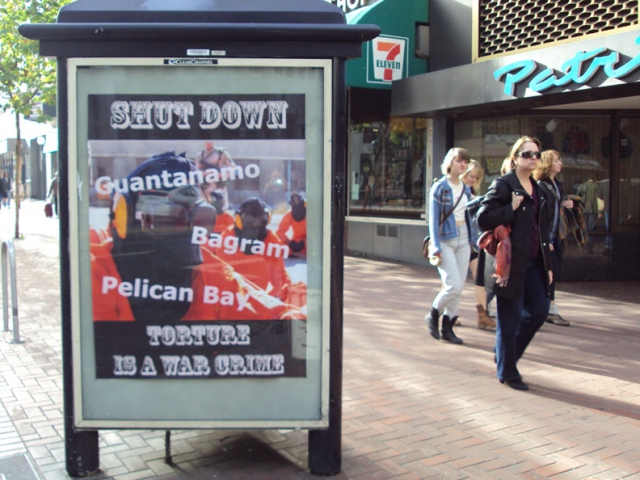
Friday, May 23, 4:45 pm:
I start off the holiday weekend at a demonstration to shut down Guantanamo. I hardly know anyone there. I stand quietly near the cage I helped build long
ago, holding my sign so the people coming out of the BART station can see it. It’s a poster I made four years ago, that
says Shut Down Guantanamo, Bagram and Pelican Bay – Torture Is a War Crime. A young South Asian man (I later learn he’s
Pakistani) comes up and asks me what Pelican Bay is. I explain that it’s a supermax prison in Northern
California, where men are held in solitary confinement for years on end, that
it’s where the hunger strike that swept the California prisons last summer
originated. He tells me about being
detained after 9/11, because a neighbor he went to junior high school with
called the police to report that he was dating a white woman. His parents first learned he had a girlfriend
from the FBI.
4:55 pm: A Vietnamese
man comes out of BART and asks me what’s going on. I explain it to him briefly. He argues that it’s war, these things happen
in war. “Which came first, the attack or
the locking up?” he asks. The young
Pakistani man quickly takes over the task of educating this guy, using lots of
examples he’s accumulated from his work with a civil rights organization. I’m happy to let him do the talking for a
long time. The Vietnamese guy says, “Well,
I came from a Communist country and this is still the freest place on earth.” I can’t stop myself from mumbling, “Not
really.” Both men scold me for
interrupting him and disrespecting his narrative. I feel terrible. I’ve acted arrogantly out of privilege. I stand silently, listen to them argue for
about ten minutes. The I move away from
them and spend the rest of the hour standing with my sign, talking to no
one. When I leave at 5:45, they are
still talking.
Friday night: As I’m
coming home from dinner with a friend, it occurs to me that those men used privilege
as well, to silence and shame me. I
wonder whether they would have spoken to a white guy that way, and whether he
would have taken it so hard. I think about my South Asian woman friend who has trouble arguing with older women,
even when she knows she’s right, because her culture taught her respect for elders. Clearly, this young South Asian man had no
such difficulty.
Saturday, May 24: We’re
working on UltraViolet, the quarterly
newspaper I help produce. I decide I
want to write about how power and privilege analysis, for so long confined to
activist circles is starting to be discussed in the mainstream due to Twitter hashtags
like #SolidarityIsForWhiteWomen and #NotYourAsianSidekick and the media frenzy over
Tal Fortgang’s “Checking My Privilege: Character as the Basis of Privilege.” I can’t get a handle on the subject. I spend three hours and write two paragraphs. I get home late and don’t see the news about
the killing spree at UCSB.
Sunday, May 25: On
the way to UltraViolet production, I skim
the New York Times story about how Eliot Rodger’s hatred of women who rejected
him drove him to kill. I’m too stunned and
creeped out to think much about it. I
manage to finish my article. I mean to
put in the story about what happened at the demonstration on Friday, but in the
end I don’t. It ends up being mainly
about whether Ta-Nahisi Coates’ cover article about reparations will help people
understand what white privilege means. I
worry that I’m not saying anything everyone doesn’t know, but my co-editors
like it. Layout takes longer than we
hoped; we finish about 9:45 pm.
Monday, May 26, 1:00 a.m.:
I finish everything I need to do and send the paper to the printer. I look at my Twitter feed. The first tweets that catch my attention are
on the hashtag #YesAllWhiteWomen. (I recently
started following Suey Park, Mikki Kendall and Lauren Chief Elk. I might have to unfollow them soon ’cause man
are those girls prolific. I don’t want
to because they’re interesting, but I’m constantly scrolling back and back and
back to try to find the beginning of the conversation.) I read between the lines that something
called #YesAllWomen is a phenomenon. I
don’t realize how big of one. I check it
out and it doesn’t seem that white to me.
It seems like a lot of women from many demographics (mostly young, but
it’s Twitter after all) sharing stories and pain - an online consciousness
raising group. I don’t see any need to
post anything. No one’s online anyway at
that hour, and I have almost no followers.
Monday afternoon: I
take a long walk and think about what I would like to write about this
episode. One phrase that immediately
comes to mind is the title of one of Rebecca Solnit’s essays, “The Longest War.” I think about how much U.S. policy since
before there was a U.S. has been about denying women’s sexual autonomy. I think about how Andrea Smith says that one
reason Native American tribes had to be subjugated was to eliminate examples of
societies with gender equality. I wonder
if Rebecca Solnit has read Andrea Smith.
I think maybe I should ask her.
Monday night: I get
home and look at Facebook. Everyone’s
talking about #YesAllWomen. Interesting the
way my worlds are starting to collide.
People I didn’t think knew each other apparently do at least on
Twitter. I look at the tweets, favorite
a few. Feel sad. Finally post “We don't need a hash tag. We
need a real anarchafeminist revolution. #YesAllWomen” 2 people favorite it. The average tweet in the convo seems to be retweeted
200+ times and favorite 300+. I’m not
surprised; the hashtivists aren’t going to like my tweet and the twitterphobes
aren’t going to see it.
I check out Facebook, where at least I have a more respectable
number of “friends.” Someone has posted
an article about “The Woman At the Heart of San Francisco’s Anti-TechGentrification Protests.” The woman is
someone I recognize from demonstrations but don’t really know. She’s young, white, college educated and has been
in San Francisco for about a decade. She’s
awesome, but it seems to me there are hundreds, maybe thousands of people at
the heart of the anti-gentrification protests.
It occurs to me that she probably had no idea that was going to be the
headline and was only trying to get more publicity for the issue. The article is pretty sympathetic given that it’s
on businessinsider.com. I feel bad for being snarky. I chalk it up to the fact that it’s been a
long war, I’ve been at this losing activism thing a long time.
I get email from a friend who’s writing her memoir. She mentions that she’s finding it hard to
compress her 85 years into a manageable page count. She worked with Alice Paul on the National
Women’s Party, the campaigns to free Joan Little and Yvonne Wanrow
and moved to Wilmington, North Carolina as part of a multiracial women’s group supporting
the Wilmington 10. I think that I haven’t been at this so long
at all.
Tuesday morning, May 27:
Rebecca Solnit is on Democracy Now.
She’s good. Amy Goodman keeps
asking her specifics about Eliot Rodger and she keeps saying, “We need to stop
focusing on this one guy and talk about the systemic violence that women face
every day. This guy killed six people,
but three women are killed by intimate partners every day in this country.” The segment includes a clip from the video posted by Eliot Rodger. I've avoided watching or listening to it. It makes me cry. It's not the good kind of crying.
Tuesday afternoon: I
check out #YesAllWhiteWomen. There are a
lot of tweets from white women cautioning each other not to be defensive, to
listen. There are a number of tweets on
#YesAllWomen saying “Remember to retweet women of color, not just white women.” I wonder if they can always tell the race
of people on Twitter.
I see a tweet from Ken Jennings, Jeopardy Super-Champion.

I think, “We may really be getting somewhere.” I click on Ken’s feed and see this:

(Julia Collins just
won her 17th game, with a total of $372,000. I'm completely in love with her.) I wonder why Twitter ruined Ken Jennings' life and think maybe I'm lucky to have almost no followers. I consider that the woman who started #YesAllWomen had to shut down her account because of all the hate mail. I think spending your life in anonymous activist collectives may well be underrated.
Tuesday, 6:10 pm: I
get off work and walk to an event about Oscar Lopez Rivera, a Puerto Rican
independentista who has been imprisoned by the U.S. government for 33 years
this week. Walking up Market Street, I
think about what I want to write about all this. I keep thinking of more and more things I
want to pull in, but no unifying theme.
I pass the massive @Twitter edifice, which used to be Western Furniture Exchange and Merchandise Mart, and the soon to be closed Flax art supply store.
I get where I'm going and decide to post this
as a diary.


