A bit over 20 years ago, I attended a conference at San
Francisco’s Mission High School called Dynamics of Color. Organized by a multiracial planning group
over many months, it was a two-day extravaganza for lesbians to grapple with
the myriad ways that racism divides us and gets in the way of our organizing
for liberation.
I was there with half a dozen other members of LAGAI,
which then stood for Lesbians And Gays Against Intervention – we’ve since gone
through a few reworkings of the full name, which is now LAGAI – Queer
Insurrection. Since our mission
statement, since the group’s founding in 1983, included, “To confront and
challenge racism within the lesbian/gay community,” we were all looking forward
to this conference as something historic and important.

As part of the introductions, we were given guidelines for calling out and responding to racial/racist dynamics that arose during the conference. To concretize the discussion, the organizers put on a role-play that they said was based on something that actually happened during the conference organizing. The role-play was a meeting. A white woman announced that the outreach group had finished a huge mailing the night before, sending announcements (snail mail, that’s how we did it in those days, folding and stamping hundreds of letters and separating them by zip code and sending them off to physical mail boxes) to hundreds of organizations. A mixed-race woman asked if a certain organization was on the list. The white woman stammered. She couldn’t remember, and she didn’t have the list with her. She’d left it in the car, which was parked blocks away and she didn’t want to go get it. The interchange culminated with the white woman crying and the women of color explaining, one by one, why that was an inappropriate and manipulative response. Eventually she stumbled over an insincere apology, and that was the end of the role-play.
I felt a gnawing in the pit of my stomach. Not because I had done something like
that. Not because I could identify with the
white woman screwing up, crying in a meeting and being bawled out for it,
although I could. I didn’t believe the
scenario, and I felt that it augured badly for the conference. I discussed it later with my closest friend,
who had the same reaction – that role-play seemed like a straw dog. My friend said, “Every white woman I know
would have brought the list.”
“Yes, I said. She
would say, ‘Oh, you want to see the list?
Here it is. Please, feel free to
add to it,’ and she would produce a list of ten single-spaced pages containing
every group you ever heard of and lots that you never did, overwhelming you
with her competence, and your insignificance.
Finally the agonizing preliminaries were done and BarbaraSmith, founder of Kitchen Table Press
was introduced as the keynote speaker.
“Sometimes,” she began (I’m paraphrasing, of course, this
is all at a remove of two decades) “I regret the day we ever decided to do
anti-racism work in the lesbian community.”
I sensed a collective gasp. She couldn’t be saying, “You brought me all
this way to tell you you’re wasting your time.”
She wasn’t, exactly, but she was cautioning us against spending all our
time focusing on the small harms we do to each other and losing sight of the
bigger harms caused by the military-prison-industrial-educational complex.
“When I look around,” she said, “the people running the
schools, the jails, the FBI, the Pentagon, they’re mostly not lesbians.”
That was truer then than maybe it is now, but the
principle remains worth holding onto, as discussions of toxic twitter feminism
begin to devour all the air in our intellectual atmosphere. The opportunism of mainstream white feminists
is a problem. It certainly bears some of
the blame for our failure to build a revolutionary, broad-based women’s
movement confronting inequality, colonialism and imperialism. But the lion’s share of responsibility for
that failure doesn’t lie with feminism.
Feminism is not responsible for the backlash against it from Reagan and
Schlafly and Cruz and Huckabee and and and and.
It’s not responsible for the rightward tornado that has swept the
country and the world since circa 1973.
Mainstream feminism has not been as progressive as it should and could
have been, but it has been consistently more progressive than the rest of the
country. Ultimately, the radical
movements that should have been pushing on the mainstream of feminism and
everything else did not fail to mobilize mass support because of feminism. We failed all on our own, with lots of help
from various forms or counterintelligence but also helped by our own
unforgiving cultures.
In the early nineties, after volunteering with San FranciscoWomen Against Rape for eight years, I was tired of constantly hearing about
what a problem white women were in the organization. I felt stuck, like people expected me to do
something I didn’t know how to do, to be something I wasn’t, and if I asked what
it was, I was shirking responsibility for confronting my own racism. I decided the best thing I could do was
remove my toxic presence from the organization.
I wasn’t trying to be petulant. I really thought I was doing the right
thing. If I couldn’t be part of the
solution, at least I could stop being part of the problem. I put more of my energy into ACT UP (the AIDS
Coalition to Unleash Power) and LGBT antiwar organizing. When ACT UP San Francisco imploded, due to
the unwillingness of some of the middle- and upper-middle-class white gay men
to consider racism, sexism and classism for even one precious minute, I went
back to SFWAR with a new appreciation for an environment where at least, our
divisions were seen as something to be confronted. I learned that I could survive criticism and
even grow from it. I learned not to take
every criticism of white feminist culture personally. Most of all, I learned that the culture of an
organization really can change, if there’s enough unity and commitment from the
people in it.
I also made friends, both white women and women of color,
who helped me to take those steps, and feel supported in my learning
process. That’s a piece that can easily
be lost in movements where ideological purity is highly valued. Of the people I’ve known who used to be
political and no longer are, nearly every one has said the reason they stopped
was because they felt unvalued and unsupported by their fellow activists.
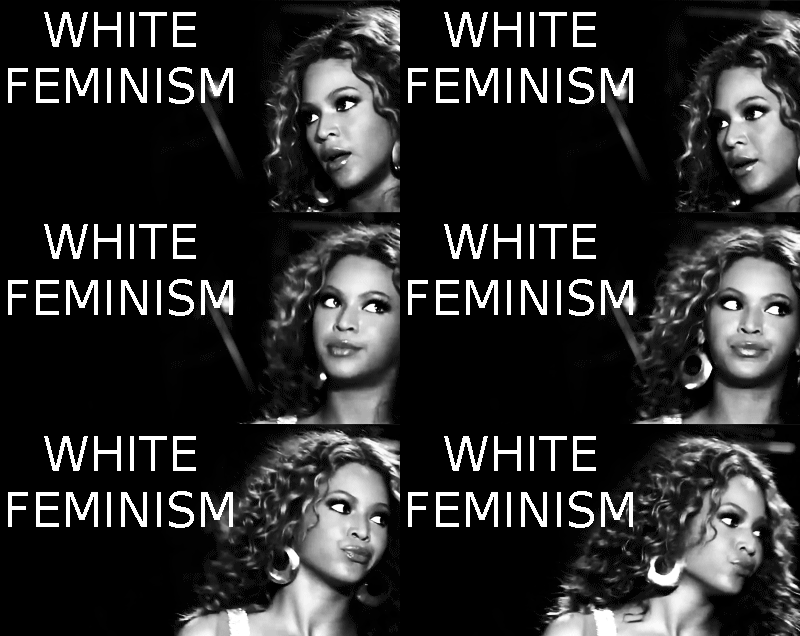
When I hear about Susan B. Anthony’s racism, or Betty
Friedan’s classism and anti-lesbianism, Gloria Steinem’s Zionism and
Islamophobia, Margaret Sanger’s pro-eugenics beliefs, I’m mortified. I don’t want to be tainted by those positions
and it’s tempting to follow the trend of defining them only by their
failures. Yet I don’t define Malcolm X or
Huey P. Newton by their sexism, or MLK by his caving into homophobia and red-baiting.
Recently, I heard an incredible radio documentary by Fran
Luck, a producer on Joy of Resistance at WBAI New York. It traces the founding of the National
Organization for Women to the exclusion of women from the podium at the 1963
March on Washington. In the aftermath,
African American women leaders organized, a woman named Pauli Murray wrote an
op-ed which Betty Friedan read and reached out and suggested that they have a
meeting in Washington, D.C. to form a national organization for women’s
equality. This history doesn’t wipe out
the ways in which Friedan later narrowed the scope of women’s issues to those
that most affected white middle-class women.
But it’s interesting to me that we all know the later history, and
almost no one knows the founding story.
My friend Carwil Bjork-James writes helpfully:
Anger can motivate awesome work and can motivate
toxic and destructive work. It can be clarifying and illuminating, or convince
us that our closest friends are just out to get us. But in expressing our anger
about pop culture (that is, about people who made art that reinforces our (or
others’) oppression, rather than directly oppressing us), I would suggest these
propositions:
--Strategically deployed anger ultimately seeks to
enlarge the community seeking social transformation, not to split it.
--Publicly expressed anger depends on establishing
that it is justified to make it strategic.
--Even justified anger needs calm, patient work of
educating current and potential allies.
I’ve been one of the people who liberally dispensed anger when
people didn’t live up to my highest standards of anti-oppression politics, who tolerated
no middle ground the cutting edge issues of any given day. At the time, I believed that was necessary
and important for pushing movements forward, and I’m not going to say that it
wasn’t. It’s only in hindsight that I
think, maybe I helped drive people away from the movement. Maybe they were people who didn’t belong
there. But maybe some of them were
people who could have been helped to see how their behavior, or their use of
privilege or their short-sighted vision was detrimental to our mutual
goals. My own politics have certainly
evolved over the years, yet at times I casually judged some people as not worth
educating.
I will never regret trying to make the movements I worked in as radical, as inclusive, as responsive to real people’s needs as they could be. But I do regret some of the strategies I’ve used. As I get older, I realize I want my contribution to be the people I brought into activism, not the people I turned away or turned off.
I will never regret trying to make the movements I worked in as radical, as inclusive, as responsive to real people’s needs as they could be. But I do regret some of the strategies I’ve used. As I get older, I realize I want my contribution to be the people I brought into activism, not the people I turned away or turned off.
Hard as it is for women in their twenties and thirties to believe, multicultural feminism is still in its infancy. Less time has passed since the founding of Ms. Magazine (42 years) than it took the first wave of US feminists to win the right to vote (71 years). But as I follow the angst of online feminists trying to walk that line between grinding each other down and letting each other off the hook, I remember Barbara Smith's words all those years ago and I can't help thinking, "We haven't come very far."


