Sunday, July 17, 2011

The uses and abuses of hunger strikes

Hundreds of California prisoners are entering their third week of a hunger strike to win five eminently reasonable demands related to conditions in the Secure Housing Units (SHUs). 
According to solidarity committee members, many of the men (and possibly some women) are in serious medical danger.  On Democracy Now! on Friday, solidarity committee spokespeople Dorsey Nunn and Molly Porzig said that some of the strikers are near death.
I’m really upset to hear that, because it’s very clear that as of now, there is nowhere near the type of mobilization outside the prisons that will be needed to win significant concessions from the California Department of Corrections.  The reason there’s a federal receiver for health care in California prisons is because, according to the judge, “on average, an inmate in one of California's prisons needlessly dies every six to seven days due to constitutional deficiencies in the CDCR's medical delivery system.”    Now the spokesperson for the receiver told the San Francisco Chronicle that “They have the right to choose to die of starvation if they wish.”  So clearly, prison officials are not highly motivated to make sure that prisoners do not die in their custody.
A friend of mine said on Thursday that he had called Senator Mark Leno’s office to ask them to pressure CDCR to negotiate seriously with the inmates.  He was told that Leno, who introduced the California Single Payer health care bill and is one of the more progressive members of the Senate, has no position on the strike yet.
The hunger strikers frequently invoke the example of Bobby Sands and the other Irish political prisoners.  I think they may not know, however, as much of that history as it would benefit them to know.  For instance, the 1981 strike was the second hunger strike by those prisoners. The first, in 1980, ended with a tentative agreement that the British then reneged on.  In contrast to the 1980 strike, when all the prisoners refused food simultaneously, in 1981, the prisoners struck one by one, so as to build on each subsequent death.  Another thing they should know is that that protest was the culmination of five years of increasingly militant protests by the hunger strikers, all of which were supported by tens of thousands of demonstrators on the outside – and that was only in Ireland.  Bobby Sandsbecame a household name all over the world by the time of his death, and had been elected to the British Parliament.  100,000 people attended his funeral.    But even his death did not get it done.  Nine more prisoners died of starvation before the others ended their strike in response to pleas from their families.  It was only after the strike ended that most of the demands were met.
In November 2009, in preparation for the Copenhagen climate talks, eight international activists began a fast that lasted 53 days, through the end of the failed summit.  They were supported by dozens of people around the world who fasted for shorter periods of time.  The Climate Justice Fast website says, “Hunger striking is a form of protest unparalleled in its ability to capture attention and catalyse social movements. Throughout history, it has been successfully used to create awareness and mobilize the public behind social causes, and as the most powerful statement against injustice that an individual can make.  
With all respect and admiration for the dedication and sacrifice of the climate fasters and others who use this tactic (which I never have), I think they misstate the evidence.  Hunger striking is certainly a powerful tool of nonviolent action.  But it is neither “unparalleled in its ability to … catalyze social movements,” nor is it “the most powerful statement … an individual can make.”  In fact, as the Irish example and the ones that will follow illustrate, a successful hunger strike is never an individual action.  It always takes a powerful movement to support and amplify its impact, and it should generally be the culmination of a series of actions and organizing, not the beginning.  Gandhi's Salt March catalyzed at least as many people as did his hunger strikes.  So did the Freedom Rides, the occupations of nuclear power plants, and numerous other types of protest.
This is not a criticism of the prisoner strikers.  They have few options for serious protest, and they have already accomplished a lot – more words have been written and spoken about the SHUs in the last three weeks than in the last ten years, I am sure.  But I hope that their supporters will encourage them to think very carefully about their next steps.  It’s very difficult, nearly impossible, in fact, for prisoners to know how much attention their strikes are or are not getting on the outside.  I have had the frustrating experience of supporting people who decide to go on hunger strike in jail, believing it will help them get their demands met, while we are scrambling to get even their hometown newspapers to write one sentence about them.  It’s demoralizing for everyone.
In this case, I pointed out to one of the solidarity committee members today that I, who am very concerned and somewhat involved already, don’t know the name of one prisoner involved in the strike.  That’s not good, especially when you remember that even Gandhi, an international hero of epic proportion, seldom achieved his (stated) objectives through hunger striking.
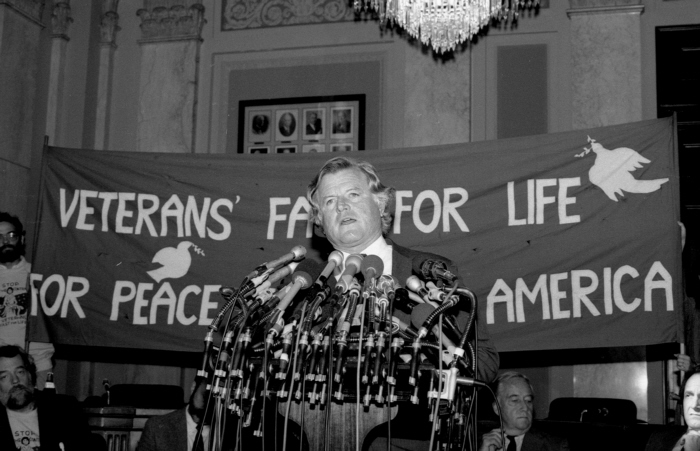
Senator Ted Kennedy speaking at the Veterans' fast
for life press conference.
photo by Bill Becker
Here are a few more examples of hunger strikes you may or may not know about:
Veterans Fast For LifeOn September 1st, 1986, four veterans began a water-only “fast for life” on the Capitol steps in Washington, D.C. They wanted to to draw attention to, and to protest, President Reagan's illegal and extraordinarily vicious wars against the poor of Nicaragua, El Salvador, and Guatemala.  They ended the fast on October 18, having gotten a meeting with House Speaker Tip O’Neill, who strengthened his support for hearings on the Iran-Contra scandal.
Troops Home Fast:  On July 4, 2006, CODEPINK and Gold Star Families launched a hunger strike called TROOPS HOME FAST, calling for the U.S. government to bring our troops home from Iraq--FAST. A core group of long-term fasters fasted in front of the White House, in Washington DC. After 28 days of fasting, the group agreed to end their strike when they received an invitation from leading members of the Iraqi Parliament to meet with them in Jordan to discuss their plans for peace in Iraq.  (Again without minimizing the power of this action, you may have noticed that five years later, we still have many troops in Iraq.)
Third World Liberation Front strike, U.C. Berkeley 1999Six students began a hunger strike on the lawn of the University of California’s administration building for over a week. They were demanding increased funding and respect for the embattled Ethnic Studies program, which had been won by the original Third World Liberation Front in the late 1960s.  After a week of spirited demonstrations involving thousands of students and community supporters, and over 120 arrests, the students won nearly all of their demands, including 8 more full-time faculty to be hired over the next few years, a promise to help fund a Center for the Study of Race and Gender; a temporary place for a multicultural student center, space for a mural commemorating Ethnic Studies, student representation in the task force that makes important decisions in the department, and amnesty for the students who were arrested.
Anti-nuclear Fast For LifeBeginning on Hiroshima Day, August 6, 2003, 13 international activists fasted for 40 days, hoping to catalyze a stronger international movement to end the nuclear arms race.  
Diane Wilson vs. Formosa Plastics:  Shrimp-boat captain Diane Wilson went on hunger strike four times during her multi-year campaign to get a zero emissions agreement from Formosa Plastics.  But it took more drastic action still to convince the company.  In response to the question, “What was the turning point with Formosa Plastics to stop dumping toxins?” she says, “I think it was when I took my shrimp boat out to sink it on top of their discharge point. Up until that point, it was hard to motivate the fisherman, because they were so depressed and they did not believe you could fight city hall. They believed their days were numbered, but when I took my boat out to sink it, I touched them in a place that wasn't in their head; it was in their heart. I got all of those shrimpers to go out in their boats in the middle of a storm, and it was unheard of. I think when Formosa saw that, they realized I had the people behind me and that's when they gave up.” More info
Mitch Snyder and Community for Creative Nonviolence vs. Reagan:  In 1984, homeless activist Mitch Snyder fasted twice to force the Reagan administration to renovate a shelter in Washington, D.C. which CCNV had created by occupying an abandoned federal building. The first fast ended on the eve of Reagan's second election when Reagan promised to execute necessary repairs. Reagan failed to follow through on this promise, and CCNV sued to get the repairs made.
Cuban political prisoners:  On April 3, 1972, Pedro Luis Boitel, an imprisoned poet and dissident, declared himself on hunger strike. After 53 days on hunger strike, receiving only liquids, he died of starvation on May 25, 1972. Guillermo Fariñas did a seven-month hunger strike to protest against the extensive Internet censorship in Cuba. He ended it in Autumn 2006, with severe health problems although still conscious. Reporters Without Borders awarded its cyber-freedom prize to Guillermo Fariñas in 2006.  On February 23, 2010, Orlando Zapata Tamayo, a dissident arrested in 2003 as part of a crackdown on opposition groups, died in a hospital while undertaking a hunger strike that had been ongoing for 83 days, in Cuba's "Kilo 8" prison. He had declared the hunger strike in protest of the poor conditions of the prison in which he was held.
Iranian dissidents:  On June 12 of this year, Iranian journalist and nationalist activist Reza Hoda Saber died of a heart attack following a 10-day hunger strike at Evin Prison.  Saber stopped eating food and later stopped drinking water in protest at the death of his fellow dissident Haleh Sahabi, who died during scuffles with security forces at the funeral of her father.
Tamil hunger striker suspends London protest to attend UN talks:  “Sunday 12 April 2009, Thousands of Tamil protesters converged on central London yesterday as one of two hunger strikers protesting at the continuing military assault on Tamil separatists announced that he was suspending his fast. … Sivatharsan Sivakumaraval, 20, and Prarameswaran Subramaniam, 28, who have set up camp in Parliament Square, have been on hunger strike since 6am on Tuesday. They agreed to take liquids for the first time early on Friday. Sivakumaraval said he had agreed to drink water after being promised he would be able to take part in talks on the plight of Sri Lankan Tamils.” 

Now you can certainly make your own determinations, but it seems to me that the keys to successful hunger strikes are:
  • a target that cares (or has to appear to care) whether the strikers live or die
  • concrete demands that are fairly easy for the target to meet, or at least do not demand an existential change (Diane Wilson was not trying to get Formosa to stop making plastic, for instance)
  • mass mobilization of supporters
  • ability to generate a lot of sympathetic media
  • a campaign that incorporates other tactics leading up to the strike
  • a way to escalate when their demands are not met
I believe the prisoners’ hunger strike has a lot of these elements, but what it does not have yet is mass mobilization, which is probably what it will take to make the CDCR care whether the prisoners live or die.  I’m also not sure the prisoners have thought about how they can escalate if they do not win quickly.
They have demonstrated an impressive ability to organize across racial lines and among different prisons.  Now they may need to slow down, regain their strength and give those of us outside a chance to catch up with them so that their sacrifice will not be in vain.

Wednesday, July 13, 2011

5 Good Things to Watch While Cooking


Okay, I don't have a future as a food photog.
 Here’s the great lesson I’ve learned about blogging this week:

What used to be called “wasting time” can now be referred to as “doing research.”

Last night I had two tasks when I got home from work at 8:00 pm:

(1) Make dinner
(2) Figure out what to blog about today. Wednesday seems like a good day to feature diversions to get you through the week: books, movies, etc. My revelation last night was that if I make television part of the “etc.”, I could accomplish both tasks at once.

See I like to watch TV while I’m cooking. That obviously puts some limitations on what I can watch. It needs to be something that doesn’t require all that much actual watching. It might in fact be better referred to as “listening to television” with occasional forays into the living room to see what’s going on. Subtitles, obviously, are out. On Demand or on tape is best so if I miss something really important, I can rewind. Another criterion is that it’s under an hour, since I like to think that’s how long I’m going to spend cooking on a week night. Though somehow, I always end up eating around 10:30, which means it doesn’t quite work out that way.

So, for those of you who might also like to cook with television, here are my recommendations (for full disclosure, I did not watch all of these last night, but I did watch all of them while cooking this week):


1.  “Friday Night Lights” (48 mins On Demand; series finale is this Friday on NBC). I’m really sad that this series is ending. I’ve always loved teen series – I admit that I even used to sneak peeks at 90210, but this one is above and beyond, in my opinion. Why? I considered this question carefully last night, while checking out the episode where Tami goes to Philadelphia. Because the dialogue sounds real, and the actors have great timing. It doesn’t sound like, “Listen up, here’s the moral.” It doesn’t use cheesy music to let you know something big is going to happen. The story lines don’t all get tied up neatly in a bow at the end of each episode. The kids might be a little perfect, there’s a little too much symmetry between Matt and Vince in the quarterback-with-abandonment-issues-who-has-to-take-care-of-his-parent role, but at least it deals with real issues in a real way and the teachers aren’t always right. If you never watched the show because you don’t like football, be assured, it’s got very little to do with football.

2.  “No Contract No Cookies: the Stella D’oro Strike” (34 mins, HBO On Demand). A moving, though heart-breaking, portrait of striking workers at the Stella D’Oro cookie plant in the Bronx. In 2009 – yeah, just two years ago – a judge ruled in favor of the workers saying the company was bargaining in bad faith. Which seems kind of obvious, since their goal was to bust the union. What I wondered what, why can’t every group of striking workers go to court and win like that? Why can’t the Castlewood Country Club workers, who never even went on strike but have been locked-out for sixteen months sue and win? And then, as soon as the court made the company bring the workers back to work, the company “exercised its legal right” to move out of state and hire nonunion labor. So why do they have that right, but not, apparently, the right to “bargain in bad faith”? Something’s wrong with our labor law, obviously, which I knew (though, according to my friend the labor lawyer, a rare bright spot in Obama’s record is some of his appointments to the NLRB). The film could have delved into that more, but it’s worth watching. Another thing I found interesting is that everyone’s making pro-union movies (Triangle Fire, Made in Dagenheim, ) while unions are being run out of the country. Don’t know if you can get this one if you don’t have HBO; if you do, it’s available on demand until July 31.

3.  “Rookie Blue” (48 mins On Demand; you can also watch it online for free). I kind of hate myself for starting to watch this series, because I had sworn off any new cop shows. But you know, it’s summer and that means re-runs and really really bad reality shows. So I checked it out and I have to say, it’s good. Like, “NYPD Blue” good, sometimes. Maybe it’s because it’s Canadian (Oh, Canada!). Or maybe because two of the three writers are women. The head writer is Tassie Cameron, who adapted Margaret Atwood's The Robber Bride into a miniseries. Putting that one in my Netflix queue (but the DVD is not out yet).

4.  Rachel Maddow Show (roughly an hour, 9:00 pm on MSNBC). Okay, sometimes she is really annoying. Like two nights ago, the “Best Thing in the World Today” was this ultra-nationalistic portrayal of the U.S. women’s victory over Brazil in the World Cup (soccer, for anyone who is less sports-knowledgeable even than me).  Apparently she thinks it says something good that U.S. men love to watch scantily-clad women running around a field. But the best thing about TRMS, besides that she sometimes has interesting people on, is that she repeats everything three times, which makes it perfect for cooking because if I happened to be washing the mushrooms or something and missed something, I can pick it up the next time.

5.  “Check Please Bay Area” (30 mins., available On Demand for a week, you can also watch back episodes online). I like to hear about new restaurants, even went to one of them for onion cakes (Red Jade on Church Street) but the best thing is that the people never agree. Well, actually, all three did say they would return to Saha, an Arabic fusion place in the hotel district, which sounds fantastic but pricey ($40 per person without drinks). More fun to listen to/watch than a cooking show, in my opinion, because you don’t really need to see the food.

What didn’t make the list:

From Spain with Love” Cooking meets travel, but not enough of either. You don’t get enough of the country or the people, most of it takes place in the kitchen, but you don’t actually learn to make anything either.

Republic of Cannabis”. Pros and cons on the regulation of marijuana production in Mendocino County. Too many talking heads saying nothing you didn’t expect. Boring.

What was on the menu:
Spaghetti with spinach, broccoli, carmelized onions and shitake mushrooms in a creamy pesto sauce, a glass of organic merlot, garlic bread, fruit salad of nectarines and strawberries (love summer!).

Monday, July 11, 2011

What Issues Get You Hot? (Help Me Blog Better!)

On Saturday I took a workshop on blogging at the Writing Salon. The teacher was the very talented Britt Bravo, whose blog is have fun do good.

Thanks to www.proposedsolution.com
for this great graphic.


The majority of the women in the class were food bloggers, like my niece. They all already have followings – even the ones that don’t have their blogs up yet. One woman is launching a book blog, which would be a great idea even if she were not in publishing. One created lazybuddhist.com, which is a fabulous name, and Buddhism is huge, so of course she also has lots of admirers, publication offers, etc. I felt at a distinct disadvantage.

Everyone was really nice, and they laughed at the name Democracy Sometimes, but I could tell that an activism blog wasn’t anyone’s idea of a fun way to spend their leisure time. Predictably, when we broke into small groups, a delightful young woman in my group said, “Honestly, I try not to think about politics.” I doubt anyone ever says, “I try not to think about food.” Well, maybe the odd dieter does, but they don’t mean it.

I have to admit, I was a little tempted to fold up my computer and spend the day doing something productive, like playing internet Scrabble.

But then I thought, come on. I don’t have to rival the foodies or the knitters. Surely there are a few thousand people out there who are as turned on by radical social change as I am. I just need to figure out where they are and get them to let me into their blogging community.

So, here’s what I’ve decided to do. I’m going to make a commitment to this blogging thing for a year. I’m gonna post a lot more often – going for three times a week, and one of those will be a book or movie review, so feel free to suggest ones I might like (no horror flix, please). That’s my part. But I need you those who at least occasionally read my blog and like it to help me.

See, one of the things I learned in this class, though perhaps it shouldn’t have taken a $150 class to get it, is that blogging is conversation. And the thing about conversations, at least conversations we want to have, is that they’re not one-way. So I’m also going to try to write about what people want to read, rather than strictly what tickles my own fancy, and you need to let me know if I’m hitting it or not.

So please, no more saying, “I’m going to comment on your blog one of these days.” Do it for the Gipper, or Tiny Tim, or whoever.

In the class I made a list of topics I might want to write about. Which of these, if any, would make you want to comment, tweet, post to your facebook page, email it to your friends?

I know I'm anti-voting but please, take a minute to vote for your favorites, or suggest ones that are not on the list. (You’ll note that among them are “Invite friends to post,” and “interviews with …”, so if you want that to be you, you know where to find me.)

Vote Early, Vote Often (choose as many as you like):
1. Welcome to Palestine Flytilla/Free Gaza Flotilla
2. The Dominique Strauss-Kahn Affair
3. What’s going on with the Israel BDS movement
4. What’s the story with those crazy Stand With Us people? (maybe even an interview with one of them?)
5. Who's doing what to save Social Security, and does any of it have a chance?
6. Is this the worst time ever in the world, or do we just know more?
7. Interviews with other lefty bloggers
8. Interviews with older feminist and queer activists
9. Why do left-wing groups have so much trouble living our ideals?
10. What makes activism fun? What makes it a drag?
11. Who’s doing what, when, where and how? How to plug in?
12. Step-by-step guides to organizing campaigns (there are a lot, but how to choose among them?)
13. Van Jones’ new “Rebuild the Dream” campaign
14. The real true story of the 1989 Golden Gate Bridge Blockade (with video)
15. Why did we just learn that Bradley Manning is gay? And now that we know, does it matter?
16. Invite guest bloggers to share strategies for movement building
17. How campaigns work and don’t work
18. The anti-vegan critique of Lierre Keith and why smart people are so divided over it
19. Why is the Tea Party so effective, or is it?
20. How to find media sources you can trust?
21. What will it take to save Social Security?
22. Is internet organizing a fad or here to stay?
23. A deeper look at gender inclusivity in the left media
24. Twitter: Can you say anything worth saying in 140 characters?

Friday, July 1, 2011

A Very Busy Week

Last week brought 5 (count'em five!) demonstrations. So busy I didn't even have time to blog about them. Need to rest now.


#1: Queers Tell Frameline: Say no to Israeli pinkwashing


#2: Solstice in the Streets


#3: Lockout the Lockers Out - Showdown at Castlewood Country Club


#4: The Dyke March


#5: Free Bradley Manning Contingent at SF LGBT Freedom Day Parade
Check out photos and video

Sunday, June 26, 2011

When Are Radical Gender Activists Going to Get Out of Our Own Way?

This morning, in observance of Corporate LGBT Pride Day, KPFA talk show host Philip Maldari actually devoted an hour to radical queer politics, or more precisely, to a critique of gay marriage. It was not bad. Of course, the two guests didn’t give credit to any of the people who have been making that critique and doing the activism to back it up for years, but they raised important issues. But then Philip, a gay man who until quite recently never identified himself as such on the air, said that he, and KPFA in general, never interviewed Harvey Milk back in the day because they considered Harvey too reformist for their then-revolutionary station.

“He was getting people to register to vote, saying ‘Forget about the revolution,’” Philip alleged.

Now first of all, that’s just not true. Harvey Milk was probably an arrogant jerk in a lot of ways, but he was very radical, and he never said anyone should give up on the revolution. He was pursuing electoral office, yes, but as part of a broad progressive coalition that briefly transformed San Francisco politics. He was the one who went bar to bar to get gay bars to drop Coors beer, building a coalition with unions to oppose Coors’ anti-gay and anti-labor policies.

And secondly, if that were the reason for ignoring Harvey Milk, you would assume that KPFA had interviewed a lot of radical queers to critique the mainstream gay movement. I’m pretty sure if you go back and look through the archives from that period, you’re going to find that they did not do that.

The real reason that the dominant group at KPFA didn’t interview Harvey Milk is the same reason they have not covered the campaign to get Israeli money out of the LGBT film festival or the Ban the Army, Not the Queers work: because they’re f***ing homophobes and have no critique of the patriarchy. It’s the same reason staff members like Philip are always trying to get rid of the one hour a week of gender-oriented programming KPFA has had for the last six years, and the reason KPFA has no queer show.

The Marxist left defined the gay movement and the women’s movement as bourgeois and reformist. To this day they refuse to pay attention to any but the most mainstream elements of those movements, and then use their bourgeois reformism to justify ignoring queer and women’s issues.

Neither of Philip’s guests challenged his revision of history. Of course, neither of them was living here during the time of Harvey Milk (I wasn’t either, but I moved here the year after Milk was killed, and got involved in the still-very-vibrant queer left within a few years of that), so they may not actually know either how progressive Milk was or how uninterested KPFA was in anything queer. They also didn’t challenge him because they are part of an unfortunate tendency by radical feminist and queer activists to collude in our own expungement.

The fact is that pretty much every social movement has its assimilationist mainstream, its radical and conservative wings. The queer movement is in no way unique in being painted in the mainstream media with the single brush that makes us look the most like the dominant society. But the women’s movement, and by extension the LGBTQ movement which grew out of it, may well be the most universally blamed for our own repression.

A couple weeks ago I went to a panel at the Queer Women of Color Film Festival where Erica Huggins, a leader of the Black Panther Party, spoke. She said that one of the things that contributed to the downfall of the Party was not dealing with misogyny and sexism in the group. I have heard a few women make statements like that before, but I’ve never heard anyone say that the main reason the Party ultimately failed to make lasting change was because of such internal problems. Clearly internal dynamics, including between men and women, contributed to a culture of suspicion which was exploited by the FBI in its COINTELPRO. But if divisions had not already existed, the FBI infiltrators would have set out to create them. Most of the left recognizes that it took a mighty effort by the government to bring down the Panthers.

Students for a Democratic Society, the Free Speech Movement and other parts of the student counterculture were as white and middle-class dominated as parts of the second wave women’s movement and the post-Stonewall gay movement. But I don’t hear people using the cultural and class homogeneity of the student movements to dismiss their achievements, despite the fact that they didn’t bring down capitalism or end U.S. wars for empire.

But when the women’s movement is discussed in left-wing circles, its failures are attributed almost solely to its racism and narrow class base. Hardly anything is ever said about the concerted effort to dismantle the gains of the feminist movement, a backlash as intensive and pernicious as COINTELPRO. (In fact, it bears mentioning that parts of the women’s movement were targets of COINTELPRO.) If you listen to the mainstream media, patriarchy’s resurgence can be laid at the doorstep of male-bashing sex-negative bra-burners. If you listen to left media, you’ll blame the bourgeois biases of Betty Friedan and Gloria Steinem.

Young women who are products of Women’s and Gender Studies programs at prestigious colleges say, “I don’t call myself a feminist because feminism is a white thing.” That’s almost the only thing they know about feminism. They don’t know that Michele Wallace, author of Black Macho and the Myth of the Superwoman and a member of the Combahee River Collective, says “I’ve never understood how any woman could not be a feminist.” They don’t know that Egyptian doctor and former political prisoner Nawal el-Saadawi, said in a recent interview, “There are many feminisms, and I am a revolutionary anti-imperialist feminist.”

Revolutionary feminists and queer activists have an obligation to stand up for our own history. Everyone loves to believe they are doing something brand new and exciting, but the honest truth is, few of us ever are. It doesn’t make what we’re doing less valuable to give credit to those who came before us, and to those who are standing right beside us.

Friday, May 13, 2011

Pointless Blogging = Pointless Politics = Pointless Running

I was working on a post about my favorite topic - despair and its antidotes, and I ran into a post entitled "How Running a Marathon Is a Lot Like Being a Small Blogger" (and to Roxana, the author of that post, I can only say, you don't know what a "small blogger" really is - compared to me, you're HuffPo).

Check it out. It's brilliant. It completely changed what I was going to write.

She compares being a small "niche" blogger to being one of the people in the pack at the Boston Marathon - you do it for your own reasons, not to "win." I think that analogy is equally applicable to being a habitual protester/leftist decryer of the status quo.

The problem is that the awareness of how true that is, which has been good enough for me lo, these many years, is wearing thin.

A friend recently recommended the book How I Became a Famous Novelist. She said it was so much more than she expected, and that's why reading it was such a joy. She contrasted it with the much-hyped The Help, which she found so much less than it should have been. I think what I'm experiencing now is the activist version of her reading experience.

It's not that I suddenly need or expect to be effective. It's just that right at this moment, being the gnat buzzing around people's eyes for a minute on their way to Starbuck's is so much less than we could be, it's too depressing to keep doing it. For most of my activist life, people on the left have been predicting that our economy and environment were on the verge of collapse, and that when that happened, capitalism and imperialism would inevitably fall and a more caring form of social organization would take its place. At the same time that I was skeptical of those assumptions, I did take it for granted that the purpose of our organizing was to position ourselves to move into the void created by the capitalist elite fleeing to the Cayman Islands or wherever they've stashed their loot. But now the crash has come and the Tea Party has moved in to exploit it for the benefit of the same monied interests they pretend to oppose, and we, the left, are doing -- what? A few tepid demonstrations and a lawsuit or two. A couple good occupations of state capitols, a recall initiative in Wisconsin.

I am going to a demonstration after work today to save education in California. But what does it even mean to "save" a system that is already so broken, that it has the highest teacher-student ratio in the fifty states? Why are we demonstrating only to save education while health care and welfare and in-home support services for disabled people are also decimated? Simple: because the teachers' union doesn't represent the nurses or the IHSS workers, and no one represents the patients or the women who depend on CalWorks to feed themselves and their kids. Why won't any of my coworkers, many of whom are parents and nearly all of whom are products of California public schools, go to the demonstration? Simple: because no one asked them to, because no one thinks they really will.

Because no one thinks we can really win. Everyone knows that in order to win the crash, we need to unify and bring out everyone, professional workers and clerical workers and low-waged workers and unemployed and homeless and housed, union and nonunion, teachers, students, nurses, patients, people who don't come to demonstrations because they're busy writing grants for their nonprofits and people who don't come because they're home taking care of their elderly parents and people who don't come because they're out buying iPad2s.

Or because they're busy massaging their little blogs or running marathons they know they are not going to win.

My question is, when and how does the person 2/3 of the way back in the marathon suddenly get the idea that they could win if they acted like they could? I watch a lot of tennis and every now and then there's a player who's been plodding along year after year, getting to the quarterfinals or the semis now and then, who all of a sudden breaks through and wins a big tournament and before you know it they're #2 in the world. It happened to Patrick Rafter and Vera Zvonareva. And they were the same players the day before they won their first big tournament and the day after. They didn't get implants or something that enabled them to hit harder or run faster. They worked out, sure, but they'd been hard workers for years. They obviously always had the talent to win, and god knows, they always had the desire to win, but they didn't have the belief they could win. And for some reason, one day they did and after that they believed it because they had done it.

One big thing these sports stars have going for them is coaching. They have someone they are paying to be in their corner, to keep yelling "You Can Do It" from the sidelines. So maybe I'll take up a collection to hire a John Madden for the social justice movement.

Wednesday, May 11, 2011

3.5 Weeks In Paradise


I recently returned from almost four weeks at Hedgebrook, a women's writer's retreat on Whidbey Island in Washington State. The opportunity to spend that time engaging deeply with my own writing and other women writers was truly one of the most magical that I have ever had. I feel it changed me a lot, especially changed my relationship to writing and made me take myself more seriously as a writer. I had a lot of time and space to reflect on the purpose of writing and to remember that writing really does, at its core, change the world. (Hedgebrook's tag line is "Women Authoring Change.")

It was really special to be in a place that has nurtured the creative spirit of giants of women's writing, like Gloria Anzaldua and Adrienne Rich. To read the journal entries left by Sheila Ortiz Taylor, Gloria Steinem and Ursula LeGuin, and feel that by leaving my own entry I was in a tiny way blending my voice with theirs to make a great writer's soup to nourish the women who come after me. I was privileged to meet some amazing writers, whose work and friendship I will cherish always, and to find a kindred spirit in a local woman who offered to take me to lunch one day.

I have never written so deeply or with so much joy. I wrote pages and pages most days, without even noticing the passage of time. I was gifted with that precious experience I've heard of but never really believed in - where I felt I was watching my story unfold and only had to write it down. We will see what comes of it in terms of representation, publication and readership - the forms of outward success. But the inward success of knowing I did the best writing I could do, finding characters whose company I enjoyed, who whispered to me not only what needed to happen in my current book but where they (think they) want to go next - that no one can ever take from me and I thank Hedgebrook so so much for choosing me and Murder Under the Fig Tree for this adventure.

Check out my photos.

The website is www.hedgebrook.org for any woman writer (and writing is construed pretty broadly - the woman who took over my cottage was a very talented songwriter I went to hear the other night at a local club) who might want to apply in the future. The application deadline is in September for the year. And even though I know everyone is stretched in terms of donations, if you want to nurture women's creativity and bring out the voices of women hungry for change, please think about adding Hedgebrook to the organizations you support.