Showing posts with label sports. Show all posts

Friday, September 14, 2012

Teen Dating, Arranged Marriage, and Hating on Women's Bodies

Two best things I've read this week:  

An Anti-Teen-Dating Diatribe

Syrian-born, U.S.-raised author, poet and scholar Mohja Kahf, on the double standard applied to "teen dating" and "arranged marriage" in the West.
...
Teen dating supplanted family-based courtship in the U.S. fifties. Sure there was dating before, but only for adults. Whole industries spawned to support teen dating, and now the entire culture seems to assume it is a universal human right.
Cotillion pressure begins early in Aunty Mohja’s Southern hometown. Mothers gussy up eleven-year-old daughters in strapless gowns to be pawed awkwardly by boys at a school dance where lights are low and paper decorations evoke adult notions of “romance.” Fathers grin and push seventeen-year-old sons out the door with car keys and hotel reservations for this bizarre ritual called “prom.”  Oho, Aunty Mohja went to American high school and knows all about prom night.
This, but delicate sensibilities are shocked, shocked, at traditions of teen marriage among some sectors of Muslims. Aunty Mohja is not saying early marriage is best. But compare the two customs, both acknowledging teen sexuality. For Muslim parents to provide a nubile woman with a reliable life partner, with whom she can build a home as well as satisfy her sexual desires—someone who bears witnessed responsibility if she conceives a child, in a union nurtured by surrounding family—this is oppressive, while parents providing ill-prepared teens with the means for furtive groping amid all sorts of conflicting messages about what they are to do in this badly set-up ritual, that’s benign?
This is a must-read

Tennis: Serena Williams and Taylor Townsend - Race, Weight, USTA, and US Open

Cliff Potter on why the #1 junior tennis player in the world almost didn't get to play in the U.S. Open.  Funny, I watched a lot of the Open and heard nothing about that.  Why?  Could it be because Patrick McEnroe, who made that horrendous decision, is part of the broadcast team?  Can you say "conflict of interest?
Serena Williams has a body that is bodacious in all respects. Totally dissimilar to most bodies on tour, men and women.
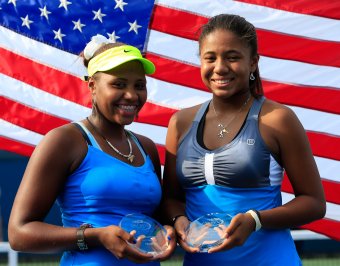
Williams' physique is shared with Taylor Townsend, a 16 year old African-American and the number 1 seed in the girl's juniors in singles. Taylor lost on Friday in the junior girl's US Open singles tournament, but won the US Open girls doubles title.
Like most of us, you would have thought nothing of Taylor Townsend's weight or race.
But you are not the USTA and Patrick McEnroe, at least as to weight.
Read about what happened to Taylor, her response and how Serena Williams stood up for her and made the federation back down.

Saturday, August 4, 2012

Why am I wasting time watching the Olympics?


Watching the Olympics is definitely a guilty pleasure.  I feel like I shouldn’t watch them, but I can’t stop.

Here are the reasons not to watch:


1.         The commentators – they tell us what we already know and what we don’t want to know, and top it off with overblown schmaltz.  My favorite line so far, Bob Costas on the U.S. women’s gold medal gymnastics team:  “Like all Olympic champions, they will now walk together forever.”  What does that mean?  That their walk from the floor to the medal stand will be televised incessantly for the next few days or years?  That they will all be remembered equally? not true.  That they will always care about each other?  Probably true, but so what?  And not only did he say this meaningless line with such gravity, but due to some sloppy editing, he said it twice.

2.         The selection.  They only show a few of the sports (though I guess if you’re home during the day, you can watch many hours of soccer and kayaking) and a tiny few of the competitors – the Americans and the winners, and sometimes not even all the winners – in the men’s gymnastics team final, they focused so much on the U.S. team that they barely showed the Ukrainian bronze medal team at all.  Once upon a time, I remember watching things like archery and weightlifting, but I guess they’ve decided the people who participate in those sports aren’t gorgeous enough for prime time.

3.         The obsession with winners and losers.  Okay, it’s a competition, it’s about winning.  But coming in fourth at the Olympics is just not losing by any stretch.  When figure skater Michelle Kwan finished second at the 1998 games, she said to her family on international television, “Hope you still love me.”  When gymnast Nastia Liukin was waiting to see if she’d won gold or silver four years ago, her father and coach said, “She didn’t come here to finish second.”  I thought, she’d better have won because if she didn’t, her father won’t love her.

When the commentators talk incessantly about the heartbreak of coming in second or fourth, the catastrophe of not having a good meet, they ignore the obvious fact that someone has to finish fourth and even last.  If it’s our girl, we cry for her; if it’s someone else’s favorite, we cheer.  The British crowd went wild when the Japanese team screwed up because it meant their guys won silver.  Understandable, but did anyone stop to think about what the Japanese guys were feeling?

Even with the Americans, once they drop out of medal contention, they drop off our screens as if they were never there. What happened to John Orozco after he fell from grace on Wednesday night?  They spent days getting us to root for the guy, and then he totally disappeared.

4.         Michael Phelps.  Someone I would just not want to spend one second listening to, who happens to be a freakishly talented athlete.  I cannot reach for the remote fast enough when he steps out of the pool.  Though to be honest, I haven’t heard an athlete give a good interview this year.

5.         People critiquing things they can’t do themselves.  A coworker of mine is an ice dancer.  She started skating pretty late in life, which I admire enormously, and she’s gotten very good for essentially a recreational skater (though with the expense and injuries she’s had to bear, it’s hard to call it “recreation”).  She doesn’t like watching freestyle skating and says the triple jumps the Olympic champions do aren’t very hard.  Once I asked, “So how many can you do?”  Of course, she said, “Well I can’t do any.”  I know what she’s trying to say – that we’ve lost appreciation for the technique of pure skating, without the Wow Factor of big jumps and spins – but it still doesn’t make sense to me to say that a triple-triple or quad-triple combination isn’t hard.  If it wasn’t hard, everyone would do it because they all want to win.  If you’re the only woman in the world who can do something, it might not be what a sophisticated viewer enjoys watching, but it’s obviously difficult.

Of course, Olympic television coverage is not geared to the educated viewer.  People watch baseball, football and golf week after week, and develop an understanding of the finer points of what’s involved.  In sports like gymnastics, skating and diving, which most of us watch every four years, the audience is inevitably going to be seduced by the big high-flying skills and not necessarily what people who have actually learned the sport know to look for.

That’s what they pay the analysts for, and that’s why they harp on the tiny hops on the dismounts or the fact that a diver bounced their toes twice before leaving the springboard.  But those commentators can’t do the skills they’re picking apart either, because most of them competed decades ago, and the sports have evolved light years since then.  Olga Korbut was the first gymnast I remember becoming a household name in this country, back in 1972.  She did a single back somersault on the balance beam, and the officials considered outlawing the move after that because it seemed so dangerous.  That same year Kathy Rigby, the top U.S. gymnast, left out her one planned aerial cartwheel on the beam in hopes of helping her team win the bronze, which they didn’t.  Now every beam routine must include at least one somersault and the gymnasts are doing one aerial move after another, some with twists.

I pass this mural on my way home
from West Oakland.
6.         The commercials.  I mostly don’t watch them, but every now and then you accidentally catch one.  They’re so obnoxious.  There’s the homophobic one for Matthew Perry’s new show, with Shawn Johnson and the guy in the Star Spangled Spandex, and then there’s NBC’s unfortunate airing of their “Animal Kingdom” promo right after calling attention to the fact that Gabby Douglas is first African American gymnast to win an individual Olympic gold.  Then there are the annoying “Thank You Mom” ones, which I guess are selling Proctor & Gamble cleaning products, Visa’s soft-focus “Go World” series featuring the caramel voice of Morgan Freeman, and just to break it up, Barack Obama promising to really create jobs if we give him another chance.

7.         The knowledge that neighborhoods were destroyed and millions of dollars taken from London’s crumbling social infrastructure, while laws intended to regulate corporate exploitation of the Games are being used to stifle free speech. 

Here are the reasons to watch:

1.  The athletes are amazing.
2.  The athletes are amazing.
3.  The athletes are amazing.
4.  There’s nothing else to watch.

Friday, September 2, 2011

Venus Williams: Bringing Up Designer Baby

Venus Williams had to withdraw from the U.S. Open due to recently-diagnosed Sjogren’s Syndrome. Big deal, if you’re not a tennis fan, and not earth-shattering even if you are. At 31, Venus’s glory days have been behind her for a while. She has played very little over the last few years, battling one injury after another and, some say, flagging interest in the game.


We feel bad for Venus, but she isn’t the Williams everyone’s interested in anyway. That’s Serena, fifteen months younger, seven major titles more decorated, and everyone’s pick to win a fourth Open this year.

Thanks to by Jayegirl99 for the photo.
Serena herself is just back from a series of debilitating injuries and illnesses, some life-threatening. In May, she was rushed to the hospital with a pulmonary embolism (a blood clot in her lung) and a related hematoma in her stomach. Both of those were likely complications from a freak injury – she cut her foot at a bar, requiring two surgeries, which kept her out of last year’s U.S. Open.

Okay, so again, what’s the beef? Lots of people get blood clots, especially after surgery. “Prior surgery, air travel, prolonged sitting, birth control pills, obesity and pregnancy can predispose a patient to a blood clot in the leg that can travel to the lung,” a cardiovascular surgeon told People magazine in relation to Serena’s hospitalization.

It got me thinking, though. Two young women in the same family, legendary for their fitness, with a highly paid entourage helping them tweak their diets and exercise regimens, battling conditions that are fairly rare for people of their ages. Sjogren’s is an autoimmune disorder that, as sports viewers have heard numerous times over the last couple days, “strikes 4 million Americans annually, 90% of them women.” What the commentators haven’t mentioned is that the condition – a disorder in which “a person’s white blood cells attack their moisture-producing glands” – normally appears in women in their late 40s.

Bad luck? Maybe, but I also found this suggestion: “Elite athletes -- often perceived as the epitome of health and fitness -- may be more susceptible to common illness and are therefore proving useful in helping scientists understand more about the immune system…”

What the study tentatively suggests is that “[S]alivary proteins [proteins in saliva] such as lactoferrin and lysozyme act to prevent microbes from infecting the body and typically increase as the body fights off infection … An initial observational study comparing elite rowers with sedentary individuals over five months clearly showed that exercise was associated with a significant reduction in the concentration of lactoferrin. Theoretically, exercise is a stress on the body and leads to a greater susceptibility to illness. The decrease in salivary proteins, one of the body's first lines of defence against infection, may help explain this.’”

So basically, if I understand this correctly, the moistures that our glands secrete are filled with proteins that help us fight infection, but in athletes, some of these fighter instincts are suppressed. Now here’s what I could find about the causes of Sjogren’s Syndrome.

“Researchers think Sjogren's syndrome is caused by a combination of genetic and environmental factors. … Scientists think that the trigger may be a viral or bacterial infection. It might work like this: A person who has a Sjogren's syndrome associated gene gets a viral infection.

The virus stimulates the immune system to act, but the gene alters the attack, sending fighter cells (lymphocytes) to the eye and mouth glands.

Once there, the lymphocytes attack healthy cells, causing the inflammation that damages the glands and keeps them from working properly.”

Once again, it seems to me, we are talking about secretions that are supposed to protect the body being altered in some way that prevents them from doing their jobs.

The health risks of girly sports like figure skating and gymnastics, where prepubescent girl athletes are encouraged if not forced to starve themselves in order to appear delicate and cute and then put enormous stress on their brittle bones, have been well documented – not that anything has been done to stop it.  (Though young girls are most susceptible to that type of abuse, notably because the biological changes of a normal puberty can completely change their balance and center of gravity and destroy their promising careers, it’s plenty damaging to males too. Two time Olympic pairs skating champion Sergei Grinkov died of a heart attack at 28, while Christopher Bowman, whose career was hindered in part by his resistance to “discipline”, died of an overdose at 40.) We all know that repeated concussions leave football players with a huge risk of dementia, sleep disorders and depression, and that boxing causes severe brain injuries, leading the British Medical Association to push for it to be banned.

But tennis? What can be more wholesome? It’s outdoors, it’s not one set of repetitive motions; it takes eye-hand coordination and speed and endurance and anticipation. You can be a “thinking” player like Martina Hingis or an ultraphysical one like Rafael Nadal, or a combination, which is what the Williams sisters have always been considered. Though there’s a lot of sexist looksism aimed at the women, and comments about how “fit” someone is and who should lose a few pounds, most of the players don’t appear anorexic or emaciated.

It could be that it’s not what the sport is that causes the most severe injury to a young person pushed into focusing on one thing before they are old enough to choose.

It’s hard to write something that might sound like an indictment of Richard Williams and Oracene Price. They’ve been dragged through the wringer by the tennis establishment and media, who’ve criticized everything from their coaching methods to the way they congratulated opponents’ parents to the way their daughters dressed. African Americans from Compton, with no formal tennis education, were not going to be welcomed into a bastion of white upper-class etiquette if they didn’t bow down to its received wisdom, and the Williams – parents and kids – did not. They weren’t Arthur Ashe or Althea Gibson. They weren’t grateful, they weren’t humble and they weren’t always gracious. They were just good. The girls had to prove over and over that they were smart and polite, while their every expression and utterance was scrutinized for evidence of race.

The story itself is oft-told. Richard Williams was watching television and saw Virginia Ruzici, a Romanian tennis star of the 70s, win a tournament and get a check for $40,000. He decided to have two more daughters and make them into tennis players. He taught himself and his wife to play, sought advice from videotapes, coaches and sports psychologists, and started his new daughters playing when they were three and four-and-a-half. The rest, as they say, is history.

I saw Venus in her first pro competition, which was here in Oakland. She won a round, maybe two, before losing to one of the best players of that period. She was a gangly, happy fifteen-year-old who jumped up and down when she won her first match, but when she lost she was disconsolate. It had, apparently, never occurred to her that she couldn’t be the best the minute she stepped on the court. A year and a half later, she made the finals of the U.S. Open, losing to Hingis. The next day, I happened to see her and her father on a talk show from New York. Her father said something like, “I would rather Venus run track, because she’s never lost a track meet.” He also at that time made a statement which would be quoted widely for years: “Venus is going to be great, but Serena will be better.”

I figured he was just trying to motivate his daughter, but I found his comments abusive. He needed to be building Venus up, not subtly putting her down. I’ve never completely trusted the rivalry between the sisters. I don’t doubt for a second that they’re as loving and close as they appear and claim to be. They’ve had ample time, by now, to go their own ways if they wanted and they haven’t. They continue to live together, play doubles together, root for one another, talk each other up. Serena said today when asked about her sister’s illness, “I can’t put into words how much I care about Venus.”

Venus and Serena seem to have good lives. They’re fabulously wealthy, wildly famous, beautiful, educated. But they are also designer babies. We question the morality of having kids to create a genetic match for a family member who needs a transplant, but what about the morality of having kids to raise their families out of poverty? The Williamses are far from the only ones. Martina Hingis’s mother named her for Martina Navratilova because she was going to be a tennis champion. Tiger Woods’ father put a golf club in his hand before his first birthday. In the book Bounce, Matthew Syed tells the story of Laszlo Polgar, who in the late sixties and early seventies had three daughters to test a theory about chess. Olympic gymnast Dominique Moceanu sued her parents for emancipation when she was 17, after her father squandered $2 million she had earned from competition and endorsements. Danica Patrick’s father has managed her career since she started racing go-karts at ten years old.

In her autobiography, Serena insists no one ever made her play tennis. She wanted to do it, she says, because that’s what you did in her family. I’m sure that’s true. When you’re a little kid, you want nothing more than to do what your older siblings do. Despite all the hype these days about ADD and ADHD, it’s not hard to get kids to practice something over and over and over. In my experience, kids will gladly spend three hours pumping coins into broken video games, sliding down a slide or running back and forth between two trees.

But there’s a difference between the kid who decides to run back and forth for an hour, and a kid who does it because her parents set up starting blocks and a finish line. Even more difference if the parent or an older sibling times the child with a stopwatch.

In my family, it was religious education that was important, so I wanted to be a star in that arena. My sister learned to read Torah – that is, learned to read the notations for chanting the weekly portions, and to read the archaic Hebrew without vowels – at age 10, so I learned at 9. When my oldest sister decided she wasn’t going to ride in cars on the Sabbath – a custom my family, which was Conservative, did not practice – I did too. No one forced me. At the time, I thought religion was important to me. As an adult, I somewhat reluctantly concluded that it isn’t.

I wasn’t hurt by my religious education, and I don’t regret it. But I also wasn’t supporting my family with it.

Ordinary kids in this country aren’t allowed to work until they’re 16, and then their hours are sharply regulated. The days when tweeners went out to pick strawberries or work in textile factories because their little fingers were more nimble than the grownups’ are supposed to be over – though Michelle Bachman and others want to bring them back (and plenty of immigrant kids work in hidden sweatshops). Yet child athletes can get commercial endorsements and financial backing, even in highly dangerous sports like motocross and snowboarding. On a plane a few years ago, I sat next to a 12-year-old kid who was returning from a motocross competition. He showed me a picture of himself in a sports magazine. He couldn’t even get a driver’s license, but he was being sponsored to jump motorcycles over concrete walls. He’d already had two surgeries.

Richard Williams, along with Earl Woods and Laszlo Polgar and the rest, prove that it’s possible to create a champion. What none of them have proven is that that creates a happy, healthy human being. What Venus seems passionate about is clothing design. It’s the career she chose for herself; tennis was chosen for her before she was born. Maybe it’s time for the designer baby to just be a designer.
Friday, May 13, 2011

Pointless Blogging = Pointless Politics = Pointless Running

I was working on a post about my favorite topic - despair and its antidotes, and I ran into a post entitled "How Running a Marathon Is a Lot Like Being a Small Blogger" (and to Roxana, the author of that post, I can only say, you don't know what a "small blogger" really is - compared to me, you're HuffPo).

Check it out. It's brilliant. It completely changed what I was going to write.

She compares being a small "niche" blogger to being one of the people in the pack at the Boston Marathon - you do it for your own reasons, not to "win." I think that analogy is equally applicable to being a habitual protester/leftist decryer of the status quo.

The problem is that the awareness of how true that is, which has been good enough for me lo, these many years, is wearing thin.

A friend recently recommended the book How I Became a Famous Novelist. She said it was so much more than she expected, and that's why reading it was such a joy. She contrasted it with the much-hyped The Help, which she found so much less than it should have been. I think what I'm experiencing now is the activist version of her reading experience.

It's not that I suddenly need or expect to be effective. It's just that right at this moment, being the gnat buzzing around people's eyes for a minute on their way to Starbuck's is so much less than we could be, it's too depressing to keep doing it. For most of my activist life, people on the left have been predicting that our economy and environment were on the verge of collapse, and that when that happened, capitalism and imperialism would inevitably fall and a more caring form of social organization would take its place. At the same time that I was skeptical of those assumptions, I did take it for granted that the purpose of our organizing was to position ourselves to move into the void created by the capitalist elite fleeing to the Cayman Islands or wherever they've stashed their loot. But now the crash has come and the Tea Party has moved in to exploit it for the benefit of the same monied interests they pretend to oppose, and we, the left, are doing -- what? A few tepid demonstrations and a lawsuit or two. A couple good occupations of state capitols, a recall initiative in Wisconsin.

I am going to a demonstration after work today to save education in California. But what does it even mean to "save" a system that is already so broken, that it has the highest teacher-student ratio in the fifty states? Why are we demonstrating only to save education while health care and welfare and in-home support services for disabled people are also decimated? Simple: because the teachers' union doesn't represent the nurses or the IHSS workers, and no one represents the patients or the women who depend on CalWorks to feed themselves and their kids. Why won't any of my coworkers, many of whom are parents and nearly all of whom are products of California public schools, go to the demonstration? Simple: because no one asked them to, because no one thinks they really will.

Because no one thinks we can really win. Everyone knows that in order to win the crash, we need to unify and bring out everyone, professional workers and clerical workers and low-waged workers and unemployed and homeless and housed, union and nonunion, teachers, students, nurses, patients, people who don't come to demonstrations because they're busy writing grants for their nonprofits and people who don't come because they're home taking care of their elderly parents and people who don't come because they're out buying iPad2s.

Or because they're busy massaging their little blogs or running marathons they know they are not going to win.

My question is, when and how does the person 2/3 of the way back in the marathon suddenly get the idea that they could win if they acted like they could? I watch a lot of tennis and every now and then there's a player who's been plodding along year after year, getting to the quarterfinals or the semis now and then, who all of a sudden breaks through and wins a big tournament and before you know it they're #2 in the world. It happened to Patrick Rafter and Vera Zvonareva. And they were the same players the day before they won their first big tournament and the day after. They didn't get implants or something that enabled them to hit harder or run faster. They worked out, sure, but they'd been hard workers for years. They obviously always had the talent to win, and god knows, they always had the desire to win, but they didn't have the belief they could win. And for some reason, one day they did and after that they believed it because they had done it.

One big thing these sports stars have going for them is coaching. They have someone they are paying to be in their corner, to keep yelling "You Can Do It" from the sidelines. So maybe I'll take up a collection to hire a John Madden for the social justice movement.