Showing posts with label Rachel Maddow. Show all posts

Thursday, April 5, 2012

Just the Facts, Ma'am … Wait, What's a Fact?

A couple weeks ago, in my piece about Mike Daisey and the Apple Factory, I questioned why both This American Life host Ira Glass and Marketplace reporter Rob Schmitz appeared to take the word of Daisey’s translator about facts that contradicted Daisey’s version of events. A friend objected to my “throwing barbs suggesting that the translator is lying.” I didn’t intend to do that. I have no reason to believe the translator is lying; I know nothing about her. My point was that Glass and Schmitz don’t know anything about her either. Of course, Daisey admitted to many of the inaccuracies the translator revealed, and that would lead us to believe that where there’s a contradiction between their memories, hers is likely to be more accurate. But is that true?

Daisey’s credibility is shot because we know he lied. Fair enough. But we also know he told the truth, and that’s the piece that’s easy to forget. (In what could be an accident of good timing, last Friday the Fair Labor Association released a report which substantiates many of the stories in Daisey's show.)

The other night, Rachel Maddow, whom I adore, led off her show with a critique of Rick Santorum’s campaign speeches. She played a clip of Santorum reporting that according to something he read, “At eight of the ten University of California campuses you can’t take a class in American history.” She played the clip a few times, she asserted that it’s absurd, and then to contradict it, she read from the course catalog of one U.C. campus, UC Davis, showing that it offered numerous classes on U.S. history.


Then she moved on to debunk a previous claim by Santorum – this one alleging that old people in the Netherlands wear “Do Not Euthanize Me” bracelets and leave the country rather than go to Dutch hospitals because they fear involuntary euthanasia. Santorum claimed that 10% of the country’s deaths are from euthanasia, and half of those are involuntary. Rachel then said, “It’s not hard to fact check this assertion. All you have to do is ask a Dutch person.” She then played a clip of herself sitting down with a Dutch journalist, Erik Mouthaan, who assured her that this is “totally not true.”

Actually, asking a Dutch person does not qualify as “fact-checking.” If a Dutch politician said that half of Americans are poor, I’m sure you could find lots of U.S. citizens, sadly even journalists, to confidently assert that that was rubbish. They’d be wrong, however.  I recently told a friend I was pretty sure both she and I have incomes in the top 30% of U.S. households. This friend, who is quite well-informed, emphatically disagreed. She is wrong. A single person who earns $65,000 or more is in the top third, and without knowing her exact salary, I know she is well above that. Of course, being in the top third of households in a country where half the people are poor is no great feat.
I waited for Rachel to give the real statistics on euthanasia in the Netherlands, but they never came. Those statistics are not difficult to come by. The Washington Post blog Fact Checker reports:

In 2001, The Netherlands became the first country to legalize euthanasia, setting forth a complex process. The law, which went into effect a year later, codified a practice that has been unofficially tolerated for many years.

Under the Dutch law, a doctor must diagnose the illness as incurable and the patient must have full control of his or her mental faculties. The patient must voluntarily and repeatedly request the procedure, and another doctor must provide a written opinion agreeing with the diagnosis. After the death, a commission made up of a doctor, a jurist and an ethical expert also are required to verify that the requirements for euthanasia have been met.

… In 2010, the number of euthanasia cases reported to one of five special commissions was 3,136, according to their annual report. This was a 19 percent increase over 2009, but “this amounts to 2.3 percent of all 136,058 deaths in the Netherlands in 2010,” said Carla Bundy, spokeswoman for the Dutch embassy in Washington.
Rachel’s guest was right, but she did not prove it, any more than Santorum proved his "Don’t euthanize me" bracelets claim. Going back to the University of California and American history, Santorum said that eight out of the ten campuses don’t offer such classes. In order to prove him wrong, she would need to show that at least three do, but she stopped with the one.

As it happens, UC Berkeley offers at least four, including:

100.007: The Great Exhaling
1948 was the year that America-after the Great Depression, after the Second World War, after sixteen years of the all but revolutionary experiment in national government of the New Deal and even in the face of a Red Scare that in many ways would dominate the next decade-let out its breath. Finally, that great exhaling said, we can go back to real life- but what was ";real life";? Centering on 1948, but moving a few years back and a few years forward, this class will explore the sometimes instantly celebrated, sometimes all but subterranean experiments in American culture that tried to raise and answer that question. The artists who emerged to tell the national story were male and female, black and white, from the west, the east, the south, and everywhere in between. They included Tennessee Williams of Mississippi and Marlon Brando of Nebraska with A Streetcar Named Desire; Jackson Pollock of Wyoming with abstract paintings so big they seemed like visionary maps of the country itself, a country where anything could happen; Miles Davis of St. Louis, with the spare, quiet walk down noir streets of the music that would come to be known as "The Birth of the Cool"; the cross-country explorations of Jack Kerouac of Massachusetts, Neal Cassady of Colorado, and Allen Ginsberg of Newark, New Jersey, following in the footsteps of Lewis and Clark, certain that the real American remained to be discovered; the grind-house, B-movie spread of noir, with the faces of Barbara Stanwyck of Brooklyn and Gloria Grahame of Los Angeles spreading the suspicion that in America nothing was as it seemed and rules and morals were for fools...
UCLA’s History Department website has a “United States” link you can click on and it tells you that:
“With more than twenty-five distinguished faculty members in the field of U.S. history, the UCLA Department of History offers one of the country’s broadest, most diverse, and successful graduate programs in the subject. Faculty expertise ranges from the pre-colonial history of the Americas to the present.”
How many facts does it take to screw up a monologue?

Wednesday, July 13, 2011

5 Good Things to Watch While Cooking


Okay, I don't have a future as a food photog.
 Here’s the great lesson I’ve learned about blogging this week:

What used to be called “wasting time” can now be referred to as “doing research.”

Last night I had two tasks when I got home from work at 8:00 pm:

(1) Make dinner
(2) Figure out what to blog about today. Wednesday seems like a good day to feature diversions to get you through the week: books, movies, etc. My revelation last night was that if I make television part of the “etc.”, I could accomplish both tasks at once.

See I like to watch TV while I’m cooking. That obviously puts some limitations on what I can watch. It needs to be something that doesn’t require all that much actual watching. It might in fact be better referred to as “listening to television” with occasional forays into the living room to see what’s going on. Subtitles, obviously, are out. On Demand or on tape is best so if I miss something really important, I can rewind. Another criterion is that it’s under an hour, since I like to think that’s how long I’m going to spend cooking on a week night. Though somehow, I always end up eating around 10:30, which means it doesn’t quite work out that way.

So, for those of you who might also like to cook with television, here are my recommendations (for full disclosure, I did not watch all of these last night, but I did watch all of them while cooking this week):


1.  “Friday Night Lights” (48 mins On Demand; series finale is this Friday on NBC). I’m really sad that this series is ending. I’ve always loved teen series – I admit that I even used to sneak peeks at 90210, but this one is above and beyond, in my opinion. Why? I considered this question carefully last night, while checking out the episode where Tami goes to Philadelphia. Because the dialogue sounds real, and the actors have great timing. It doesn’t sound like, “Listen up, here’s the moral.” It doesn’t use cheesy music to let you know something big is going to happen. The story lines don’t all get tied up neatly in a bow at the end of each episode. The kids might be a little perfect, there’s a little too much symmetry between Matt and Vince in the quarterback-with-abandonment-issues-who-has-to-take-care-of-his-parent role, but at least it deals with real issues in a real way and the teachers aren’t always right. If you never watched the show because you don’t like football, be assured, it’s got very little to do with football.

2.  “No Contract No Cookies: the Stella D’oro Strike” (34 mins, HBO On Demand). A moving, though heart-breaking, portrait of striking workers at the Stella D’Oro cookie plant in the Bronx. In 2009 – yeah, just two years ago – a judge ruled in favor of the workers saying the company was bargaining in bad faith. Which seems kind of obvious, since their goal was to bust the union. What I wondered what, why can’t every group of striking workers go to court and win like that? Why can’t the Castlewood Country Club workers, who never even went on strike but have been locked-out for sixteen months sue and win? And then, as soon as the court made the company bring the workers back to work, the company “exercised its legal right” to move out of state and hire nonunion labor. So why do they have that right, but not, apparently, the right to “bargain in bad faith”? Something’s wrong with our labor law, obviously, which I knew (though, according to my friend the labor lawyer, a rare bright spot in Obama’s record is some of his appointments to the NLRB). The film could have delved into that more, but it’s worth watching. Another thing I found interesting is that everyone’s making pro-union movies (Triangle Fire, Made in Dagenheim, ) while unions are being run out of the country. Don’t know if you can get this one if you don’t have HBO; if you do, it’s available on demand until July 31.

3.  “Rookie Blue” (48 mins On Demand; you can also watch it online for free). I kind of hate myself for starting to watch this series, because I had sworn off any new cop shows. But you know, it’s summer and that means re-runs and really really bad reality shows. So I checked it out and I have to say, it’s good. Like, “NYPD Blue” good, sometimes. Maybe it’s because it’s Canadian (Oh, Canada!). Or maybe because two of the three writers are women. The head writer is Tassie Cameron, who adapted Margaret Atwood's The Robber Bride into a miniseries. Putting that one in my Netflix queue (but the DVD is not out yet).

4.  Rachel Maddow Show (roughly an hour, 9:00 pm on MSNBC). Okay, sometimes she is really annoying. Like two nights ago, the “Best Thing in the World Today” was this ultra-nationalistic portrayal of the U.S. women’s victory over Brazil in the World Cup (soccer, for anyone who is less sports-knowledgeable even than me).  Apparently she thinks it says something good that U.S. men love to watch scantily-clad women running around a field. But the best thing about TRMS, besides that she sometimes has interesting people on, is that she repeats everything three times, which makes it perfect for cooking because if I happened to be washing the mushrooms or something and missed something, I can pick it up the next time.

5.  “Check Please Bay Area” (30 mins., available On Demand for a week, you can also watch back episodes online). I like to hear about new restaurants, even went to one of them for onion cakes (Red Jade on Church Street) but the best thing is that the people never agree. Well, actually, all three did say they would return to Saha, an Arabic fusion place in the hotel district, which sounds fantastic but pricey ($40 per person without drinks). More fun to listen to/watch than a cooking show, in my opinion, because you don’t really need to see the food.

What didn’t make the list:

From Spain with Love” Cooking meets travel, but not enough of either. You don’t get enough of the country or the people, most of it takes place in the kitchen, but you don’t actually learn to make anything either.

Republic of Cannabis”. Pros and cons on the regulation of marijuana production in Mendocino County. Too many talking heads saying nothing you didn’t expect. Boring.

What was on the menu:
Spaghetti with spinach, broccoli, carmelized onions and shitake mushrooms in a creamy pesto sauce, a glass of organic merlot, garlic bread, fruit salad of nectarines and strawberries (love summer!).

Tuesday, May 25, 2010

Is Failure the Chicken and Success the Egg?

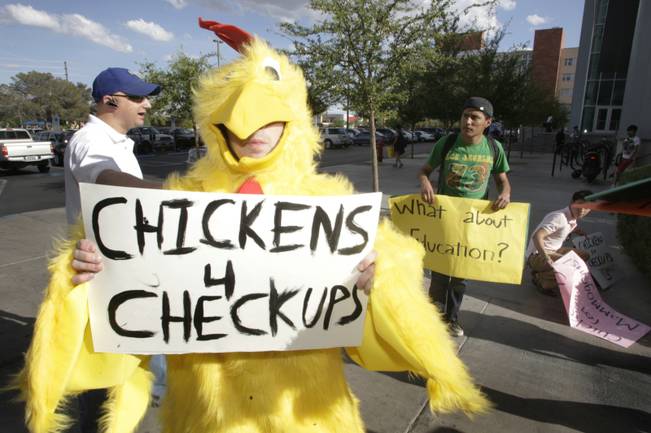
(Thinking about chickens because of Nevada's new law that you can't wear a chicken costume to the polls.)


More reflections on Budrus, the Movie.

After seeing the movie, I went back and looked at my journals from those early days of action in Budrus. Here is a little bit of what I wrote after the first day:

After two hours or more, another group of soldiers arrived with two police jeeps. Ayad asked us to get in front. Ted and I did. The army commander came toward me and I pointed the camera at him.

He said, “You can put away the camera because I didn’t come to make a scene.”

“Why did you come?” I asked.
“You know why.”
“No, I don’t.”
“I came here to build the Fence.”
“Well, I did know that, but I meant right now, why did you come?”
He said, “We both know the Fence is going to be built. We can do it today, or tomorrow we come in with hundreds of soldiers, we close the school, put the village under curfew. But my government wants to build the Fence, and I know and you know we are going to do it.”

I got a sinking feeling, because of course he is right. If they want it, they can do it. But I said, “No, I don’t know that.”

Reading that now, of course, I think, “I should have had more faith.” But nothing in my experience gave me reason to. And this is the little piece that I think doesn’t come through so well in the film: People did not go out there knowing or even believing that they could win. The villagers did not tell their kids to go to the fields that day instead of to school because they knew no one would be shot. Iltezam didn’t jump into the hole and sit there under the blade of a bulldozer, and her father did not stand there and encourage her to do it, because they knew the bulldozer would stop. Quite to the contrary, they knew that Rachel Corrie had recently been killed, in a situation not so different from theirs.

I can’t help wondering what international reaction to the film would be like if that were the story. (Of course, probably there would have been no film if that were the story.) Would Ayad and Naami be known, not as the brilliant organizers of nonviolent resistance who raised a brilliant daughter to follow in their footsteps, but as proof that Palestinian parents don’t value the lives of their children enough to keep them from sitting in front of bulldozers? What would all those people who say, “This film is so wonderful, these people are so brave, if only the Palestinians had used this nonviolence from the beginning, they would have won in a day,” be saying then? Presumably the same things they are saying about Rachel Corrie and Tristan Anderson, who were equally nonviolent and brave: they shouldn’t have been there. What happened to them was their fault, because they had an irrational hatred of Israel and the Jews.

I’ve said this before, but people have a tendency to read social movements through their outcomes. Working backwards, we make a coherent narrative out of their strategies and tactics, their power struggles and organizational styles, leading inevitably to their successes or failures. We subject both our own and other people’s movements to this torturous dissection, and we pretend that we are deciding what to participate in based on our clairvoyant ability to determine which movements are going to succeed. All of us would have stood with Mario Savio on Sproul Plaza, but none of us would have been killed at Haymarket; all of us would have joined the French Resistance and none of us would have joined the Judenrat (the Jewish Councils in Nazi-occupied Europe, which cooperated with the Nazis in the belief that they would be able to help their people survive). A few years ago, I asked my friend’s son, who was 9 at the time, if when they taught him about Martin Luther King, Jr. in school they made it clear that the government, and many of its citizens, did not approve of what King was doing at the time. He said no, they teach that everyone always loved King. Okay, I said, then do they tell you that they put him in jail? Yes, he said, but I’ve never understood why.

The movements that succeed are not only a result of their forebears which succeeded. When we credit Gandhi’s march to the sea with helping to win India’s independence from Britain, we should also remember that he opposed the creation of Pakistan and that his hunger strike failed to prevent a bloody civil war.

The campus anti-apartheid movements in 1986 were no different from the ones in 1979. I was part of both, and I can absolutely tell you that. The 1986 movement didn’t succeed because it had better strategy than its predecessor. It succeeded because the movement of eight years earlier, along with so many other things, most of them in South Africa but some as far away as South Korea, had changed the conditions under which the students were struggling. And nonetheless, in 1987 it did not look like that movement was going to succeed in helping to dismantle apartheid.

My favorite book is Gone to Soldiers, Marge Piercy’s tapestry of interconnected stories of World War II. Toward the end of the book, one of the heroines, a captured resistance fighter, with her fellow prisoners is forced to watch the execution of inmates who carried out an act of sabotage at Auschwitz. She says, “No one cheered.” When I read that, I thought, well of course not. Why is she saying that? And then I realized that she meant they wanted to cheer, not for the execution but for the resistance. They were not standing there thinking, how stupid and reckless those women were to do something that could result in not only their own deaths but others’ too. It’s not that every act of resistance is the right one, but sometimes you don’t know which is going to be the right one until you’ve taken a few or many wrong ones.

Everyone loves a winner, and we especially do in this country. We don’t like to be reminded of our failures. But next time you hear an inspiring story of resistance and triumph, take a minute to think about how you would be feeling about the resistance if there was no triumph. Because most of the time, that’s likely to be the case.