Wednesday, May 28, 2014

Diary of a Confused White Woman


Disclaimer:  This is a diary. It's not a manifesto.

Wednesday, May 7: I interview Rebecca Solnit about her forthcoming book, MEN EXPLAIN THINGS TO ME for KPFA Women’s Magazine.  Before we start, she asks how much time I want.  I say an hour.  She looks surprised, and mentions that she really hasn’t written that much about gender.  I tell her not to worry, I don’t plan to spend the whole time on gender issues.  The interview goes well.
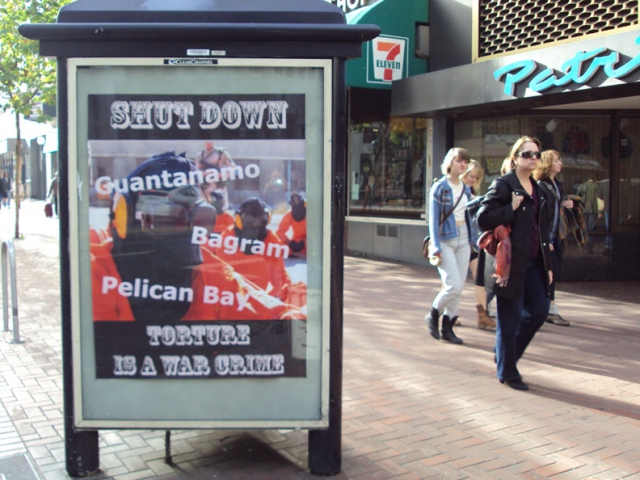
Friday, May 23, 4:45 pm:  I start off the holiday weekend at a demonstration to shut down Guantanamo.  I hardly know anyone there.  I stand quietly near the cage I helped build long ago, holding my sign so the people coming out of the BART station can see it.  It’s a poster I made four years ago, that says Shut Down Guantanamo, Bagram and Pelican Bay – Torture Is a War Crime.  A young South Asian man (I later learn he’s Pakistani) comes up and asks me what Pelican Bay is.  I explain that it’s a supermax prison in Northern California, where men are held in solitary confinement for years on end, that it’s where the hunger strike that swept the California prisons last summer originated.  He tells me about being detained after 9/11, because a neighbor he went to junior high school with called the police to report that he was dating a white woman.  His parents first learned he had a girlfriend from the FBI.

4:55 pm:  A Vietnamese man comes out of BART and asks me what’s going on.  I explain it to him briefly.  He argues that it’s war, these things happen in war.  “Which came first, the attack or the locking up?” he asks.  The young Pakistani man quickly takes over the task of educating this guy, using lots of examples he’s accumulated from his work with a civil rights organization.  I’m happy to let him do the talking for a long time.  The Vietnamese guy says, “Well, I came from a Communist country and this is still the freest place on earth.”  I can’t stop myself from mumbling, “Not really.”  Both men scold me for interrupting him and disrespecting his narrative.  I feel terrible.  I’ve acted arrogantly out of privilege.  I stand silently, listen to them argue for about ten minutes.  The I move away from them and spend the rest of the hour standing with my sign, talking to no one.  When I leave at 5:45, they are still talking.

Friday night:  As I’m coming home from dinner with a friend, it occurs to me that those men used privilege as well, to silence and shame me.  I wonder whether they would have spoken to a white guy that way, and whether he would have taken it so hard.  I think about my South Asian woman friend who has trouble arguing with older women, even when she knows she’s right, because her culture taught her respect for elders.  Clearly, this young South Asian man had no such difficulty.


Saturday, May 24:  We’re working on UltraViolet, the quarterly newspaper I help produce.  I decide I want to write about how power and privilege analysis, for so long confined to activist circles is starting to be discussed in the mainstream due to Twitter hashtags like #SolidarityIsForWhiteWomen and #NotYourAsianSidekick and the media frenzy over Tal Fortgang’s “Checking My Privilege: Character as the Basis of Privilege.”  I can’t get a handle on the subject.  I spend three hours and write two paragraphs.  I get home late and don’t see the news about the killing spree at UCSB.

Sunday, May 25:  On the way to UltraViolet production, I skim the New York Times story about how Eliot Rodger’s hatred of women who rejected him drove him to kill.  I’m too stunned and creeped out to think much about it.  I manage to finish my article.  I mean to put in the story about what happened at the demonstration on Friday, but in the end I don’t.  It ends up being mainly about whether Ta-Nahisi Coates’ cover article about reparations will help people understand what white privilege means.  I worry that I’m not saying anything everyone doesn’t know, but my co-editors like it.  Layout takes longer than we hoped; we finish about 9:45 pm.

Monday, May 26, 1:00 a.m.:  I finish everything I need to do and send the paper to the printer.  I look at my Twitter feed.  The first tweets that catch my attention are on the hashtag #YesAllWhiteWomen.  (I recently started following Suey Park, Mikki Kendall and Lauren Chief Elk.  I might have to unfollow them soon ’cause man are those girls prolific.  I don’t want to because they’re interesting, but I’m constantly scrolling back and back and back to try to find the beginning of the conversation.)  I read between the lines that something called #YesAllWomen is a phenomenon.  I don’t realize how big of one.  I check it out and it doesn’t seem that white to me.  It seems like a lot of women from many demographics (mostly young, but it’s Twitter after all) sharing stories and pain - an online consciousness raising group.  I don’t see any need to post anything.  No one’s online anyway at that hour, and I have almost no followers.

Monday afternoon:  I take a long walk and think about what I would like to write about this episode.  One phrase that immediately comes to mind is the title of one of Rebecca Solnit’s essays, “The Longest War.”  I think about how much U.S. policy since before there was a U.S. has been about denying women’s sexual autonomy.  I think about how Andrea Smith says that one reason Native American tribes had to be subjugated was to eliminate examples of societies with gender equality.  I wonder if Rebecca Solnit has read Andrea Smith.  I think maybe I should ask her.

Monday night:  I get home and look at Facebook.  Everyone’s talking about #YesAllWomen.  Interesting the way my worlds are starting to collide.  People I didn’t think knew each other apparently do at least on Twitter.  I look at the tweets, favorite a few.  Feel sad.  Finally post “We don't need a hash tag. We need a real anarchafeminist revolution. #YesAllWomen  2 people favorite it.  The average tweet in the convo seems to be retweeted 200+ times and favorite 300+.  I’m not surprised; the hashtivists aren’t going to like my tweet and the twitterphobes aren’t going to see it.

I check out Facebook, where at least I have a more respectable number of “friends.”  Someone has posted an article about “The Woman At the Heart of San Francisco’s Anti-TechGentrification Protests.”  The woman is someone I recognize from demonstrations but don’t really know.  She’s young, white, college educated and has been in San Francisco for about a decade.  She’s awesome, but it seems to me there are hundreds, maybe thousands of people at the heart of the anti-gentrification protests.  It occurs to me that she probably had no idea that was going to be the headline and was only trying to get more publicity for the issue.  The article is pretty sympathetic given that it’s on businessinsider.com.  I feel bad for being snarky.  I chalk it up to the fact that it’s been a long war, I’ve been at this losing activism thing a long time.

I get email from a friend who’s writing her memoir.  She mentions that she’s finding it hard to compress her 85 years into a manageable page count.  She worked with Alice Paul on the National Women’s Party, the campaigns to free Joan Little and Yvonne Wanrow and moved to Wilmington, North Carolina as part of a multiracial women’s group supporting the Wilmington 10.  I think that I haven’t been at this so long at all.

Tuesday morning, May 27:  Rebecca Solnit is on Democracy Now.  She’s good.  Amy Goodman keeps asking her specifics about Eliot Rodger and she keeps saying, “We need to stop focusing on this one guy and talk about the systemic violence that women face every day.  This guy killed six people, but three women are killed by intimate partners every day in this country.”  The segment includes a clip from the video posted by Eliot Rodger.  I've avoided watching or listening to it.  It makes me cry.  It's not the good kind of crying.

Tuesday afternoon:  I check out #YesAllWhiteWomen.  There are a lot of tweets from white women cautioning each other not to be defensive, to listen.  There are a number of tweets on #YesAllWomen saying “Remember to retweet women of color, not just white women.”  I wonder if they can always tell the race of people on Twitter.

I see a tweet from Ken Jennings, Jeopardy Super-Champion.


I think, “We may really be getting somewhere.”  I click on Ken’s feed and see this:


(Julia Collins just won her 17th game, with a total of $372,000.  I'm completely in love with her.)  I wonder why Twitter ruined Ken Jennings' life and think maybe I'm lucky to have almost no followers. I consider that the woman who started #YesAllWomen had to shut down her account because of all the hate mail.  I think spending your life in anonymous activist collectives may well be underrated.

Tuesday, 6:10 pm:  I get off work and walk to an event about Oscar Lopez Rivera, a Puerto Rican independentista who has been imprisoned by the U.S. government for 33 years this week.  Walking up Market Street, I think about what I want to write about all this.  I keep thinking of more and more things I want to pull in, but no unifying theme.  I pass the massive @Twitter edifice, which used to be Western Furniture Exchange and Merchandise Mart, and the soon to be closed Flax art supply store.

I get where I'm going and decide to post this as a diary.

Sunday, May 11, 2014

Why Ivo Welch Will Fail


After reading Ivo Welch’s op-ed, “Why Divestment Fails,” in Saturday’s New York Times, I sat down to write a response called “Why Divestment Works.”  Welch is an economics professor at UCLA, and he was writing about why the victory of Stanford students last week, convincing the school to divest from fossil fuels, would not help to promote cleaner energy or stop climate change.

His contention is based on “an academic study, [in which] my co-authors and I found that the announcement of divestment from South Africa, not only by universities but also by state pension funds, had no discernible effect on the valuation of companies that were being divested, either short-term or long-term.”

So first of all, even if that’s true, something caused Polaroid to leave South Africa in 1977 (only seven years after African American employees made it the first major target of a disinvestment campaign in the U.S.), Chase Manhattan to end loans to the country in 1985, GM and IBM to pull out in 1986, etc., etc.  That something may have been the general instability of the country by that time, but the timing was suspiciously close to the wave of college and university divestments triggered by campus activism between 1984 and 1987.

“The wide ostracism may well have weighed on President F. W. de Klerk’s mind. But it was not the economic effect of the boycott that forced him to the table,” Welch writes.

The fact is, we all know, that the impact of divestment is not primarily economic, either on the companies or on the governments that are its targets.  Divestment and boycott campaigns largely work through “shaming and blaming” and they are very good at it.  Take, for instance, the recent short-lived campaign against Mozilla, after they appointed a CEO linked to anti-gay activism.  It goes without saying that the threat to Mozilla of people boycotting its free service was not economic in the immediate sense.  Companies generally don’t want a bad image, and if their image gets bad enough, it’s worth it to them to try to distance from whatever the bad behavior is.  Anyone who has watched “Have You Heard from Johannesburg” (and if you haven’t, you have to) knows that South African officials were worried enough about the boycott/divestment threat to spend quite a bit of their own money bringing business leaders on junkets to South Africa so they would go home and tell their buddies how “complex” the situation was.

Now admittedly, it’s going to be a bigger deal to get oil companies to stop producing oil than to get them to pull out of South Africa, which was hard enough.  But that does not mean that the student activists are wrong to demand that the money they’re giving their schools (often at great cost to themselves) not be invested in technologies that are killing their futures.

As I delved into the 1999 research which now makes Ivo Welch a sought-after debunker of the fossil fuel divestment movement, I discovered a small cottage industry of social scientists using graphs and regressions to prove that student protest is ineffective, and they’re specifically targeting the anti-apartheid movement because it’s the most recent successful, large-scale campus-based social movement.  A lot of this research is done by a Stanford business professor named Sarah Soule, whose 1995 doctoral thesis argues that student protest was not effective because “Educational institutions which hosted shantytown protests had slower rates of divestment policy adoption than did those institutions without shantytowns.”  

Ten years later, Soule tempers her dismissal of the movement, concluding, “certain kinds of divestment policies were, in fact, impacted by the presence of a student movement. In particular, universities appear to have responded to shantytowns by adopting partial divestment policies, however full divestment policies were driven by entirely different factors, most notably a higher proportion of black students and the presence of Black Studies program or department.”

Her conclusion, I think, points to a fundamental flaw in this kind of research.  While it’s certainly useful to try to determine whether protest has a verifiable effect on policy, political decision-making is not a virus in a test tube.  You can’t simply introduce protest to a naïve mouse and see how it responds.  I would assume that campuses with a lot of Black students and Black Studies departments were probably for a lot of reasons more likely to be open to the arguments for total divestment.  This is borne out by the details of Soule’s research, which finds that smaller liberal arts colleges were more likely to pursue total divestment based on moral suasion (although I can attest that it did not happen without student activism), while larger schools with larger portfolios tended to be more motivated by concerns about the cost of divestment and enacted partial divestment only in response to student protest.  Thus, it’s clear that the only way to really measure the efficacy of protest would be to measure the pace of divestment at schools which had protests with similar ones that did not.  That could prove harder to do because protest was viral (even though protest is not a virus either), so similar campuses probably had similar protests.

My first question when I saw Ivo Welch’s piece was, “Who’s paying him to discredit divestment?”  I couldn’t find an answer to that; his old website from Brown says “there are almost no grants available for academic finance research.”  That doesn’t mean no one is, but at least in Sarah Soule’s case, I have the nagging sense that she’s genuinely trying to shed light on the process of social change.  Nonetheless, when Welch writes in the New York Times, “Morals matter. Would I have divested from South Africa? Yes, but I would have had no illusion that doing so would have made a difference,” he is basically a softer version of George Will, who wrote in 1985, “the current campaigning against South Africa is a fad, a moral Hula Hoop, fun for a while.”

But the students should take heart.  Those who try to stem a rising tide of campus activism with calls for a modulated inside strategy usually fail.

Sunday, April 13, 2014

Putting the Eich in Eichmann


The rumblings about Mozilla CEO Brendan Eich’s donation to the campaign against gay marriage reached me through a facebook posting by my friend Sarah N.:
So first I couldn't use Firefox to access the Obamacare website because it kept crashing. Then I couldn't use it to access OKCupid because OKCupid is protesting the Mozilla CEO's anti-gay stance. Time for a new browser, clearly. But I have not been able to find a good way to block annoying pop-up ads on Safari. Recommendations.”

Oh, no, I thought. My two least favorite issues – gay marriage and “free speech”, colliding – and in the middle of it all, I’m going to have to find a new browser?  (Though in the five years I’ve had an OKCupid profile, I’ve gotten exactly one date.)

You can imagine how relieved I was when Mozilla caved into the pressure and accepted Eich’s resignation.

Great.  Crisis averted.  I barely had to think about it, and now I could go back to using Mozilla searches to figure out why well-informed Americans can’t see the problem in trying to broker “peace” between Israelis and Palestinians while arming one side to the teeth. 

Then the media firestorm began.

It was not surprising that Bill O’Reilly and Rush Limbaugh launched into tirades about liberal fascists.  For better or worse, that’s their job.  I don’t think they even believe it any more.  They just do it because that’s what keeps the lights on in their mansions.


But when the liberal media joined in the condemnation of the “intolerance” of “the New Gay Orthodoxy”, I had to check back in.

Christian Science Monitor:  “The resignation was greeted with cheers among many in the gay community and beyond…But others are drawing a different lesson from what happened to Eich, likening the events to a “scorched earth” policy that’s antithetical to a society where tolerance for opposing viewpoints is a mainstay of the Constitution.”

REUTERS:  Tech workers in Silicon Valley debated on Friday whether Mozilla CEO Brendan Eich got the comeuppance he deserved or was himself a victim of intolerance when he resigned under pressure this week amid outrage over his opposition to same-sex marriage.
Andrew Sullivan appeared on Stephen Colbert, arguing that gay people got our rights by showing how nice we are.  Hey, Sullivan, that thing we commemorate every June wasn’t the Stonewall Ice Cream Social, it was a riot.

But again, Sullivan’s line wasn’t surprising – his claim to fame is that he’s the gay conservative.  More upsetting was that Colbert, reading between the lines of his conservative “character” to glimpse the real Colbert (who I don’t think will make it as David Letterman – but that’s another rant), seemed to agree with him.  So did Bill Maher, talking about“The Gay Mafia.” 

Sullivan’s argument, besides the “catch more flies with honey” baloney is that “when people in the workplace feel threatened for things they do completely outside of the workplace, their political views – I mean, in California, if you actually fired someone for a political view you disapproved of, it would be against the law.”   
He further expounded on his blog:

“When people’s lives and careers are subject to litmus tests, and fired if they do not publicly renounce what may well be their sincere conviction, we have crossed a line. This is McCarthyism applied by civil actors. This is the definition of intolerance. If a socially conservative private entity fired someone because they discovered he had donated against Prop 8, how would you feel?”
 There are a few problems with Sullivan’s reason-ing and the liberals who are so comforted by it: 
  • There is no such thing as “McCarthyism by civil actors.”  McCarthyism, by definition, was about a government conducting political interrogations and purges.
  • This is why I hate discussions about “free speech”:  almost no one understands what it is.  Freedom of speech is supposed to mean one thing:  that we can’t be imprisoned for what we say (doesn’t always work – ask Sami al-Arian or Lynne Stewart).  Freedom of speech does not exist in the workplace.  I work for a corporation – I know.  They might not be able to fire me – in California – for voting Green but they sure could fire me for insulting one of their clients.  Refusing to do business with someone because I don’t like their politics is not violating their freedom of speech.  It’s exercising my right to choose who I want to associate with.  Drowning someone out in protest is not violating their right to free speech.  It’s just rude.
  • OK Cupid pressuring Mozilla to get rid of Eich is not the same as AIPAC and CAMERA pressuring universities to fire professors who criticize Israel (or, in the case of Iyemen Chehade, showing an Oscar-nominated film that makes Israel look bad).  Those professors are not advocating that some people be denied equal rights; they’re advocating rights for people who currently don’t have them.  Moreover, they are not the leading face of the university.  For every professor who supports Palestinian land rights, there are ten who don’t – more’s the pity.
  • Professors and teachers are fired, all the time, for their political beliefs, and I don’t recall Andrew Sullivan or Bill Maher springing to the defense of Debbie Almontaser, Ward Churchill, or Shannon Gibney.
  • The CEO of a company is not a “worker.”  It’s not like Mozilla went and checked the political affiliations of the people in the mailroom.  The CEO is a symbol of the company.  Mozilla did not fire Eich for his opinion. They pushed him out because his actions made them look bad.  Here are a couple things that happened last December: 
    • "Media company IAC has "parted ways" with company PR executive Justine Sacco over her tweet: "Going to Africa. Hope I don't get AIDS. Just kidding. I'm white!" 
    • Lululemon CEO Chip Wilson resigns in wake of controversial remarks.  “In an interview last month, Wilson touched off a flurry of criticism by suggesting to Bloomberg TV that production issues may not be the only issue. “Quite frankly, some women’s bodies just actually don’t work for it,” he said. “It’s really about the rubbing through the thighs, how much pressure is there.” 

I never heard of either of those people, and I doubt most of you did either.  So why have we heard so much wailing about poor Brendan Eich?

In the end, what our liberal friends are saying is, “Gay rights aren’t really that important.”  If Brendan Eich had donated $1,000 to the Nazis, I don’t think Frank Bruni would have written, “Something remarkable has happened — something that’s mostly exciting but also a little disturbing ... I’m referring to the fact that in a great many circles, rejection of the Nazis has rather suddenly become nonnegotiable.”

Remember Anthony Wiener?  Most of the liberal establishment supported Nancy Pelosi in forcing him to resign from Congress.  So apparently, it’s okay to fire someone for taking pictures of their dick, but not for being one.