Sunday, November 13, 2011

Live Long and Prosper?


Around 3:00 pm yesterday, just when I was thoroughly sick of being at work, I got an email from a coworker entitled “PUMPKIN PIE.”  She had brought two pies from a bakery near her house and was offering to share with people she likes.  She’d even brought a can of whipped cream.  I ran up there.  Didn’t literally run, I took the elevator, maybe it would have been a good idea to pre-burn the calories by walking up the 24 stories, but the building doesn’t allow it and there was that little problem of having work to do.  But it sure helped get through the rest of the afternoon.

As I washed the pie down with cappuccino - our office recently got new machines that offer espresso, cappuccino (not bad, really), French Vanilla (fat free, whatever that means), Hot Chocolate, and various combos - I flashed on the most recent interview I’d heard with Michael Pollan, who nearly always seems to be on one talk show or another.  “If you’re not hungry enough to eat an apple, you’re not hungry,” he said.  (To which Stephen Colbert replied, “That’s quite an insult to the apple industry.”)
Now Pollan, who has actually done a lot of great work on the food industry, is not as bad as a lot of the people I incessantly hear on the radio.  People like John McDougall, creator of Livestrong and Jeanie Redick, founder of Eat forLife, who claim we are “meant” to eat only whole, unprocessed plant foods, are missing a fundamental point.

If I were not “meant” to eat pumpkin pie, it would not taste so good or make me so happy.
Moreover, the people who claim that humans are by nature hunter-gatherers (though they really mean gatherers, because they’re all vegans), and that eating dairy is a recent alien innovation, never met my ancestors.  Pollan suggests we follow “the wisdom of our grandparents” when it comes to food.  My grandmother did not invent the recipes for malai (corn bread with farmer cheese, butter and sour cream) or noodle kugel with cream cheese and sour cream, or milchiks, a type of pastry whose very name means “dairy.”  She learned them from her mother, who no doubt learned them from hers.

The basis for all these new-fangled theories about how we should not eat anything but unadulterated vegetables is that the only reason past generations were able to get away with ingesting inappropriate animal products was because they didn’t live long enough to experience the ill effects.  Now that we in the developed countries are not so subject to the ravages of typhoid, rampant tuberculosis, war or being eaten by bears, we are discovering how unhealthy our diet is.

Again, this seems counter-historical to me.  My grandmother lived to be ninety.  I wouldn’t say the last five or so years of her life were that happy, and she wasn’t necessarily in the best health, but more of that has to do with a fairly sedentary lifestyle once her kids were grown up, less awareness of the importance of taking steps to prevent things like osteoporosis, and probably also early experiences in Romania.  She had some heart issues late in life, but as far as I know, she never had a major illness until then.  For most of her life she was happy.  She had most of her kids and grandkids around her (she lived in Montreal, and I grew up 800 miles away in Richmond, Virginia, but she usually came to stay with us for the winters), and friends and other family members, and her cooking – with lots of butter and other dairy products, as well as meat – was one of the things that made her happy.

In fact, what population scientists predict is that our generation and those that follow will not live as long as those who preceded us.  Yet many more people now are vegetarians and vegans, lots of us are eating organics and getting our vegetables fresh from farmers’ markets rather than canned or frozen, which is what I mostly grew up on.  (Smoked fish might be a delicacy now, but it was invented as a means of preserving fish in countries where without it, people would starve during the winter.)  All evidence is that it’s the poisons in our environment, as well as in the foods that are mass-marketed, that pose such hazards to our health (and to be fair, Michael Pollan has helped to spread that awareness).  That is, it’s the social problems created by corporate capitalism, not our individual taste for unhealthy foods, that are toxic. So the wisdom of the nutrition experts setting up their Wellness Clubs at Whole Foods should be contemplated carefully.

But my big revelation in what I have dubbed my Pumpkin Pie Moment is that I don’t care if I live as long as I possibly can.  I hope I live another twenty years or more, I have a lot of things I want to do.  But living as long as possible just isn’t my top priority.  Being happy is.  Not that there is necessarily a contradiction.  A few months ago, I heard an interview with one of the researchers on The Longevity Project, a huge study begun in the [twenties] which followed a large cohort of Americans for their entire lives.  Now that they are all dead (including the original researcher, Lewis Terman), a team has compiled information on what factors seem to yield the longest, most satisfying lives.

The shocker that’s grabbed the headlines was that Happiness Doesn’t Help.  The people who were most “conscientious” or “responsible” lived longer than those who were carefree, thus ostensibly bursting the age-old assumption that stress and worry are bad for your health.  Okay, that’s interesting.  But the researcher I heard on the radio, Leslie Martin, used that information to advise parents not to worry if their kids are not making friends or having a good time, because they’ll be fine in the end.

Now I’m all for telling parents to stop measuring their kids against a one-size-fits-all playbook.  But the fact that anxious, friendless kids may in the long run live longer than their happy, well-adjusted peers is not a good argument.  Presumably, the parents of a seven-year-old are not deciding what is and is not a problem for her based on whether she’s going to live to be 84 or 88.

Now admittedly, when I read the study I found it more nuanced than it sounded in the interview.  They measured not just how long people lived but how satisfied they were with their lives.  And one of their points is that there was no behavior that determined who lived longest or had the most success, keeping in mind that all the participants in the study started out in fairly privileged circumstances.  One of my secret ahas:  no specific diet ended up yielding better results than any other in their study.  The NPR story about the study is entitled, “It’s Not All About the Broccoli.”  Alas, cruciferous vegetables, which I happen to love, according to this particular study at least, do not significantly prolong our lives.

I mentioned that to a coworker.  She said a friend of hers who recently died from breast cancer said, “If I’d known I was going to die now, I wouldn’t have eaten all that broccoli.”
 
Well I’m going to keep eating broccoli, but I’m also going to keep eating pumpkin pie and ice cream.  I’m also going to stop worrying so much about what other people think I should be doing, and if that doesn’t help me live longer, at least it’s going to make me happier.

Thursday, November 10, 2011

This Thanksgiving, Give Thanks for Occupy Wall Street

Five reasons to be grateful to those intrepid activists who trudged down to Wall Street with their tents on September 17:
1.  Labor is back.  Tuesday’s victory in Ohio, repealing the governor’s attack on public workers’ bargaining rights, has been hailed by union leadership as “one of the biggest victories in decades for a labor movement that has been on the defensive all year.”  The fact is that the victory itself was pretty modest, but it was a rebuff to Gov. John Kasich and his buddy Scott Walker and the other Tea Party governors who just six short months ago were poised to trample the labor movement into the ground.  When the outpouring in Wisconsin failed to stop the tide, the unions and their supporters seemed about ready to throw up their hands in defeat.  The OWS movement, for all its ostensible “fuzziness” and lack of “concrete demands,” showed that something could be done.  It’s like a cloud has lifted.  You go to demonstrations and see people you haven’t seen since the first day of the Iraq War, if then.  People are crawling out of their holes.  I believe if this continues, some day we might see actual organizing in the private sector – though perhaps I’m overestimating the legs this movement is gonna have.

Photo of Oakland General Strike, from Planet Save

2.  Protest is fashionable.  I remember the last time that was true.  It was in the eighties, the antinuclear days.  If you were a protester, people wanted to know you.  In 1983, I got invited to a wedding by people I hardly knew, because I had just gotten out of jail from the big Livermore Labs blockade.  I was their celebrity protester.  Media went around interviewing us about our (boring) lives for protester profile features.  Now it’s like that again.  The scruffy people I go off to meet on my lunch hour are not seen as a possible source of contagious diseases; rather, coworkers want to shake their hands so they can go home and tell their kids they met one of those Occupy people.
3.  It’s a great time to be a political blogger.  Enuf said.  My twitter following is still pathetic, but hits on my blog are climbing.  More to the point, there’s a lot of other stuff I want to read.  Though #Occupy or #OWS are still not trending on Twitter.
4.  People are debating nonviolence.  I might rather everyone agreed about the value of nonviolent struggle, but at least people are thinking deeply, from Time Magazine to the movement itself (check out the videos from Occupy LA).  A few great things I’ve read today:
in response to the police, it rests on being able to show that nonviolence works. Thanks to Erica Chenoweth and Maria J. Stephan, whose work I already quoted last week, we now have information at our disposal that can make this case. … The basic finding is that of 323 violent and nonviolent movements they analyzed between 1900 and 2006, 53% of the nonviolent ones succeeded as compared to only 26% of the violent ones. What's even more telling is that when the movements were repressed, the nonviolent movements were 6 times more likely to succeed.”  (From Miki Kashtan’s blog and she gives the link to the full article.)
“Lack of agreements [about nonviolence] privileges the young over the old, the loud voices over the soft, the fast over the slow, the able-bodied over those with disabilities, the citizen over the immigrant, white folks over people of color, those who can do damage and flee the scene over those who are left to face the consequences.” (An Open Letter by Starhawk and other trainers)
“If there is any chance that nonviolence will be proclaimed as a strategy, especially in Oakland, especially
And by far the most ill-informed is this comment: 

 Non-violence doesn’t not work when your opponents are sadists.
Sorry, “indio007” but you are dead wrong about that (assuming "doesn't not work" was a typo).  It’s precisely when your opponents are sadists that nonviolence works best.  Ask the Freedom Riders.  Or more to the point, ask the people who spent five hours blockading Wells Fargo a few weeks ago while the cops ignored us.
I went to the Occupy Oakland forum on property damage last Thursday, brought on by the confrontations following the General Strike.  It was very interesting - 500+ people sitting in the cold and dark mostly respectfully listening to one another.  Most people (though not all) spoke for some form of nonviolence, some for tactical or strategic reasons, others to protect the camp and those in it who are vulnerable.  To me the most impressive was a guy who was part of the building occupation Wednesday night who critiqued his own group for setting a fire and building a barricade rather than locking arms and blockading with their bodies.  That indicated to me that (some) people are thinking deeply and learning from one another.
5.  Everyone’s learning to use twitter and text loops (well, almost everyone).  A die-hard friend of mine was convinced to get a cell phone because she didn’t want to risk missing the call to come defend Occupy Oakland in the middle of the night.

Thursday, November 3, 2011

General Strike! And Now What?

It wasn’t a general strike, but it was pretty great.

marching to the Port of Oakland last night
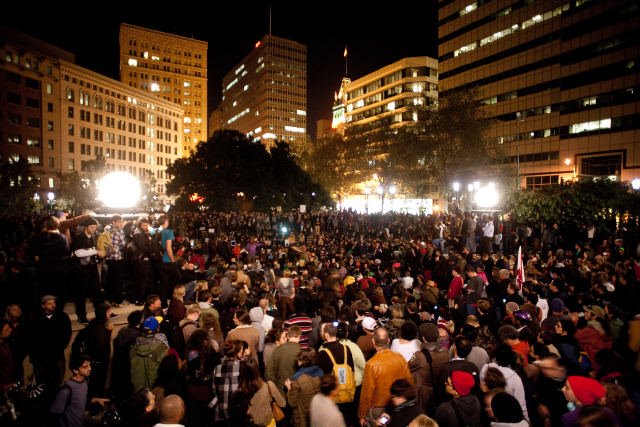
At least 10,000 people came out to protest in Oakland yesterday, bringing a host of issues, sectors and tactics to make the demands of the 99% visible. It reminded me of the Shutdown of San Francisco in the first days of the Second Iraq War in 2003. The police, still hanging their heads over their outrageous aggression of last week and either under orders from or to embarrass Mayor Jean Quan, or both, kept an extremely low – read almost nonexistent – profile, allowing the windows of numerous banks and Whole Foods (all within a few blocks of my house) to be shattered. Walking home last night after the picket at the docks reminded me of nothing more than the streets of Seattle after the first day of the WTO in 1999. With the helicopters whirring overhead (they still are as I write this), it looked and sounded like a war zone.

KRON, our local NBC affiliate, reported that 41% of people responding to their poll said they were “all for the general strike,” and another 31% said it was “fine as long as it stays peaceful.” That means that a whopping 72% basically approve of it; of the rest, 17% said it was stupid because it wouldn’t do any good, while only 7% actively disapproved.

It’s almost enough to convince you that the revolution is coming.

The big question is, what comes next? Of course, I might know the answer if I had the strength to go back to Oscar Grant Plaza for the ten o’clock convergence, but I just can’t do it. My guess, if past movements are any guide (which, as I have previous suggested, they might or might not be), is that there will be two factions on that question. One will say, “We got ten thousand people [except they’ll probably say they had twenty-five; the city called it 4,500, which is both ridiculously low and ridiculously precise] this time; let’s do it again next week and we’ll get fifty thousand.” The other will say, “This was great, but we can’t repeat it; we need to deepen our approach. We can’t just keep protesting, we have to figure out what we’re FOR.” There will be those who want to focus on building the new society in the camp, and those who think they should be doing outreach to the community, to draw in the sectors who were not out today – and in fact, though the numbers were impressive, from what I saw on television and in person, there were a lot of communities missing from today’s actions.

The 99% movement also needs to be thinking about what the government’s next move is going to be. I don’t want to make anyone paranoid, but I predict the era of COINTELPRO is upon us. Last week, it seemed like the government strategy was going to be a simple one: crush and dismantle the camps one by one. It’s just a hypothesis, but it seems pretty likely that Homeland Security has been handing out more than Darth Vader costumes and stun grenades. The impressive display of interdepartmental cooperation at Oakland last week – 17 different police departments! – supports that theory; otherwise, mightn’t San Francisco and Berkeley have said, “No, we can’t come help raid Oakland, we have our own occupations to worry about”? And readers of Naomi Klein’s The Shock Doctrine will recognize the “shock and awe” approach favored by their counterinsurgency experts: go in in the middle of the night with overwhelming force and create as much chaos as possible in the first three minutes. The theory is supposed to be that that stuns people into submission. In the case of Occupy Oakland, it clearly didn’t, and that apparently was the root of the problem. They just didn’t imagine that people would regroup that day and come back out that night.

That strategy had to be scrapped because now mayors of cities like Santa Rosa are saying, “We don’t want to risk what happened in Oakland.” That statement is absurd on its face; as my friend Buff said, it’s like saying, “I’m afraid I might bomb you.” But if the people saying it are not calling the shots, it makes more sense.

So now that shock and awe are out of favor, I suspect the DHS plan is first to hope that the bad weather back east kills off OWS and ripples through the offspring, and failing that, various forms of destabilization. And let me just say that from what I’ve seen of Oakland and San Francisco, it wouldn’t take a counterinsurgency genius to destabilize these movements.

First of all, they are trying to use consensus, and even though most of them are using modified consensus, it’s a cumbersome and challenging process for a thousand or ten thousand people who don’t know each other and don’t have that much political unity. As a possible harbinger of things to come, at the SF general assembly (GA) the other day, apparently a few people objected that they didn’t realize they had agreed to modified consensus, and insisted on going back to “pure” consensus – whereby one person can block a decision. While I hope it isn’t, that could be a dangerous tool in the hands of someone wanting to wreak havoc.


What I saw when I got to OGP last night

Second, at least in Oakland and San Francisco, and I imagine in just about every large urban area, there are basically two camps. There are the political people, largely white, young and well educated, and then there are the homeless. There’s crossover and there are people that are not either of the above – especially now in Oakland, you have the professional organizers and people from other movements who were motivated by the crackdown to get involved, but I have really noticed that if you go to the camps in the middle of the day, you get one impression and if you go to the GA, you get a totally different view of who is there. And this is something that was mentioned at the SF GA the other night, when the subject of drug and alcohol use in the camp was raised.

Third, even within the “political class” at the camps, there are a lot of different stripes. There are anarchists and socialists and reformists and people who are not into labels. There are people who think the cops are part of the 99%, people who think the cops are the army of the 1%, and people like me who think if the cops want to be part of the 99%, they need to act like it. Even among anarchists, there are those who favor strategic property damage and provoking not-so-strategic confrontations with the police, and people who adhere to strict nonviolence, and everything in between. In those situations, it’s not very hard to sow discord. (Right after I finished writing this, I got a text message that the police were attacking the camp. When I got there, I found that a small group of men was setting fires and taunting the police, who were responding – unnecessarily but predictably – by firing tear gas and sound bombs into the camp, and threatening to arrest a much larger group of people who were only sitting on the sidewalk.)

So, how can the 99% Movement protect itself against destabilization? It’s not going to be easy. There’s no magic bullet. The first step is being aware of the potential. The second is guarding against paranoia and suspicion. If we start accusing everyone we don’t know or don’t like of being an agent, the government won’t need to send in any actual agents.

Here are a few things to think about:
  • Is someone who has recently shown up trying to take too much control? Especially, are they trying to control money?
  • Does someone always seem to be urging people to do things that will escalate the risk of confrontation with authorities? Do they get impatient or angry when anyone questions the strategic purpose of their proposals?
  • Is there anyone who always seems to be at the center of strong and hostile disagreements at general assemblies or working group meetings?
  • Is there someone who uses sexuality in a manipulative or aggressive way? Someone whom women, people of color or queer people say is behaving in an abusive or harassing way?
  • Is there someone your gut tells you not to trust, even if you can’t explain why?
If you answered yes to any of those questions, what should you do? Once again, I want to stress I don’t know the answer. I don’t think I’ve ever been in a group where a member was later revealed to have been an agent or infiltrator. But if I suspected someone, this is what I would do:
  • Talk to others I know I can trust, and see if any of them feel the same way.
  • Try to get information about the person I mistrust that can be verified, and see if it checks out.
  • Confront sexism, racism, bad process, shady dealings involving money in a principled and forthright way. Don’t let people sweep them under the rug but don’t make accusations I can’t defend.
  • Keep an eye on the person or people I mistrust. Be open to realizing that I’m probably wrong about them.
  • Listen if someone tells me that someone harassed or abused them, and be an ally. Stand up against abusive behavior no matter who the perpetrator is.
  • Try to remain friendly and open to new people. Don’t get sucked into a culture of suspicion.
  • Trust my instincts, but don’t worship them.
Some excellent things to read about COINTELPRO and infiltration:

Agents of Repression:  The FBI’s Secret Wars Against the American Indian Movement and the Black Panther Party, by Ward Churchill and Jim Van der Wall.  The best history ever of the COINTELPRO of the seventies, must read for activists (but it will make you never want to leave your house).

"Why Misogynists Make Great Informants: How Gender Violence in Movements Enables State Violence", great article by Courtney Desiree Morris, initially published in the feminist journal make/shift.
 
"Informants, Infiltrators & Provocateurs", nice, pithy and practical.

Friday, October 28, 2011

The Movement and the Moment, Part IV – Movement Envy


I’m a jumble of mixed emotions watching the events at Occupy Oakland and SF unfold.

First of all, I’m not there.  A few weeks ago, I was dropping by regularly at both camps, but when all the drama came down, I was 150 miles away in beautiful Fort Bragg on a long-scheduled two-week writing retreat.  Which, BTW, has been wonderful.


My fellow writer, with whom I’m sharing this lovely retreat courtesy of some generous friends who lent us their place here, is much younger and works for a labor organization.  Her roommate was one of the people who was dragged off to Santa Rita andheld in solitary confinement on $10,000 bail the other day.  Her friends were up all night Monday waiting for the raid in Oakland, and again on Wednesday at OccupySF.  For her, the mixed feelings are about guilt that she isn’t there sharing the work and the risk.

For me, it’s pure jealousy.  Not, of course, of the people who got shot in the head with teargas canisters or the ones who spent a day or three in jail.  But of the people who got to feel that incredible power and solidarity of the actions themselves, especially what I heard and saw of Wednesday night’s march in Oakland, the vigil for the wounded activist, Scott Olson, the 3,000-person general assembly (though the report on the OO website says 1,607 people voted)  Of hearing that the planned raid on Occupy SF was called off because of the massive outpouring of support by new and seasoned activists.  Of the energy and joy that comes from having such unity of purpose, and of knowing that YOU DID IT.  Even though if I were there, a part of me would still be whispering, “They did it, not me.”

I can’t help it – I have Movement Envy.  It was supposed to be us, who got that rush of seeing everything you’ve worked for come true and then some.  I’ve worked for thirty years for this, and I didn’t get it.  Some people who started their organizing just a few short years ago, not because they were not committed but because they were not even born when I started my activist life, were the ones who lit the spark that caught.  It’s not because they were better at it than we were, which is not to take away from their genius – but trust me, we had genius too.  It’s because their timing happened to be good.

Now some of my friends will say that all the fruitless work we’ve been doing for years has laid the groundwork for this.  There are small ways that is obviously true.  The forms of direct democracy that are prevalent in the Occupy movement – facilitation and consensus and hand signals and not having identifiable (and arrestable) leaders – come out of the various anarchist and anarchofeminist movements of the seventies and eighties.  People would not now be talking about affinity groups and spokescouncils if we had not used those forms in the antinuclear movement, and we would not have used them then if the Spanish anarchists – a tragically doomed movement itself – had not developed them.

But in the larger sense, I don’t think it is really true that all the work we did has any direct relationship to the success of Occupy Wall Street and its progeny.  This movement – or these movements, hard to know which is accurate yet – grew out of the material conditions of their time, here and around the globe.  People used forms that they had learned from older movements, but if those forms had not been there, they would have used others, and if there were no models they wanted to copy, they would have invented their own.  The form didn’t create the movement; the moment did.

Two years ago, I asked, “What do you do when it’s not your moment?”  I ask that again, but with very different meaning.  What do you do when the potentially revolutionary moment comes and it’s not yours?

This movement is not about those of us who have been doing labor organizing, queer liberation, feminist, anti-militarist, international solidarity, even anti-capitalist or anarchist organizing for years.  That’s what’s driving some organizers crazy.  They have spent years crafting careful and creative and sometimes quite effective campaigns to stop foreclosures, to tax the rich, to hold banks accountable, to oppose social service cuts, to cut military spending, to defend labor – it’s all great, it’s all still important, but this movement is neither a product nor an extension of those campaigns.  This is a parallel movement, with a different class base, a very different trajectory, and a different style.  (If you doubt that, you might want to check out this blog about some conflicts that have arisen in DC, between the “Stop The Machine” protest and the Occupy DC encampment, or this one about tensions between "organizers and organized" at OWS.)  The people who have been studying and researching and planning and writing and speaking about these issues are going to be infuriated a lot of the time because people are going to be talking about their issues who know a lot less and have put in a lot less sweat and soul than they have on them.  I empathize.  I’ve been there.

I’m also highly ambivalent about the general strike that Occupy Oakland has called for Wednesday.  I don’t believe they can pull off anything like a general strike.  3,000 is a lot of people to come to a protest and meeting, but the adult population of Oakland is 300,000.  Maybe that 1% (hey – you are now the 1%! but in truth, not all of the people who attended the GA the other night were from Oakland) can actually mobilize sufficiently in a couple days to multiply itself by 20 or 30 – I’m not going to say they can’t.  What they’ve been able to do so far is pretty amazing.  You can’t achieve big if you don’t dream big.

Calling for a general strike on such short notice seems to me to trivialize the cost to most workers of taking a day off from work, when you have no union to protect you, which the vast majority of private sector workers do not.  (In 2008, the private sector unionization rate for San Francisco-Oakland-San Jose was 12.1%, which is a lot higher than I would have guessed; I know almost no one who is in a private sector union.)  I also feel like people without significant roots in the labor movement thinking they can organize a general strike in a few days is kind of disrespectful toward the people who have been organizing labor for years, and haven’t been able to do that.

Now there is no way I can stay home from work Wednesday, having just been on vacation for two weeks.  I also don’t work in Oakland, but that’s kind of a cop-out.  My coworkers can’t do it either – they need the days off for when there's no school.  We have better benefits than nearly everyone, and that means we get two days’ bereavement leave when a parent or child dies.  But they wouldn’t do it if they could, even if they knew about it.  Most of them, the five hundred or so people who work at the law firm where I word process, have never been to a protest.  The didn’t strike when the amount they have to pay for their health benefits went up by 30%.  They didn’t strike when 20% of our coworkers were laid off.  The first political action they take is not going to be giving up a precious vacation day for something that, if it is important to them at all, is important for philosophical reasons.  And less privileged workers don’t get vacation days at all.  If they don’t go to work on Wednesday, they won’t get paid, which they cannot afford, or they could even get fired, which they definitely cannot afford.

A strike is not individual workers deciding to take a day off.  A strike is a collective action based on some collective ability to insulate individuals from the consequences.  This very audacious and well-intentioned and creative movement just doesn’t have that capacity yet.  If they can get the transit workers on board – and I think their contract probably forbids it, so it’s a very tall order – so the buses and trains don’t run, then private sector workers who’ve never seen a union organizer will have a way to say that they couldn’t get to work.  Without that, what you’re asking for is, at best, a boycott.

The Great American Boycott in 2006 was organized over several weeks, and at the time they called it, they had already had half a million people march for immigration rights in Los Angeles.  And honestly, that was no general strike either.  200,000 marched in SF, but they came from all over the Bay Area.  Business was scarcely interrupted except in heavily Latino industries.

I don’t want to be a professional nay-sayer.  (You might say, well you’re doing an awfully good job of what you say you don’t want to do.)  Remember, this piece is about Movement Envy.  My experience of movements that are (maybe) very different from this one might be limiting my view of what’s possible.  So OO and OSF and ODC and OCD, go ahead and reach for those stars.  But at the same time keep in mind that many of us are still stuck down here on earth.

Friday, October 21, 2011

An Excellent Piece on Occupying and Organizing

I'm not blogging this week or next, because I'm on a two week writing sprint to finish revising my second mystery.  But before I left, I had started collecting some thoughts on the relationship between organizing and movement building, how they can inform each other, and how they differ.  And just now I ran across this article by Rinku Sen from ColorLines that basically says a lot of what I wanted to say.  So I'm off the hook!

Here's a teaser, followed by the link to the full article.

Occupying, Organizing and the Movements That Demand Both

by Rinku Sen

Sunday, October 16, 2011

Abortion is back, but only on television

I was behind on my television watching – all those marches and blockading Wells Fargo (pictured here, my four and a half hours wedged into a revolving door) got in the way – so I just saw the episode of “Grey’s Anatomy” where Cristina has the abortion.  The whole way through, I was waiting for Owen to talk her out of it, or for her to suddenly realize, oh, I’m not too focused on my career to be a mother, I have always wanted a baby, Meredith’s right, let’s stay home and raise our kids together while our husbands save lives.  I expected her to get called in to help on some emergency surgery on a child, and see the mom stroking the baby’s head and burst into tears, maybe even go running out of the room in a very un-Cristina-like way.

Of course they kept us in suspense for the whole show; last five minutes, she’s there on the table with Owen standing next to her and the doctor says, “I have to ask you one more time, are you sure you want to do this.”  I thought, okay, this is it, she’s going to shake her head.  I had a tomato in my hand, all ready to throw at the screen (and a cloth ready to wipe it off).  She nodded.  The doctor said, “All right, let’s get started.”  The vacuum aspirator whirred to life along with the closing music and voiceover.

This was not the first television abortion I’ve seen recently.  In the penultimate season, Becky had one on “Friday Night Lights.”  That was even more surprising, because she was a teenager in Texas.  And she didn’t die or slide into depression.  She didn’t regret it.  She even got her boyfriend back.  Tami (the principal, who told her to talk to her mother and sent her to an options counselor) got fired over it, but that seemed pretty true to life and she got her old job as a guidance counselor back.

Is it possible that abortion is no longer “television’s most persistent taboo,” as Kate Aurthur wrote in 2004?  Aurthur was talking about a show I never watched, “Degrassi: The Next Generation,” a Canadian teen drama where a character also had an abortion and did not regret it.  But “Degrassi” was a cable show, and Viacom, which owns the channel that shows it in the U.S., opted not to air the episode until three years later.  She referenced all the episodes where a strong, feminist character walks out of the clinic in the nick of time with her fetus intact – Andrea on “Beverly Hills 90210,” Miranda on “Sex in the City,” some others I never saw but I could add Susannah on “Thirtysomething.”

My personal favorite was “Party of Five,” where Julia miscarried just minutes before she’s supposed to leave for the clinic.  I was volunteering on a women’s health hotline at that time, and I groaned, imagining all the girls sitting around waiting for their miscarriage instead of scheduling their abortions.  Of course, I’m not a soap opera watcher, or my favorite would certainly be Erica’s reversed abortion on “All My Children.”  And people said “The X Files” was creepy.

“Is abortion no longer too taboo for TV?” wrote Entertainment Weekly's JenniferArmstrong after yet another character on ABC Family’s “The Secret Life of an American Teenager” decided not to have the abortion.  It does seem like the fear of backlash that kept the networks from portraying abortion as a legitimate option for 30+ years has waned.  Observers have noted that the “Friday Night Lights” and “Grey’s Anatomy” episodes have drawn little fire from the right-wing.

So does the fact that the floodgates are now open mean that the political climate has shifted?  Yes, but not in the way we might think.

The networks have not exactly been silent on the abortion issue since Bea Arthur’s “Maude” took the plunge in 1972.  CBS did choose to air an implicitly anti-abortion ad during the 2010 Super Bowl, over the profuse objections of pro-choice activists.  Cop shows have done numerous shows dealing with clinic bombings.  Some have been pretty good, others ranged from stupid to offensive – often it turns out that the bombing was not politically motivated but was some desperate father’s way of preventing his wife or girlfriend from having an abortion – but all have been “balanced,” offering ample opportunity for the anti-choice people to expound.
   
One of the best, not surprisingly, was on “Cagney & Lacey” in 1985.  The episode challenged assumptions by having Mary Beth Lacey, who was Catholic and pregnant with her third child, talk about having had an abortion at 19 (in Puerto Rico, since it was still illegal in New York).  “Carol Altieri, CBS vice president for program practices, said her department took ‘special care’ to ‘flesh things out so that all points of view were prominent.’ Much of the right-to-life viewpoint is posed by actress Fionnula Flanagan, guest-starring as a pro-life activist,” reported the LA Times.  Even so, the producers were so worried about backlash that they enlisted feminist organizations to help in a preemptive publicity campaign.

Ten years later, even a show like that would have been unthinkable on major network television.
In the aftermath of the “Cagney & Lacey” episode, Chicago Tribune columnist Stephen Chapman complained, “his week, officers Christine Cagney and Mary Beth Lacey let down their audience by enlisting in the campaign to preserve abortion rights.  The episode, revolving around the bombing of an abortion clinic, could have done justice to the opposing partisans and to the demands of television entertainment. Instead, it offered shrill propaganda….”

After a 2009 episode of “Law & Order” based on the murder of Dr. George Tiller in Wichita, the National Right to Life Committee’s website boasted, “In the end [the killer] is found guilty of the murder; but over the course of the episode a host of the arguments and issues surrounding abortion are covered in a manner unusually sympathetic to the pro-life cause... virtually every pro-life argument you knew you would never hear on a network program is a part of ‘Dignity’ [the episode’s title].

The fact is that by now the anti-choice battle has been nearly won.  When “Maude” aired its controversial episode in 1972, abortion was legal in New York but not in most of the rest of the country; Roe v. Wade was about to be decided.  In 2010 Gallup published a piece entitled, “The New Normal on Abortion: Americans More "Pro-Life.”  For two years in a row, they reported, more respondents considered themselves “pro-life” than “pro-choice,” after decades of the reverse.

But it’s not only, and not most importantly, in matters of public opinion that the anti-choice movement is secure.  88% of U.S. counties have no abortion provider, and a whopping 97% of non-metropolitan areas.  More than two-thirds of states do not allow public funding to be used for abortion, and the rising cost and economic crisis puts it out of reach for most women who need it.  Frivolous lawsuits and even criminal prosecutions set up byanti-abortion activists discourage new doctors from becoming abortion providers.  Most states have parental notification laws for women or girls under 18, and many require parental consent (in some states, parents must be notified but do not need to consent - it's unclear, however, how many girls are able to access abortion over their parents' objections).  Some states, including Texas, require the woman to see the fetal heartbeat on a sonogram before getting an abortion.

The anti-choice movement doesn't need to worry that teenagers who see "Friday Night Lights" will decide to end their pregnancies.  If Becky were a real teenager in a small Texas town like Dillon, it's far more likely she would end up getting a sonogram at a fake abortion clinic (a clinic run by an anti-abortion group masquerading as an abortion provider) than that she would have actually gotten the abortion so easily.

No wonder there hasn’t been a big outcry over Cristina’s or Becky’s abortions.  Television characters can get abortions now, but most real women cannot.

Tuesday, October 11, 2011

Understanding Movements: Extraordinary Times versus the Rest of the Time

A friend who has been very involved in Occupy SF put on his Facebook status the other day that this movement has changed everything he thought about movement building. I suspect a lot of activists, especially younger ones, are feeling that way.


I’m not.

This 99% movement is amazing. It’s glorious. It’s so time for it. But it’s not The Movement. I hate to say it, but it’s not going to last.

I keep hearing people say it’s been 30 years since there was a movement this big. I don’t know where they’re getting that thirty year figure from, or if it’s just that the people who are saying it really mean 1968-72 and don’t want to admit that that was forty years ago. But in fact, there was a movement that was this huge and this amazing that started just about thirty years ago the antinuclear movement. In the summer of 1980, hundreds were arrested at dozens of actions that temporarily shut down nuclear power plants all over the country. Thirty years ago next year, a million people took to the streets of New York to demand a freeze on nuclear weapons. Between March of 1982 and June of 1983, we had over 3,000 arrests at the Lawrence Livermore National Labs, where nuclear weapons are – sadly still -- developed. Many of the people arrested in those nonviolent protests spent two weeks or even thirty days in Santa Rita jail. We were The Movement then. Almost no one even remembers it.


Courtesy CISPES

 In the mid-eighties we had another huge movement. It was called The Pledge of Resistance; I mentioned it in my last blog. Over 100,000 people signed pledges to do civil disobedience in opposition to U.S. aggression in Latin America, and thousands actually did it. In one week in 1985 there were 1,000 arrests across the country in hundreds of local actions.

Remember 2003? Millions of people around this country marched, as part of an international movement, to stop the Iraq war before it started. When that failed, tens of thousands took part in nonviolent direct action. Over 1,600 were arrested in San Francisco alone in the first three days. That was just eight years ago.

1999-2000 was the year of the “anti-globalization” (what I prefer to call global anticapitalist) convergences. It was the year of the Letter-Number-Code-Name actions: N30, A16, D2K (November 30, 1999 was the day 15,000 people, more or less, shut down the World Trade Organization summit in Seattle; April 16 was the day 5,000 or so protested the International Monetary Fund/World Bank meetings in DC; Democratic Convention 2000 brought thousands to Los Angeles for heavily policed marches, concerts and the occasional sit-in.

Where are the people who created those movements? Some were students or youth organizers who have gone on to be the community organizers of today, working for nonprofits or unions on small-scale grassroots campaigns. Some burned out and went to graduate school, or became depoliticized. Some were among those who became inspired by Obama’s promise of hope and change, and some of those have since become disillusioned and depoliticized, while others have become radicalized and maybe are among those sitting in in parks across the nation. Some of us were long-time radicals then, and we’re still doing what we were doing before that – helping to fan the flames of whatever spark seems most promising. Today, it’s the 99% movement.

This movement has many things in common with all of those. It’s mobilized thousands of new activists and brought some people who haven’t been active in a while back into the streets. It’s organized on the principles of nonhierarchical direct democracy, which the media find infuriating and incomprehensible and people with jobs and busy lives find frustrating because it takes so long to make decisions. Like most, if not all, leaderless movements in this country, it does in fact have self-appointed and unacknowledged leaders and they tend to be white men. It’s plagued with racism and sexism which mostly stay bubbling under the surface, denied even by women, people of color and queer folks. It’s starting to have some divisions around issues like how confrontational to be with the police, whether it’s claiming to speak for people it doesn’t represent, and whether it’s hogging media coverage that rightly belong to other movements who can’t get any.

These are the tensions that tend to fragment and ultimately destroy movements. I certainly hope that this one will prove the exception, but it’s hard to imagine. For one thing, it’s about to be winter. There’s a reason that it was Arab Spring.

It would have been great if it had begun in June; that would have given it four months before it started to snow in New York and Chicago and pour endlessly in San Francisco. In fact, that was meant to happen, according to a very informative article on the organizing history of this spontaneous movement.

“Throughout April and May, members of A99 were organizing and debating possible future actions. They decided that Flag Day, June 14th, would be an appropriate time to launch actions. …

“On June 1st, this Anonymous call to action was published to AmpedStatus:

Acts of Resistance: What Are You Going To Do To Rebel Against Economic Tyranny?

…

On June 13th, it was announced that as part this day of action a group of people will occupy Liberty Park, a strategic public space closest to Wall Street and the New York Federal Reserve building. This Anonymous statement was released:

Activists to Occupy Financial District’s Liberty Park Until Demands Are Met – Operation Empire State Rebellion Begins…

With only 16 people showing up at Liberty Park, and only four prepared to occupy it, this part of the day’s actions were considered by some to be a disappointing failure. Though this intense form of civil disobedience didn’t gain enough support at that time, the many other actions happening throughout the day were very successful.”

The occupations have not yet met with severe repression. Yes, people have been pepper sprayed, yes, 700+ were arrested, but that’s not the type of repression that kills movements.

I mentioned the antinuclear movement. In June of 1982, 1200 people were arrested for blocking the entrances to Lawrence Livermore Labs in Livermore, California. They refused to give names and held jail solidarity until a deal was reached, which took a couple of days. Everyone was released in 2-3 days, after pleading guilty to jaywalking and being sentenced to time served. One year later, about the same number of people were arrested doing the same type of action. There had been numerous smaller actions during the year, and many of those activists had been sentenced to 30 days if they would not accept lengthy probation periods. But we believed that the large number at the June action, like the previous year’s, would make it impossible for the system to handle us for such a long time.

The men's tent, Santa Rita 1983 from my friend Luke Hauser's website
The two judges in that district took a hard line toward us. They wanted to quash the movement, which had not only organized actions at Livermore but had also disrupted tests of the MX missile at Vandenberg Air Force Base, and was aligned with other huge mobilizations in other parts of the country, like the nuclear weapons production site at Rocky Flats, Colorado. They insisted that we all accept two years’ probation or 45 days in jail. We sat in a makeshift prison camp composed of circus tents for nearly two weeks, and when a deal was finally struck, we all had to serve another four days in jail or pay a fine of $250. People lost jobs, missed kids’ birthdays, got kicked out of apartments because they couldn’t pay the rent. But we had had a great time together and gotten huge press. Daniel Ellsberg, who was among the arrestees, had debated the issue with District Attorney on ABC’s Nightline. When we got out, we said triumphantly that we would not be deterred, we were just getting started.

That was the last really big action at the Labs, which continue to develop weapons systems to this day. People had all kinds of reasons for not wanting to do civil disobedience again. Some felt that we had exhausted the utility of the tactic and needed to move into community organizing. Some felt we needed a legal strategy or to pressure policymakers. Some felt the whole nuclear issue was too liberal, and wanted to focus on opposing U.S. intervention in Central America or apartheid in South Africa. Some thought we should be working on the economic war in Oakland.

But people were also afraid. Most couldn’t risk being in jail another two weeks, or even longer. And for all the great reasons and ideas people had about what they were going to do instead, that would be more effective than symbolic actions, most of them didn’t follow through. Some did. Western States Legal Foundation was formed by a group who wanted to pursue a legal and policy strategy, and they are one of the leading antinuclear policy groups in the world today. TriValley Cares, which formed to do outreach and organizing in the Livermore area http://www.trivalleycares.org/, won the right to place an antinuclear exhibit in the visitor’s center at the Lab. They continue to organize, activate and educate to this day. Many of us took the skills we had learned in the Livermore Action Group into the Pledge of Resistance and later movements. But the fact is that the huge antinuclear direct action movement in California was crushed and the weapons continue to be developed and tested at Livermore.

I don’t say that’s going to happen to the 99% movement, but logic says it’s more likely than not. The media are going to lose interest, unless the tactics of the protests or the repression they face escalate. And if the tactics escalate, the repression is sure to follow. Capital and the government it controls are not going to just sit by and say, “Oh, well if people really want us to pay more, we will.” They will ignore the movement for a while, but if it seems like it’s picking up steam and not petering out, they’re going to move to crush it, and they’re probably going to succeed. Some of the activists will move to another level, and the rest will melt into the woodwork again, hopefully to come out another day.

And when that happens, the things people have learned about movement building during the times of less activity, when we’re sitting in rooms of a dozen people, calling 20,000 people to come out and getting 16, are going to be important. Those are what keep the tiny sparks alive so one of them can catch and ignite the flame.