Monday, March 19, 2012

A Vigil in Fremont: Bringing the Massacre Home

On Saturday a friend and I went to a vigil in Fremont held by the Afghan community, to protest the massacre of sixteen civilians in Kandahar province last Sunday. I was deeply moved by the experience.

photo: SJ Mercury News
This is a community that has been slow to protest. The South Bay, stretching from Fremont to San Jose, has the largest concentration of Afghans in the U.S., roughly 65,000 in Fremont. Some fled during the Soviet occupation, others after the Soviets withdrew in 1989. They came seeking opportunity and freedom, and that vision has been both challenged and realized. They learned about racism, xenophobia and religious bigotry, and about the hidden realities of poverty in this country, but as one of yesterday’s speakers pointed out, plenty of them broke through and made it, lifting their families to middle class and even wealthier status.

They created their shopping districts, mosques and community centers and sent their kids to UC Berkeley and San Jose State.

Then came 9/11 and suddenly the land to which they had fled from oppression became the biggest source of violence toward Afghan people. Like many immigrant communities before them -- my parents’ generation of Jews, for instance, the primary response of the threatened community was to lie low and try to remain above reproach. While those of us not directly affected by the attacks on Muslims in general and Afghans in particular could scream in outrage against war and civil liberties violations, Afghan community leaders quietly set about creating institutions to protect or defend people from the worst abuses by our government, at the same time loudly and publicly proclaiming their support for the U.S. and distancing themselves from whoever perpetrated the 9/11 attacks (none of whom were Afghan, in case anyone is confused).

Judith Miller wrote in 2010:
Given their discomfort with the foreign policy of the country that has sheltered them but is still fighting in their former home and sometimes killing their friends and relatives left behind, many Fremont Afghans are reluctant to discuss politics with outsiders. The Afghanistan war is unpopular in much of this community, several Afghans told me. So, too, is President Hamid Karzai, despite the fact that he, like an overwhelming majority of the refugees in Fremont, is a Pashtun, Afghanistan’s majority ethnic group.
For sure there have been exceptions. Afghans for Peace has been a small but consistent presence in the anti-war movement when there has been one for them to participate in. Their participation has been hampered somewhat by the fact that the Bay Area movement is led by groups which defended the Soviet invasion of Afghanistan, from which so many of the Afghans in this area were refugees. Fatima Mojadiddy, one of the most active members of Bay Area Afghans for Peace, commented on a blog post in 2010, which claimed, “The young socialist [pro-Soviet] government, which had overthrown a centuries-old monarchy, was cosmopolitan, outward-looking, and stressed the education of women as well as men. This was a time when women in Kabul could wear mini-skirts.”:

Soviet backed communists were brutal and used authoritarian force, violence, persecution, etc to enforce themselves upon the people. And Afghans in Kabul were wearing mini skirts well before the Saur Revolution of 1978, not that mini skirts really say ANYTHING about the real emancipation of women, other than Western cultural imperialism.

I am sick of how the American Left repeatedly white-washes the Soviet invasion and occupation of Afghanistan….In doing so you are no different from those who defend America's crimes towards the people of Afghanistan.
Last Sunday’s massacre seems to have broken a dam. Afghans around the country have organized vigils. Bay Area Afghans held a smaller one last Monday in Oakland, and this one yesterday which drew about 200 people to the Fremont Amtrak station, where a sign proclaims Centerville, the heart of the Afghan community.

When we arrived the people were lining both sides of the street, waving Afghan flags and signs saying, “Honk for Peace,” and “Obama We Want Peace Not War.” After about half an hour, they moved into the plaza for a rally which began with prayers. Women were asked to “line up behind the men, to respect our traditions.” I chose to stand off to the side holding a sign.

Speakers were eloquent. A young woman named Saylai Lalyas, a student at UC Berkeley, broke down in tears as she talked about how it felt to watch the news of what is being done to the people “back home.” She said, “I am not just angry, I am ready. Ready to take action.” The action she was urging is political – registering to vote and running candidates for local office. She pointed out that the Afghan community has never had a representative on the Fremont city council, in the state legislature or in Congress, despite the potential power their numbers could give them.

Abu Bakr Mojaddidy talked about the children who were killed in the villages, noting that many of the children at the vigil were the same age. He recounted the horrific violence done to those children, the mothers forced to watch their children cruelly murdered in cold blood, and said, “Those children are not over there. They are here.”

While Mr. Mojadiddy was speaking, I heard someone shouting from the street. I went to see what it was. A white man in a white pickup truck was stopped at a light, and he was leaning out his window. His head was shaved and he wore camouflage. He was staring at the protesters, and I had the sense that he hated us, but I thought, maybe I was just judging on the basis of how he looked. I hadn’t heard what he said. But when the light changed, and he pulled into the turn lane, he leaned out and this time I heard him very clearly: “Kill them all.” Fortunately, I don’t think anyone else was close enough o hear. But I had a moment of terror – what if he parked his truck and came back to attack someone? He might be ex-military, he could even be a reservist. He could be armed. Could something like this massacre happen here?

The man turned the corner and did not return.

The most moving speaker was a ten-year-old girl named Bahar. Her father explained that she had stayed up very late the night before writing a letter to President Obama, and she wanted to read part of it. She read only this sentence, “It doesn’t matter where in the world this happened, and by whom, the murder of innocent civilians, mostly women and children, is wrong.”

Her mother walked around the crowd, getting people to sign onto her letter. She gave out copies, and I read it when I got home. I wished that Bahar would have read the full letter, which I have to say shows a more sophisticated understanding of judicial process than most U.S. adults probably have. She criticized the decision to remove Sgt. Robert Bales, the accused killer, from Afghanistan, because:
“I don’t think he will receive the right justice through the trial without the representation of the families of the massacred civilians….I have a suggestion and a favor to ask: can you please order the U.S. military to bring the remaining members and community members of the massacred families from Afghanistan to the U.S. so that they can be present in the judicial process related to this massacre. This way, the families can fight for the justice of their loved ones and we will not forget the reactions and emotional duress this ordeal has caused…and they will see the American justice system in action as well as the love and generosity of Americans first hand.”
I hope the president listens to her. I hope the love and generosity of Americans will go out in some way to those families.

Saturday, March 10, 2012

Anarchism Part II: The Pacifist and the Black Masks

Didn't see Part I? Read it first.

It always surprises people who know little about anarchists that we believe in organizing and working together. As my last post explains, anarchists tend to be highly organized, and most of us have very coherent systems of thought. We can even be dogmatic, contradictory as that sounds, but what we don’t normally do, or should not do anyway, is try to regulate or control what others think. Anarchists probably have as many opinions per capita as Jews, and as for Jewish anarchists … well you do the math.


more results for "anarchist graphics"
When Emma Goldman was coming up as a young anarchist, her mentor was Johann Most, who believed in the liberatory power of individual courageous actions, including assassinations. After her lover, Alexander Berkman, went to prison for attempting to assassinate a union-busting industrialist and financier named Henry Clay Frick, Goldman changed her beliefs and became more a follower of Peter Kropotkin, who believed (by that time, anyway) in collective nonviolent action. At the same time, a guy named Benjamin R. Tucker was the main spokesperson for a libertarian anarchism, based on the premise that:

If … extortion from labor rest upon denials of liberty, plainly the remedy consists in the realization of liberty. Destroy the banking monopoly, establish freedom in finance, and down will go interest on money through the beneficent influence of competition. Capital will be set free, business will flourish, new enterprises will start, labor will be in demand, and gradually the wages of labor will rise to a level with its product. And it is the same with the other monopolies. Abolish the tariffs, issue no patents[,] take down the bars from unoccupied land, and labor will straightway rush in and take possession of its own. Then mankind will live in freedom and in comfort.
Some anarchists believe in a really radical form of autonomism, where no one ever has to be answerable to the collective, and presumably the collective bears no responsibility for the actions of the individual. I believe just the opposite – that in order for each of us to be free we must value the collective more than our individual desires, and that the collective must take responsibility for the consequences of any actions taken in accordance with its decisions.

By definition, anarchists reject hierarchy – the Greek word “archist” is long-disused, interestingly, but in the New Testament, I’m told, it’s translated as “ruler.” So even though I believe in sublimating my individual will to that of the collective, it has to be done freely and in every situation because every one of us believes that we are stronger within the collective. As soon as I feel that the collective does not serve my interest, I am free to leave it, regaining my autonomy but sacrificing the strength and protection of the community.

Though anarchists do not all reject violence, we all reject state violence. That means we do not use the power of the state, even against our enemies. If you are willing to demand that the cops arrest Zionists or anti-abortion protesters who assault you, you are not an Anarchist. As Anarchists, we have to find ways of defending our own communities, something that the various Occupy/Decolonize/Liberate camps had varying success with.

Slingshot #108, which was labeled “Extra Hella Occupy Edition” has some really excellent pieces about militancy, tactics, property damage, and the limits of collectivism and autonomy. One of the best, I thought, by Evan Buswell, reflects,

“Consensus depends on the fiction of an ‘outside’ in two respects: first, that each individual has the capacity to act autonomously outside the group, apart from the group, not affecting the group as a whole; second, that disunited elements can be merely ejected back into the already-existing society…Consensus is totally dependent on the presence of a larger state to which it can eject elements that its process has no other means to discipline.”

The mask-wearing, sometimes projectile-throwing or shield-wielding “anarchists” who have been most active and visible at Occupy Oakland do not, in my experience, use the label “black bloc” and I am not sure they all identify as anarchists. They seem to prefer the terms “militant” and “insurrectionist.” It’s completely inaccurate to call them “outsiders” or suggest that they are all or mostly “agent provocateurs.” Of course, some of them are. We probably won’t know who for many years, if ever. But that’s not limited to the insurrectionists. No doubt there are infiltrators or informers among medics, consensus facilitators and even pacifists. Many of the militants are long-term and even thoughtful activists, whom I’ve known for years. Some of them did a lot of the work to set up Occupy Oakland, and worked day and night to keep it running smoothly. They have beliefs I totally disagree with, but they are deeply held beliefs.

One thing that did surprise me is that many of them describe themselves is “nihilist.” Back in the day we used to use that term pejoratively – “don’t be nihilistic,” meant don’t be juvenile, just randomly lashing out at stuff. But like most pejoratives, it’s been reclaimed. An article on infoshop.org explains:

Nihilist anarchy is a collection of political theories, a growing tendency and influence within the anarchist movement. Nihilist anarchists approach society with skepticism and they attempt to avoid the pitfalls of speculation, even to the point of denying a future vision of society. Some focus on the need to address the problems of the present, but do so without subscribing to the models that are seen to hold back other radicals. By doing this, they reject "progress, evolution, the general strike, the insurrection to end all insurrections, or the supremacy of theory over action."
This form of nihilist anarchism, which the author distinguishes from “Nietzschean nihilism” and “Russian nihilism” is based in a “revolutionary skepticism” which holds:

  • An ethical revolution does not necessarily create an ethical society.
  • No future is as possible as any future.
  • Reject the world as it is. It must be superceded before it can be valued.
  • All attempts to inflict radical change have failed, giving legitimacy to the idea that action is not bound by moral restraint.
  • There is no single method of revolt nor is there a grand scheme behind it. When these ideas are imposed is when we are promised more of the same (reaction and failure).
  • Revolt is not found in moral living.
  • Revolt despite the consequences is worth living.
  • Revolt is without hope, but not without casualties.

The nihilists reject both “prefigurative politics,” which seek to create the new society we want to see at the same time that we struggle to overthrow the existing authoritarian institutions, and any effort to win immediate reforms while trying to create the conditions for revolution. Much like Berkman and Most, they believe visible attacks on corporate and state institutions help to show the system’s weaknesses. At an Occupy Oakland forum on nonviolence, one of the insurrectionists quoted Rudy Giuliani’s “Broken Windows Theory,” under which minor property damage is kind of a gateway drug leading to the collapse of the social order. All I can say is, if only it were so easy.

In January, a number of “anti-capitalist” tendencies in Seattle came together for a five-hour “Anti-Capitalist Smackdown: A Debate among Tendencies in the Occupy Movement.” Here’s the facebook announcement:

Participating tendencies (in alphabetic order)

  • Anarcho-syndicalism
  • Black Orchid
  • Communization
  • Insurrectionary anarchy
  • Nihilism
Schedule

3-5PM: debates on

  • The enemy (capitalism or civilization?)
  • Revolution (ultimate goals and how to get there)
  • Class & identity
  • The role of revolutionaries
5-6PM: dinner break

6-7:15PM: debates on

  • Unions & solidarity networks
  • Prefigurative (anti)politics
  • The Occupy movement
7:15-8PM: open discussion with audience

A report posted afterwards says: “Definitely successful! The venue was packed, a full house. Comrades stood outside to listen in on the debate.There was a lot of talk of future debates and open discussion on revolutionary politics between tendencies due to the success of this debate and discussion. I think it built a lot of comradary and understanding between the different tendencies.”

Wish I could have been there! Waiting breathlessly for the video.

Tuesday, March 6, 2012

Confessions of an Anarchist: Part I - All About Me

It was a couple months ago that two of my friends asked me to write about anarchism. I’ve called myself an anarchist for close to 35 years. My understanding of what that means has evolved over the years, but my identification with anarchism has only grown stronger. My friends wanted to understand the differences (and presumably the similarities) between what I believe and the so-called “black bloc anarchists” who are the subject of so much debate, derision and defensiveness since the Occupy/Decolonize movement hit the headlines.
a few of the thousands of graphics that come up in response to
a search for "anarchist graphics"

It’s taken me a long time to answer the call. Part of what distracted me was that little trip to Bahrain, and when I came back there were some family issues to worry about, as well as the sense of rootlessness and political fumbling that tends to ensue from flying 48 hours in nine days and coming back with a whole new project.
The other problem was that I couldn’t figure out what to say. What does anarchism mean to me and why am I so committed to it? It’s hard to articulate. After so many years, being an anarchist seems like breathing or cooking or being a Jew. I am because I am. But of course that’s not right. It’s not something I’ve been since I could talk – the only thing my liberal Democratic parents had in common with anarchists was their dislike of Communists (no offense to any of my Communist friends).
I started off thinking I was going to write a survey of anarchist thought, or perhaps I’d just find the best ones already written and quote from them and link to them. I searched for “anarchism” and came up with 5,720,000 million hits. “Anarchism in America” gets you 2.6 million results and “Spanish Anarchists and Soviets” nets 2.3 million. Obviously, one who sets out to write a survey of anarchist thought is going to be staring at her computer for a lot longer than I have.
So let’s start with me.
The first anarchists I knew about were probably Sacco and Vanzetti. The Haymarket martyrs came next, followed by Emma Goldman. The Kronstadt sailors and shipworkers – anarchists and left socialists slaughtered by Lenin’s Army after a rebellion in 1921 – came to my consciousness much later. So anarchism must have seemed more a path to tragedy than to liberation. After all, I grew up in the age of Communism spreading like wildfire, through Africa and Asia and heading inexorably for Latin America and burrowing its way into our own cities.
I had an instinctive hatred for capitalism, probably an outgrowth of my deep loathing for shopping. But at the same time I could not block out the cries for freedom coming from what we then called “Behind the Iron Curtain.” For if my earliest political memories were the police riots of Chicago ’68 and the death of Martin Luther King, Jr., then the Prague Spring must have been in there somewhere too.
When I went to Oberlin in 1976, there were two Communist organizations on campus – the Sparticist Youth League and the Young Socialist Alliance. Each had about four members. I couldn’t imagine being the fifth in either. For one thing, no one took them seriously, and for another, they were always looking to someone else for what to think. As my friend David recently said about me, I was just born ornery. The Sparticists believed nuclear weapons were only dangerous in the hands of capitalists, and the YSA defended the Soviet occupation of Afghanistan (in pretty racist terms, as I recall).
Anarchism, as dimly as I understood it then, seemed a way to hold both social equality and individual freedom as fundamentally important. The type of anarchism I gravitated to was a radical communitarianism, in which everyone participates to the maximum extent they are able, equally sharing the labor necessary to sustain the community and the fruits of our labor, everyone’s needs are met and our wishes respected, though not always able to be granted. It was embodied, in the San Francisco I moved to in the early 1980s, by a network of collective houses, most rented, some owned, some well-stocked and spotless, others chronically roach-infested and empty of food, all welcoming to travelers from other communities coming to town for actions or cultural events, and all populated by people deeply involved in social revolution.
That network of houses nurtured and staffed a host of other collective projects, some of which predated it and others conceived within it:
  • The People’s Food System, which at one time encompassed the Noe Valley and Inner Sunset Community Food Stores, Other Avenues and Rainbow Grocery, as well as some direct delivery initiatives
  • Abalone Alliance, which organized the massive Diablo Canyon protests in 1982-85, and Vandenberg Action Coalition, which shut down two MX missile tests in 1983;
  • The Anarchist Coffeehouse, a rotating locale fundraiser that drew hundreds every month for ten years, featuring an open mic that sometimes drew performers like Michelle Shocked, Keith Hennessy, MDC and Tribe 8.
  • Martin de Porres Soup Kitchen, a Catholic Worker “free restaurant” which still serves breakfast and lunch during the week and Sunday brunch in a converted warehouse at 15th and Potrero, and Food Not Bombs, for which I made vats of potato salad every Wednesday night during its first year.
  • Reclaiming Collective, which teaches magic and activism, organizes rituals and pagan clusters at activist convergences.
  • The San Francisco Needle Exchange, for years the largest underground source of clean needles and HIV prevention information in the country.
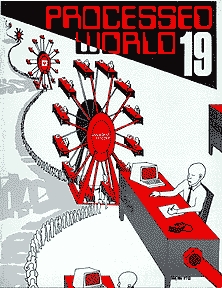
Our Bibles in that time were The Dispossesed by Ursula LeGuin, a novel in which the anarchists have grown so powerful that they were given the moon, where they scratch out an existence in mostly peace and harmony (I was superhappy to see someone reading it recently at Bradley Manning Plaza when OccupySF was still living there), and the work of Murray Bookchin (which I never read).  We read Processed World, a magazine by and for subversive office workers, and watched Born in Flames, a movie about revolutionary feminism in a post-socialist U.S.A.  We made zines with word processors and press type.

We organized in opposition to the invasion of Grenada (remember that?) and U.S. aid to El Salvador, the 1984 Democratic Convention, South African apartheid and U.S. AIDS policy, the Nevada Test Site, harassment of sex workers and owner-move-in evictions (two of the three houses I lived in fell victim to gentrification evictions). Some of us were willing to work with Communists – notably the then-anti-gay RCP and Prairie Fire, some of whose members called themselves anarcho-Stalinists. Others were not. We had discussion groups, potlucks and at least one weekend retreat at Point Reyes.

We were mostly hard-core nonviolence adherents, but not surprisingly the media didn’t always see that, confusing punk fashion statements with aggressive behavior. Or maybe it’s just that anti-authoritarian youth groups tend to be seen as threatening by the establishment, regardless of their actual politics. One affinity group in 1985 or so named itself “Hundreds of Punks from San Francisco” after warnings published in the newspaper of some northern California town in advance of a planned action there.

I identify with anarchafeminism, which sees anarchist practices such as consensus decision-making as the most empowering to women, and anarchapacifism, which holds that we need to value all life, even the lives o people who don’t value the lives of others. For me, pacifism is less about the harm I might do to someone like, hypothetically, George W. Bush, than about the harm engaging in revenge violence would do to me. I don’t believe a movement that achieves liberation through militarism will be able to resist using militarism to consolidate its power, even against the people it claims to serve. Once we can decide that it’s okay to get our way through violence, I think it is too easy to use that as a short-cut around the frustrating process of democracy. This doesn’t mean that all violence is wrong – personal self-defense, for example – but I believe Violence + Power = Oppression.

Thursday, March 1, 2012

Love the Struggle

I have had no time to blog this week.  And I am a little in a funk.  But today I am in the middle of a really boring job at work, so I turned on Living Room with Kris Welch at noon on KPFA, and say what you want about Kris, she is a true feminist, and she sometimes has really great feminist guests on her show.  So she has this woman on, named Merle Hoffman.  Never heard of her, which probably says more about me than about her.  But she is awesome.  She is the founder of Choices Women’s Medical Center, editor in chief of On the Issues magazine and the author of a new book, Intimate Wars:  The Life and Times of the Woman who Brought Abortion from the Back Alley to the Boardroom .  Now right off the bat, that title makes my hair stand on end.  I don’t know whether she chose the title; I’ve heard that non-celebrity authors don’t usually get to pick their own titles.  If she did, that’s a big problem, because no one woman brought abortion from the back alley to the board room.  Her bio says she is President and CEO of Choices, and I don’t tend to love Presidents or CEOs.  If I knew Ms. Hoffman, I might not think so highly of her.
Boy, there are a lot of great photos
of Flo to choose from.
This one courtesy Racialicious
But she just said something that I find so profound in this moment, when I’m having a lot of frustration because I feel like I keep spinning wheels and not getting very far.  She was quoting Flo Kennedy, who was apparently a friend of hers (which makes me think I might like her after all), and she said Kennedy told her, “You have to learn to love the struggle.”  And she said people ask her how she keeps going, when she never wins, and she said, “I love the struggle.”  Wow, that is just the most profound thing I have heard in ages.  I used to love the struggle.  I used to feel excited about the political work I was doing, whether it was a confrontational direct action or a five-hour meeting.  Now I tend to approach it all with a feeling of dread, of worrying that it’s not going to come off, or that it’s going to go horribly wrong, that I’ll let people down or let myself down, that no one wants to work with me, or I don’t want to work with them, that I’m trying to do things I’m not suited for or don’t have time to do things as well as I am capable of doing them.  I have petty resentments, and hate myself for them.
In the end I’m nearly always glad I did whatever it was, whether it came off or not, because ultimately I know what I’m doing is right.  I mean, the other day I interviewed a woman I met in Bahrain, Zainab al Khawaja, who was recently in prison for a week after an action.  She was lucky to be released after a week; she could be doing a life sentence for no more than that, like her father, Abdulhadi Al Khawaja, who is currently on the 21st day of a hunger strike.  I didn’t ask Zainab if she felt like it was worth it to go to jail for a week just for sitting down near Pearl Roundabout.  I know some of her friends were not that happy about it, felt like she could be more useful outside.  But I’m pretty sure she feels like whatever happens will be okay, as long as it’s for the struggle, because I think she loves the struggle.
A guy in my writing group, who is not political at all, just made a snide comment about one of my blogs, saying that it only reinforced his sense of the futility of going somewhere for a week and getting deported.  It’s funny because I don’t have that feeling about the experience at all.  It’s not like I think I made this huge difference by doing it, but clearly I made more than if I hadn’t, because now not only I but everyone I know is thinking about Bahrain, which we were not doing a month ago.  So if I never do another thing about Bahrain (which is certainly not my plan) I will still think it was worth it.  And I also loved it and was not asking myself questions about whether what I was doing was right.  I just did what came along and knew it would work out for the best.  But here, I have so many choices that it’s easy to look at other people and think they seem so much more confident about their paths than I feel.
This is the first day of International Women’s Day month, and the commitment I'm making is to do whatever will help me regain that love for the struggle.
Here's a little thing I did last week that I did not want to do, but ended up feeling really good about.

Thursday, February 16, 2012

Bahrain, We Hardly Knew Ye

It just began, and now it is over.  Yesterday morning, I was sitting in a café in Manama, Bahrain, working on a blog called “Bahrain: First Impressions.”  Now I am sitting at home in Oakland, trying to process what happened.

On February 14, I woke after only a couple hours’ sleep and couldn’t go back to sleep.  I was trembling with excitement and tension.  #Feb14, the anniversary of the start of the ongoing revolution in Bahrain, was to be the Day of Return to Pearl (Lulu) Roundabout, the huge vacant lot in the center of Manama where protesters camped out for a month last year, until March 16, when 1,000 troops from across the bridge in Saudi Arabia and 500 police from the United Arab Emirates joined thousands of mercenaries working for the Bahraini police in evacuating the camp, destroying the monument at the center of the Roundabout, killing at least 6 and injuring hundreds.  Since then, at least 60 people have died in the ongoing revolution.


Read the story of my arrest and deportation from Bahrain on the Witness Bahrain blog.

Read the BBC account of what happened on the anniversary.


Sunday, February 12, 2012

Two Fellow Activists Deported

No sooner did the Bahraini government find out we were here than they launched a full-scale effort to whisk us out of the country prior to the planned massive demonstrations on February 14, the one-year anniversary of what the Shia majority here call their ongoing revolution.

I've been working at breakneck speed, going to protests day and night, meeting with local activists, coming home and cutting video late into the night.

And that was before two of my fellow Witness Bahrain team members were arrested at yesterday's demonstration, which was entirely nonviolent (from the side of the protesters), even after police attacked with tear gas and sound grenades.  The crowd was small because all roads into the center of Manama, the capital city, were blocked by heavy police presence, and even many of the alleyways were guarded by lines of police.  But people were resolute in their determination to hold the planned march.  When police grabbed one young man out of the crowd, women surged forward to grab him back.  Huwaida, a Palestinian American well-known for her fearlessness in confronting the Israeli occupiers, ran forward, camera in hand, and demanded to know why this young man was being taken.  When police challenged her right to film and tried to take her camera, she walked away quickly, but the police ran after her and eventually she was surrounded by a group of heavily armed riot police.


Women crowded around to protect her, attempting to hold onto her while the police tried to push them away.  Local activists remarked that the brutality was far less than it would have been if we were not there, but it was brutal enough for me.  I filmed the confrontation, which ended with Huwaida being thrown into a van while police tossed sound bomb after sound bomb directly at the people.

Radhika was arrested when she tried to find out what had happened to Radhika.  A reporter tweeted last night that the government is looking for me too, hoping to remove all witnesses to their repression of the planned demonstrations on February 14.

Please go to our website (it's blocked in Bahrain -when I try to call it up it says "This web site has been blocked for violating laws and regulations of the Kingdom of Bahrain.") to read reports and see lots more video and also take a moment to sign the petition demanding Obama end US military aid to the Bahraini regime.

Thursday, February 9, 2012

Kate in Bahrain: Attack in Samaheej, 2/9/2012

The other day I landed in Bahrain, a tiny island kingdom with a bold and energetic democracy movement we hear very little about.  In fact, the Shia majority call what they have been doing for the last year a revolution.  Please go to www.witnessbahrain.org (after you read my first blog below) and sign up for our email updates.  A lot of people who are much more internet savvy than I are part of this project, and they'll be tweeting and facebooking, so if you're that type of person, please be sure to follow us on twitter, like us on Facebook, retweet and tell all your friends so we amplify the voices of the brave activists here.

The people of Samaheej knew they would be attacked today.  It was the final day of mourning for Ali Issa Abdullah Hayki, who died on Monday from teargas inhalation.  The villagers would march to the cemetery, as custom demands, and the police, who keep a close eye on the Shia village just meters from the airport, would punish the villagers for holding a funeral for someone killed in a protest.
Before the evening was over, a sixteen-year-old girl would have been shot in the face with a rubber bullet, and a boy the same age would be taken away by police.  Villagers, including small children, would be breathing air saturated with tear gas, and the police would be searching house to house for people they suspect of being protest leaders.

Today’s events were not unique in Samaheej.  According to villagers, they experience daily, or nightly, assaults by police and other security forces.

The only difference today is that we were there – four American women from the newly created Witness Bahrain.  We were there to document the abuse faced by this village, like so many others, which refuses to accept second-class citizenship and autocracy.  We are not credentialed journalists, but we are the closest there was at this protest.  Even those in western media who know what is happening in Bahrain have a hard time covering it – numerous prominent reporters have been denied entry to the country in recent weeks.  The best known are Nick Kristof from the New York Times and Kristen Chick of Christian Science Monitor.  Our local hosts have warned us that if we give out our local telephone numbers to journalists, the police will probably track our phones and deport us.  These folks aren’t messing around: even the Israeli government is not that vigilant.

So today we got to the village just in time for the march to the cemetery.  At first it seemed the people’s fears were wrong; the police were nowhere to be found.  The men prayed, the women chanted, men and boys sat quietly around the grave site and mouthed prayers.  Just as everyone had drifted back into the village, we heard the horns announcing that the police were on their way.  I saw young men covering their faces with bandanas or ski masks.  A few swung Molotov cocktails.  Minutes later I heard a series of cracks and saw gas and smoke rising in the distance.

Before long, the air was filled with gas.  I stopped to change the batteries in my little video camera – uselessly, as it turns out since I didn’t really know how to work it – and got separated from the rest of our little group.  I was having trouble breathing, and knew that it would get worse as the gas drifted into the village.  I followed a group of young men – shabab -- down a narrow street and suddenly realized that the entire area was deserted except for me and the shabab and the rapidly advancing police lines.  I was concerned that they would notice me, and maybe decide that this random foreigner with a camera was someone they should worry about.  I headed up into the village, and when I could see again, people of course started inviting me into their homes.  Some were quite insistent, wanting to keep me from harm’s way.  I kept insisting I needed to go back to the demonstration to find my friends.   

  
One woman said if we wanted to come to her house later, we were welcome to come in whether she was home or not; the door would be unlocked.

Eventually I was “adopted” by a man named Ali, who started calling around to find out where the rest of my group had gone.  At one point he led me into a house where a group of women was gathered around a teenage girl who was pressing her sleeve to her lip.  As I tried to figure out what was happening, Ali said something to one of the women and she held out something that looked like a malted milk ball, but was in fact a hard rubber bullet.  It had ricocheted off of a woman’s arm and hit the girl in her lip, which was already swelling.
 
My colleagues on the other side of the village, meanwhile, had made their way onto a roof from which they could watch the police go house to house, banging on doors.  People said they were looking for people to arrest.  If so, they did not find any in houses today, but they did arrest someone.  A 16-year-old named Ali Ibrahim Khalil Quraise, who was standing on the street with a group of younger boys.  Because he was the oldest, the cops took him and said his father should come to the police station to get him.  People were afraid that if they went, they would be taken as well, and the boy would not be released. 

We offered to go to the police station to ask, but the guy who had brought us was sure that if we did, we would be arrested and deported, so instead we came home and got a journalist we know to call the police station to ask why the boy had been arrested and what his status was.  After three tries, she finally got someone who spoke English and didn’t hang up on her.  He told her he could not discuss the arrest because it was a military matter, and gave her a non-working number for the Ministry of Interior media office to call instead.  When she reached the media office, they said she had to email them her question.  As of now – six hours later – she hasn’t received an answer.