Wednesday, August 10, 2011

Six Ways to Avoid News Fatigue

People who have known me for a long time will attest to the fact that before I had a car, I never listened to the radio. In fact, I hated radios; I don’t know why, but there was something about the disembodied voice that really annoyed me. But once I started driving, I started occasionally listening to KPFA, because it was easier than fidgeting with tapes with one hand on the steering wheel. Then came 9-11, and in my hunger for news and analysis of the changing political world in this country, I got hooked on Democracy Now! That first foray into public radio led me to This American Life, Against the Grain, As It Happens, and the occasional dip into Fresh Air. Somewhere along the line, I discovered the Sunday folk music shows on KPFA (Across the Great Divide is the best), followed by the Saturday afternoon lineup on KALW (Folk Music and Beyond, Thistle and Shamrock, A Patchwork Quilt, Bluegrass Signal), Michael Feldman’s What Do You Know and KPFA’s Voices of the Middle East and North Africa. Suffice it to say, I’m now a dedicated, if not consistent, radio listener.

A few years ago I started doing radio as well. So now when I listen it’s not only for the information they’re giving; it’s also to get ideas for stories (usually by noticing what gender angles or women’s voices are left out of the other shows), and to learn to do it better from people who have more experience and professional training.

But somewhere along the line, I stopped enjoying it so much. Of course, I still sometimes hear things that inspire, enliven, uplift or enlighten me, but more often, I turn it off feeling more despondent than I did when I turned it on.

What changed, the radio or me?

photo by 4rilla
 Probably some of both. When something is new, it’s exciting. I hadn’t known you could get all this information just by plugging in a little radio! How cool is that? It made me part of a community with my friends, who had been dedicated KPFA and KALW listeners for years. Learning to do radio has been one of the great privileges of my last few years, and since people kept criticizing my shows without giving any helpful advice, it was liberating to realize I had a classroom right on my desk at work. Now that I’ve been listening for a number of years, I realize I’m hearing the same people a lot, and I usually know what they are going to say.

But I also think that progressive community radio has been influenced by changes in the mainstream media more than we realize. Five or ten years ago, shows like Against the Grain, Democracy Now! and the KPFA Sunday Show used to interview a lot more activists than they do now. They’ve become more expert dependent, and the way you become an expert is generally by publishing a book or a New York Times op-ed or getting a Ph.D., and while you are doing those things, you’re probably not out organizing a social movement. As someone who’s trying to do both, I can tell you it’s nearly impossible.

In the first three days of last week, I probably heard or saw twelve hours of coverage of the debt ceiling deal, if you count Comedy Central. I heard eight economists, five reporters, three Congresspeople, the former Labor Secretary and the current press secretary (no partridges). I heard Dean Baker twice and Rick Wolff three times on two different shows. Not surprisingly, they said the same thing each time. Ultimately, none of them had anything to say I didn’t already know. It’s not that they don’t know things I don’t – they know a lot. But they all said the same things they’ve been saying for months because they’re being asked the same questions: why does Obama always give in to the Tea Party? (he doesn’t have enough experience standing up to bullies). What’s this going to mean for us? (bad bad bad). What would he have done if he were FDR or LBJ? (Tax the rich, create jobs, lay down the law to Congress.) Meanwhile the mainstream pundits kept repeating the mantra “You have to cut Social Security and Medicare,” without a peep from the likes of Jon Stewart or Stephen Colbert.

No one said anything about what those of us who want to see a different strategy can or should do to bring it about. Democracy Now! interviewed Terry O’Neill of the National Organization for Women, who spearheaded a campaign to get Congress to protect the needs of women, but they didn’t interview her until after the deal had been approved in Congress. I interviewed her the week before, when at least people could sign the online petition, but I don’t have the listenership that DN! has. I don’t say that it would have made a difference if another few thousand people had signed a petition, but at least it would have given people some way to participate.

Along about Thursday, a phrase flashed into my mind. News Fatigue. I’m not sure where I first heard of it, but I sure know I’ve got it. At a party the other night, I mentioned this to a number of friends and acquaintances, and nearly everyone said, “Oh, yes, I don’t listen to any of those shows any more.” A couple people mentioned things they’re listening to instead. Then Sunday evening, I happened to catch part of New America Now: Voices from the New Majority (Fridays at noon and Sundays at 3 pm on KALW 91.7 FM San Francisco). They were talking about redistricting, and the part that I heard went into depth about how prisons are used to give disproportionate influence to some very small districts. It was fascinating. I’d never heard that, it made total sense and it explained some things I had never understood. I was so interested, I sat in my car for fifteen minutes after I got where I was going.

So here are six shows I’m going to listen to instead of the daily news-oriented shows, and if you have News Fatigue, you might want to try them too:

1.  Fresh Air (KALW 9-10 am, repeated 6-7 pm; KQED 1-2 pm or 7-8 pm; podcast available): Terry Gross asks great questions and has interesting people on. It’s usually upbeat without being fluffy. Her guest on Monday was Charles C. Mann, author of 1493, which documents how Columbus changed the world by introducing Europe and the Americas to each other’s crops, animals and diseases. She's more progressive on most issues than you might think.

2. Your Call (KALW 10-11 am, repeated at 8-9 pm; available for download): Maybe it’s because it’s a call-in show, but they almost always have a more grassroots angle on whatever issues they’re covering. They bring in a lot of local folks you hardly ever hear elsewhere. (One week, their Friday media roundtable even included a guy from Socialist Worker!) A recent show I heard was “How Are Magazines Surviving” with editors and publishers of Bitch, Utne Reader and The Sun.

3. Are We Alone? Really cool science show on KALW (Tuesdays at 1:00 pm), also available for podcast or download. The last show, “Written in Code” explores “ENCORE Genes – what are they good for? Absolutely… something. But not everything. Your “genius” genes need to be turned on – and your environment determines that. Find out how to unleash your inner-Einstein, and what scientists learned from studying the famous physicist’s brain.”

4. This American Life (KALW Sundays 1:00 pm, KQED Saturday noon and 10:00 pm or by podcast): With rare exceptions, it’s interesting, funny and unexpected. The last one I heard (I podcast it, but I often forget to download the podcasts and they’re only available for two weeks) was called “When Patents Attack!” and was about patent trolls. Don’t know what that is? You want to find out!

5. Making Contact (Friday 1:30 pm on KPFA, or on the website): Unfortunately it’s only half an hour a week but they sometimes have extras on their website (they even put a piece of mine up once, though I can’t find it now). Last week’s show was called “Remixing Revolution: Art, Music and Politics”, excerpting a panel discussion called “The God’s Must Be Crazy: Reviving the Black Supernatural Experience.” Before that they had a two-parter on the Wisconsin workers’ revolt. Irresistible.

6. Rock en Rebeliòn (Sundays 5:00 pm on KPFA; check website for archives): I love this show ’cause I get to practice my Spanish by listening to people who often are not native speakers so they speak slowly. Plus it’s bilingue, so if I get lost, I can generally catch up when they drift into English, and the beats are great.

What are your suggestions to break out of news fatigue? What shows or other experiences do you love? (If you’re getting this by email, don’t email me your ideas! but go to the blog and post them as comments so other people can see them too.)

Saturday, August 6, 2011

Slut Walk and Porn Wars: What's Choice Got to Do With It?

  
Report from SlutWalk San Diego, posted on IndyBay by Zenger's Newsmagazine

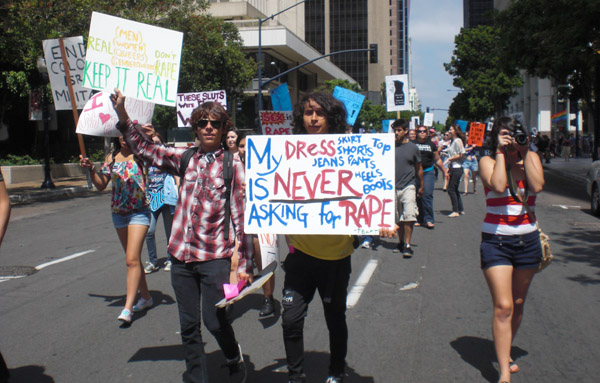
Slut Walk has sparked some of the most vibrant political debates among feminists since Monica Lewinsky. For those who don’t know about it, Slut Walk is an international response to an incident in which young women at York University in Toronto were told by police that if they don’t want to be raped, they should not dress like sluts. Women have organized marches from Sydney to New York to London. San Francisco’s is tonight (August 6). The organizers urge women to come wearing whatever they want, to make the age-old point that no woman asks or deserves to be raped, regardless of what she wears. Not surprisingly, the mainstream media has proclaimed this movement “the new feminism.”

Rebecca Traister wrote in the New York Times Magazine that she is ambivalent about the message of the walks, an ambivalence I think a lot of feminists share. Jessica Grose, writing on Slate.com, offered “kudos” for the piece, saying, “The tone of disagreements in the feminist blogosphere can be truly vicious—there can be a real tendency for other writers and commentators to pile on when you veer from the party line. … The push-back to Traister's piece has already begun…” Feministing.com hosted a thoughtful and spirited discussion among its bloggers, with Rebecca Traister joining.

Muslim women criticized the march for being uninclusive, and African American women pointed out that for years, they have been fighting for the right not to be called slut and ho.

This is familiar territory. How many rooms did I sit in through the eighties and nineties listening to feminists passionately arguing about whether sex work is liberatory or exploitative or whether it can possibly be both, whether we should embrace or deface pornography, or whether we could do both?

The transgressive nature of reclaiming pejorative identities is also something that resonates for me. In the early 1980s, groups I was part of were among the first to openly embrace the word “queer.” At antiwar demonstration, I was soberly lectured by any number of straight activists who didn’t understand why would want to be called by a word that was most often heard in the mouths of bashers. When our award-winning chant, “We’re here, we’re queer, we’re not going shopping,” was expropriated and changed to “We’re here, it’s clear, we’re not going shopping,” we almost came to blows with some of our favorite heterocommunists.
So my first reaction to Slut Walk was great, you go, girls. I looked at some of the pictures and video and they are moving.

Young women want to be attractive, and in our culture, attractive means sexy, and sexy generally means showing a lot of skin. That’s cool. They should do what makes them comfortable. The problem with that, just like the problem with trying to differentiate “sex work” from “exploitation” or “trafficking” is that we live in a misogynist culture, and in a misogynist culture, a cigar is never just a cigar.

Our culture is both hypersexualized and anti-sex. Even little girls are expected, almost required, to show that they’re sexually available and interested. Victoria’s Secret has a line called “Pink” which markets frilly halter tops and short shorts to nine-year-olds.

A friend of mine recently figured out that his 16-year-old daughter didn’t want to go to a party because she was being set up to have oral sex with some guy she didn’t even know.

I said, “Did you tell her she’d have plenty of opportunities for coercive sex soon enough?”

He said, “Actually, that’s exactly what I told her.”

At the same time, our social policy is more and more based on punishing women, especially young women and women of color, for having sex. Whether you’re talking about abstinence-only education, welfare cuts, restrictions on abortion and birth control, refusing to fund HPV vaccines or criminalization of addicted women who become pregnant, the message is clear: women who have sex for any reason other than reproduction in the context of white, heterosexual marriage are bad and should suffer.

In this environment, it’s very hard to be sex-positive. When t-shirts bearing slogans like “Yes but not w u” are aggressively marketed to 13-year-old girls, can anyone say that they are really choosing to be “sluts”? Of course, they should be free to walk around wearing anything they want and not be harassed or attacked.

The question some of us older feminists are asking though, is, are they really wearing what they want to wear, or what patriarchal society wants them to wear? Do they want to be sluts, or is that another box that they’re being shoved into and then condemned for occupying, like whore, femme fatale, bitch and superwoman?
How did we get from burning bras and corsets (which I’m told never actually happened) to marching for the right to spend lots of money on clothes that are for the most part highly uncomfortable?

Rebecca Traister asks why this is the issue that has galvanized the most feminist activism in recent years. I would add to that, why is it the issue which has galvanized the most interest in the feminist blogosphere?
It doesn’t surprise me that the mainstream media fixates on a movement of young, mostly white women dressed in not much. But does the feminist movement have to help them? On one hand, a lot of good pieces have been written, a lot of good interviews given that would never have seen the light of day if they hadn’t been on a “sexy” issue. I just wish feminist Twitter and YouTube could have helped the demand of over 250 women’s organizations not to balance the budget on the backs of women go viral, maybe the New York Times would have written one word about it. (Didn’t hear about that? Check it out.) Maybe next time, some young college women can paint their bare midriffs with the names of immigrant women being deported away from their U.S.-born children.

Tuesday, August 2, 2011

To Preserve the Welfare State, Fighting Racism Is Key

Last week I wrote about changes in Western Europe relating to the mass immigration of darker skinned and Muslim people. Steve Hill, author of Europe’s Promise, called my analysis shallow and “glass half empty.” I’m sure it is shallow – I’m a blogger, with a degree in political theory, not comparative European politics, while Steve has spent years researching European political systems. Since getting that feedback, though, I have sought out the opinions of a lot of European experts, and I haven’t really heard anything that contradicts the thesis I put forth in “Song of Norway” – that immigration and global economic conditions are pushing even the most progressive countries of Europe to the right (which doesn’t mean they are going to get there or stay there).

But I was not trying to paint a gloomy prognosis for Europe’s decline into nativism and fascism. Rather, I meant to point out that over the last half century, the most egalitarian countries in Western Europe have also been the most monocultural. As they become more heterogeneous, they might want to take heed of the experience of this country, where fear (or maybe just hatred) of the Other has been used quite disastrously to wage war on programs that promote equality.

One of the things we need to remember, when mourning the slow death of the U.S. welfare state, is that it was never motivated by compassion for people of color. Noam Chomsky points out that even in these anti-tax-and-spend days, a majority of white U.S.Americans actually favor giving more government money to poor people – unless those people are Black. They make a distinction between “supporting the (deserving) poor,” and “welfare”, which we have been trained to see as synonymous with “giving money to (undeserving) Black people or immigrants.” Not coincidentally, the attack on the welfare state grows in ferocity as the political power of African Americans is increasingly curtailed, by a combination of voter suppression, redistricting and gentrification of urban population centers.

In the mid-1930s, when the New Deal was enacted, the population of the U.S. was 88.7% white, 9.7% African American and 1.2% Mexican (in the 1940 census, Mexicans were recategorized as white). The only other groups counted were Native Americans, Chinese, and Japanese, who together made up 0.5% of the population. The electorate was well over 95% white, since 77% of African Americans lived in the South, where they could not vote.

White unemployment in 1933 was about 25%. In 1930, African American unemployment was slightly lower than that of whites (because their wages were much lower) but by 1935, it was nearly twice as high. Many African Americans were thrown out of work so that whites could take their jobs. At least half a million Mexicans were deported (“repatriated”) in the thirties, 60% of them U.S. citizens. Many of the New Deal programs, including Social Security, either expressly or de facto excluded African Americans. Nearly two-thirds of all African Americans in the labor force (as well as over half of women workers) were not covered by Social Security. Waiters, butlers, domestic and agricultural workers were all excluded from the Fair Labor Standards Act, which established the minimum wage.

The New Deal was possible because so many white people were homeless and out of work that nearly everyone, with the exception of the wealthiest white Americans, had close friends or family members who needed the help. Today that’s not the case. We say that unemployment is 9.3%, and many commentators point out that it’s really more like 16%, but even those numbers obfuscate the reality, that certain communities are affected much more heavily and others scarcely at all. Even to say that white unemployment is at 8%, African American 16.5% and Latino 12% is misleading, because those rates are not constant across racial groups. For whites rural unemployment and poverty are much higher than urban, while 40-50% of young African American men in some cities are unemployed or marginally employed.

For whites with college degrees, the unemployment rate is 2.9% while for those who haven’t finished high school it’s 12%. Since in the 2010 midterm elections, the turnout was 78% white and college educated and only 13% of voters had family incomes under $30,000 a year, we can kind of see why we’re in danger of losing our Social Security.

By far the best news I’ve read in ages is in an article called “Don’t Worry, Be Happy, Be More Equal.”  Three psychologists have recently found that Americans are happier “when national wealth is distributed more evenly than when it is distributed unevenly.”

The bad news? The wealthiest 20% don’t follow the trend.

Neither the U.S. nor Europe has a long tradition of tolerance. Contemporary Europe was built by exporting people it saw as undesirable, while the U.S. was built by exterminating them. But let’s not forget that Europe has done its share of exterminating, both on its shores and abroad. If we don’t want to see those bloody histories repeated, we must – all of us – work on creating true multiculturalism, something none of our societies have ever had.

Saturday, July 30, 2011

(Jesus Christ) Tim DeChristopher, Who Are You, What Have You Sacrificed?


Supporters at Tim DeChristopher's sentencing
from www.peacefuluprising.org
Tim DeChristopher seems to have grown up a lot in the last two years.  That’s what you would expect, from a 29-year-old who spent his last years since college facing the possibility of a long prison term.
Days after foiling a government auction of oil and gas drilling rights in the closing days of the Bush administration, DeChristopher told Democracy Now!’s Amy Goodman:

“I’ve seen the need for more serious action by the environmental movement and to protect a livable future for all of us. And frankly, I’ve been hoping that someone would step up and someone would come out and be the leader and someone would put themselves on the line and make the sacrifices necessary to get us on a path to a more livable future. And I guess I just couldn’t wait any longer for that someone to come out there and had to accept the fact that that someone might be me.”

At that time, I thought, Hey, hold on a minute.  A lot of people have been doing a lot of environmental activism for a long time.  You might not know about them, and obviously they weren’t there in the auction hall that day, but one bold action doesn’t make you the leader of the movement.  I thought he was being awfully dismissive of people with good reasons not to risk spending years in prison, and was also ignoring the importance of collective action.

In his sentencing speech, he spoke more carefully, saying he was willing to go to prison if it inspires others to act.  In a video made shortly before his last court date, he said others who have gone to prison for acts of conscience have told him that knowing you are there for what you believe in makes it easier to do the time.  In that he is certainly right.  During the month I spent in jail in Israel, I felt what a privilege it was to be in jail for doing something I wanted to do, that I was proud of doing.

DeChristopher has a lot to be proud of.  He made a concrete difference, protecting at least 22,000 acres of land from drilling, much of it permanently.  He has certainly motivated others to take actions they would not have taken otherwise – like the 26 people arrested outside the courthouse on Tuesday.

He also has a lot to think about.  There is almost never a direct correlation between one person’s major sacrifice and the growth of a larger movement.  I talked about that a few weeks ago, in my rundown of hunger strikes, some successful and others spectacularly not.  Tim DeChristopher is going to jail for an impulsive act of courage.  He did not plan it ahead of time; it’s not even clear he knew how big a risk he was taking. 

For me there’s a deep irony in the timing of DeChristopher’s two-year sentence.  Josh Fattal and Shane Bauer have been in prison in Iran for exactly two years this week.  Josh and Shane too, are imprisoned for an impulsive act – the decision to go hiking on a certain trail in Iraqi Kurdistan, on a certain day, when they happened to be spotted by Iranian border guards who decided to make them political pawns.  But unlike DeChristopher, they did not get to choose their battle.  They are imprisoned for the crimes of the U.S. government, crimes they have spent their adult lives opposing.

Sarah Shourd, who was arrested with Shane and Josh, was released last September.  I worked with Sarah on an action protesting five years of the Iraq War in 2008.  Because I knew her slightly, I have been haunted by the plight of the hikers for two years.  As I did when Lori Berenson was arrested in Peru, I constantly reflect that their fate could have been mine, if I’d been less lucky in a few situations.  And I often think about how sad it is that three young lives have been interrupted for no good reason, that they do not have the comfort of knowing they are standing up for what’s right.  They, like so many others in prisons all over the world, were simply in the wrong place at the wrong time.

I hope DeChristopher will be able to use his time in prison well and will come out convinced that what he did was right for him.  To a great extent, whether he accomplishes what he wanted to – to spark a more militant movement, is now very much out of his hands.  That’s one of the problems of acting on your own; you might find out that you were too far ahead of the people you wanted to lead.  Certainly the prosecutors and the judge in his case intended, by imposing such a harsh sentence, to make sure that others don’t follow his example.  The Daily Utah Chronicle reported

“Inside the courtroom, prosecutors said DeChristopher’s sentence would act as a deterrence to others from conducting similar acts of civil disobedience.
‘Significant acts lead to significant consequences,’ prosecutors said.”
A spokeswoman for Peaceful Uprising, a group that DeChristopher helped to found, made this “official statement” as she left the courthouse:

“Consider this your call to action. Consider this the spark that will ignite this movement. Our hearts are broken today, because we see a charismatic, bright, concerned man who cares for the future of the next generation, be incarcerated in federal prison and treated like a criminal. If there was ever a day, if there was ever a moment in history for us to stand for climate justice, this is that moment. And we will not stop, we will not be intimidated…” 
A thoughtful writer on the blog planetsave.com wonders whether people are really ready to take up the challenge DeChristopher threw down .

“Activists around the world, and DeChristopher especially, are saying that won’t silence us and will only trigger more and stronger action. The overall message and hope is that his 2-year sacrifice (which you really have to honor him for being willing to take) is going to stimulate more change and more success than would have occurred otherwise. My question is: will it, really?
“It’s easy for people to get up in arms at the news and say it will, but it’s going to be pretty darn hard to get people off their asses and doing anything comparable to what DeChristopher was willing to do.”
But one thing people should realize, and which hopefully DeChristopher now realizes, is that successful movements are composed of people willing and able to take different levels of risk.  Not everyone who was inspired by the Freedom Riders became one.  Some did, but others gave their Saturdays to picket at Woolworths, or traveled South for Wednesdays in Mississippi.

The other day, I heard Bay Area activist Brian Willson talking about his book, Blood on the Tracks.  The title refers to an action he took in 1987, when he sat in front of a train carrying weapons from the Concord Naval Weapons Station to be shipped to Central America and elsewhere.  The religious witness known as the Nuremberg Action Group had been blocking weapons trains for weeks, and every time, the train would stop and police would come and drag the people off the tracks.  But this time the Naval Command decided to teach the protesters a lesson.  They ordered the train crew not to stop.  The other blockaders scrambled away, but Brian could not.  He lost both legs.

I knew the story well – I was out of town when it happened but I had been very involved in organizing the campaign to stop weapons shipments from CNWS.  I well remembered the action the next day, when thousands dismantled a section of the tracks, an action for which only one person was prosecuted.  What he said that I didn’t remember was that it was only after he was injured that activists began a 24-hour-a-day peace camp there, escalating from blocking some of the trains to blocking every single one for months.

This week, Tim DeChristopher starts his prison term knowing he inspired several hundred people to come to court to support him, and 26 of them to get arrested for blocking the entrance to the courthouse.  Hopefully when he is released, whether it’s in two years or sooner (he is planning to appeal), he will feel good about what came from his sacrifice.

Hopefully Josh and Shane will be released tomorrow or very soon thereafter – they are supposed to be brought to “trial,” and their lawyer thinks that even if convicted of being spies – which they definitely are not, they might be sentenced to time served.  When they get home, hopefully they will be able to turn their ordeal into something they can be proud of.

Wednesday, July 27, 2011

Song of Norway

U.S. Americans on the left love to romanticize Europe in general, and the Scandinavian countries most of all. They have such a nice social safety net, high taxes, gay marriage, sex-change operations. They abjure violence, are neutral in World Wars, give out the Nobel Peace Prize. Plus they’re the source of those great Dragon Tattoo books we’re all reading, and the Wallander mysteries we love to watch on PBS.


Thanks to Anders Behring Breivik, we’re seeing another side of Scandinavia. It’s a side that closer observers have been talking about for a while. Between September and November of 2010, nearly every news outlet had a story hailing the arrival of far-right politics in Sweden, after the Swedish Democrats won ten seats in Parliament. By that time, Norway’s Progress Party held nearly 23% of the seats, making it the nation’s second largest party.

How could this be happening in the countries we so admire, and how could something nearly as terrible as the Oklahoma City bombing occur in a country so humane that its prisoners get to go horseback riding and use the internet?

In May of this year, the MiRA Resource Centre for Black, Immigrant and Refugee Women in Norway published an article entitled, “Welfare state and immigration: Non European nationals as second class citizens?” They were responding to a government report on Welfare and Migration.

“The Norwegian welfare model is, in the Welfare and Migration report, defined as dependent on high level of participation in employment and a relatively equal distribution of income in order to keep a generous and universal supply of welfare to all citizens. Immigration, according to the rapport, can contribute to the labour market with proficiency, labour and innovation, and can therefore be strengthening the welfare state. However, if the immigrants are not gainfully employed, they will become a double loss for the Norwegian state with increased welfare expenses and reduced tax incomes. As a result, migration would not be profitable for the Norwegian economy. Therefore, the Welfare and Migration Committee recommends active integration of migrants within the workplaces in order to rescue the welfare state. The committee also proposes that the various economic benefits such as child welfare allowance to the immigrant communities could be converted into the provision of employment or qualification programmes which can result in creating job participation. It means in practice that if the immigrant women are unemployed, they would not be qualified for welfare allowances like their ethnic Norwegian sisters.

“We are … sceptical to some of the recommendations which portray immigrants who become unemployed due to various factors among them discrimination on the basis of ethnicity, religion and the colour of skin, as a burden to the welfare state.”

http://www.statistics.gov.uk/populationtrends/downloads/poptrends142web.pdf
In 2000, newspapers and scholarly journals of Europe were filled with articles on “demographic change.” What this referred to was the anticipated arrival of the baby boomers at retirement age, without leaving enough replacement workers because of the declining birth rates. The fear was that this would result in both a labor shortage and the depletion of the pension funds. One of the major remedies for this coming catastrophe was to encourage immigration from less wealthy areas.

“Today, there is a growing awareness in the EU that there are at least two major policy issues in relation to population ageing. These are the ageing of the workforce and the risk of growing imbalances in the financing of the social protection. … There is a growing awareness that restrictive immigration policies of the past 25 years are no longer relevant to the economic and demographic situation in which the Union now finds itself.”
EXPERT GROUP MEETING ON POLICY RESPONSES TO POPULATION AGEING AND POPULATION DECLINE, Department of Economic and Social Affairs United Nations Secretariat, New York, 16-18 October 2000

The strategy worked brilliantly. War, climate change and global economic instability were boons for the European population crisis. Between 1995 and 2010, the immigrant population of Norway rose by nearly 250%. Over half of the 234,000 new immigrants were from other European countries, with Poland, Bosnia-Hercogovina, Kosova and Russia accounting for just over 85,000. Asia accounted for over 147,000 and Africa more than 50,000, so these “undesirable” and heavily Muslim immigrants combined to represent almost twice as many of the new Norwegians as people coming from other Western European countries.

In 2004, Italian Prime Minister Sergio Berlusconi offered a “baby bonus” to counter the declining birth rate caused by a majority of (Christian) Italian women choosing not to have children. When he learned that Muslim families had claimed the bonus, he tried to get them to return it.

In 2006, a number of European online papers published a screed against Muslim immigrant youth entitled “Swedish Welfare State Collapses as Immigrants Wage War.”  The "article" claimed that Muslim "gangs" were robbing Swedes as a form of warfare against "the Swedish model."

Flash forward to late 2009, when even the prosperous European nanny states were feeling the ripple effects of the U.S. financial debacle. European scholarly journals are full of articles with titles like, “Migration and welfare state solidarity in Western Europe”:

“In recent decades Western Europe has had to face increasing migration levels resulting in a more diverse population. As a direct consequence, the question of adequate inclusion of immigrants into the welfare state has arisen. At the same time it has been asked whether the inclusion of non-nationals or migrants into the welfare state may undermine the solidaristic basis and legitimacy of welfare state redistribution. Citizens who are in general positive about the welfare state may adopt a critical view if migrants are granted equal access.” (Steffen Mau, University of Bremen, Germany, July 2009)

“We find (1) that people who hold both negative views about immigrants generally tend to be less supportive of income redistribution, and (2) that they become even less supportive if they perceive a high share of immigrants in the population.” (C. Senik, H. Stichnoth, K. Van der Straeten, 2008)

It’s easy for us to believe that the U.S. has a monopoly on racism and immigrant-bashing. But it helps to remember that the Anglo-Saxon population of this country came from the Northern European countries in the first place, many of them escaping persecution for fairly minor differences. These societies have been notoriously homogeneous. As increasing migration into and across Europe brings waves of economic and political refugees, many of them darker skinned and/or practicing Islam, those countries start to look a lot more like this one.

Friday, July 22, 2011

Keep your gay marriage, give me my Social Security

I don’t have a partner. Maybe that’s why I’m not excited about President Obama’s endorsement of the Respect for Marriage Act, introduced by Sen. Dianne Feinstein.

Or maybe it’s because I know that close to half of all marriages end in divorce, a majority of U.S. households are headed by unmarried people, and about a quarter of the adult population has never been married. In some communities, and notably the African American community, those numbers are much higher.

So increasingly, the campaign for same-sex marriage is not about extending the rights of the majority to a minority, but about further enshrining the privileges of a shrinking minority.

But in fact, the benefits marriage activists seek are waning by the day. By the time gay elders can claim each other’s Social Security and Medicare benefits, those benefits will have been eviscerated. Social Security, as we all know, is probably at this moment being sacrificed on the altar of deficit reduction (which, of course, it has nothing to do with). While same-sex-marriage advocates insist that marriage rights will guarantee the right of immigrant couples to live together, immigrant families all over the U.S. are fighting to stay together and out of jail. The Obama administration has deported and detained far more immigrants – including legal immigrants - than the Bush administration did.

I expected Wednesday's headline to be, “Obama caves in on budget deal.” Instead, the headline was “Obama backs same-sex marriage.” Coincidence? I don’t think so. Gay marriage is being used as a distraction to appease liberals.

Gavin Newsom, who was elected mayor of San Francisco on a pro-corporate, anti-homeless platform, used same-sex marriage to liberalize his image. In 2003, Newsom fairly narrowly defeated Green Party candidate Matt Gonzalez, winning 53% of the vote after polls a day earlier showed a virtual tie. In 2007, fresh out of alcohol treatment and having being caught having an affair with a (female) employee who was married to one of his top aides, Newsom was reelected with 73% of the vote. The difference? Gay marriage.

Here’s how his own website (he’s currently Lt. Governor, after precipitously pulling out of the governor’s race without explanation), describes his mayoral career:
“In 2003, after a fiercely-contested race, Newsom was elected the youngest Mayor in San Francisco in more than a century.
“After only 36 days as mayor, Newsom gained worldwide attention when he granted marriage licenses to same-sex couples. This bold move set the tone for Newsom’s first term.…
In 2007, Newsom was re-elected with more than 73% of the vote.”
Same-sex marriage is an easy fix. It doesn’t cost anything, and a majority of the public, including a slim majority of Republicans, supports it.

I do too. Of course, I do. I’m a lesbian and I’m in favor of equal rights for everyone in all spheres. But it’s basically worthless to most people, including most gay people. I won’t even go into the ways in which it reinforces inequality. (I and plenty of others have gone into that at length over the years.  My point here is that the LGBQ community must not allow our fight for civil equality to be used to distract from the fight to the death, or really against death, that everyone in this country is in right now – a fight for our very survival.

Consider the moment. The latest poll shows Obama in a dead heat with GOP presidential front-runner Mitt Romney. 19 different polls show that a vast majority of Americans, somewhere between 62% and 80%, favor raising taxes on the wealthy to fund services and balance the budget. Obama refuses to do that. His one big legislative victory since taking office has been the health care reform bill. Who created the program that was based on? Hint: Romney’s Republican opponents have taken to referring to the Massachusetts health care plan as “Obamney Care.” So Obama needs something to separate himself from the Mormon Romney, and even just not being against gay marriage wouldn’t do it, because Romney has refused to take the “anti-gay marriage pledge” and offends "family values" voters by defending the separation of church and state.

Queer communities have been hit as hard in the recession as other communities - necessarily so, because we are part of every community. San Francisco’s cutting edge network of services for LGBT people and HIV-affected people, built through decades of community activism, agitation and organizing, has been largely decimated in the last two years. New Leaf, a 35-year-old San Francisco center serving the LGBT community with mental health, substance abuse, and HIV/AIDS services closed in October of last year. Lyon-Martin Clinic, the first lesbian- and trans-focused clinic in the country, nearly closed last year and is still on shaky ground. Just hours before the New York legislature passed the marriage equality bill, activists gathered in front of the Stonewall Inn, where the modern LGBT movement was born, to demand funding for programs for homeless LGBT youth.  Roughly 1,000 queer youth go without shelter every night in New York City, and Governor Cuomo recently cut the funding for youth shelters in half.

This is far from the first instance of minority groups winning rights as those rights, only to find their victories virtually hollow.

The standard of living for most Black South Africans has worsened considerably since apartheid was toppled. In the U.S., nearly fifty years after the Civil Rights Act was enacted, Black families with children have median incomes roughly half those of white families. Black children are three times as likely as white children to live in extreme poverty; 40% of Black children under 5 are living in poverty.

I’m not suggesting that the fight for same-sex marriage is the same as the fight for African American civil rights or the liberation of South Africa. But we should be aware of those histories, as well as many more. The unemployed youth of Egypt and Tunisia are now realizing that it’s easier to bring down a dictator than it is to break the stranglehold of neoliberal economic policies.

LGBTQ people need to keep our eyes on the real prize and not be fooled by the shiny decoy. If we don’t, the couples making their way to New York to take those marriage vows will soon be selling their wedding rings to keep each other in cat food.

Tuesday, July 19, 2011

10 Things I Don’t Understand About the Debt Ceiling Debate

Bay of Rage protest against
budget cuts in Oakland
1. Why the Republicans can get away with claiming that the entire debt is the fault of a president who has been in office for two years.

2. Why there are so many different polls on raising the debt ceiling, when no one cares what the people think anyway. See, for example, http://www.cbsnews.com/8301-503544_162-20080492-503544.html , http://www.gallup.com/poll/148454/debt-ceiling-increase-remains-unpopular-americans.aspx , http://tinyurl.com/debtapocalypse.

3. Why people (including the Obama administration) are not demanding that Congress cut its own salaries to be equivalent to the average Social Security payments (without cost of living increases).

4. Why the mainstream media never seem to ask people like Boehner, Kyl and deMint why they voted for debt increases seven times under Bush, while grilling Obama about why he voted against it once.

5. What the people who are pushing for huge spending cuts, no tax increases and a balanced budget really really think is going to happen if they win.

6. Why there don’t seem to be any women economists writing about it.

7. Why if the Progressives Caucus is the biggest caucus in Congress (83 members, compared to 26 Blue Dogs and 53 Tea Party Republicans), it has the least power.

8. What ever happened to those polls showing that Americans like socialism better than capitalism?

9. Why a political ruse like the McConnell plan can work when everyone knows about it.

10. Why #debt or #budget deal are not among the top trending subjects on Twitter right now.

Best thing I heard in the last week (or maybe in the last year):

It turns out that “Gilligan’s Island” was really anti-colonialist social commentary. Sherwood Schwartz, who created the show along with “The Brady Bunch,” said so. “‘I knew that by assembling seven different people and forcing them to live together, the show would have great philosophical implications,’ he told Time magazine in 1995. ‘On a much larger scale this happens all the time. Eventually, the Israelis are going to have to learn to live with the Arabs. We have one world, and “Gilligan’s Island” was my way of saying that.’” Honest. That was in his obituary last week.

Schwartz must have been right, though, because the show only lasted three seasons and probably has the best-known theme song in history.